Good vibrations in nanotube research
October 15, 2007 Good vibrations in nanotube research

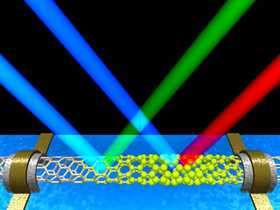
IBM scientists have measured the distribution of electrical charges in tubes of carbon that measure less than 2 nanometers in diameter, 50,000 times thinner than a strand of human hair. This novel technique, which relies on the interactions between electrons and phonons, provides a detailed understanding of the electrical behavior of carbon nanotubes, a material that shows promise as a building block for much smaller, faster and lower power computer chips compared to today´s conventional silicon transistors. Credit: IBM

IBM scientists have measured distribution of electrical charges in tubes of carbon that measure less than 2 nanometers in diameter, 50,000 times thinner than a strand of human hair. The technique provides a better understanding of the electrical behavior of carbon nanotubes, a material that could lead to smaller, faster and lower power computer chips.

IBM scientists today announced that they have measured the distribution of electrical charges in tubes of carbon that measure less than 2 nanometers in diameter, 50,000 times thinner than a strand of human hair.

This novel technique, which relies on the interactions between electrons and phonons, provides a detailed understanding of the electrical behavior of carbon nanotubes, a material that shows promise as a building block for much smaller, faster and lower power computer chips compared to today's conventional silicon transistors.

Phonons are the atomic vibrations that occur inside material, and can determine the material's thermal and electrical conductivity. Electrons carry and produce the current. Both are important features of materials that can be used to carry electrical signals and perform computations.

The interaction between electrons and phonons can release heat and impede electrical flow inside computer chips. By understanding the interaction of electrons and phonons in carbon nanotubes, the researchers have developed a better way to measure their suitability as wires and semiconductors inside of future computer chips.

In order to make carbon nanotubes useful in building logic circuitry, scientists are pushing to demonstrate their high speed, high packing density and low power consumption capabilities as well as the ability to make them viable for potential mass production.

"The success of nanoelectronics will largely depend on the ability to prepare well characterized and reproducible nano-structures, such as carbon nanotubes," said Dr. Phaedon Avouris, IBM Fellow and lead researcher for IBM's carbon nanotube efforts. "Using this technique, we are now able to see and understand the local electronic behavior of individual carbon nanotubes."

To date, researchers have been able to build carbon nanotube transistors with superior performance, but have been challenged with reproducibility issues. Carbon nanotubes are sensitive to environmental influences. For example, their properties can be altered by foreign substances, affecting the flow of electrical current and changing device performance. These interactions are typically local and change the density of electrons in the various devices of an integrated circuit, and even along a single nanotube.

A better understanding of how the local environment affects the electrical charge of a carbon nanotube is needed to allow the fabrication of more reliable transistors. Therefore, the ability to measure local electron density changes in a nanotube is essential. A team of researchers from the IBM's T.J. Watson Research Center in Yorktown Heights have just solved this problem.

This achievement was published online October 14, 2007 in the journal Nature Nanotechnology. The team monitored the color of the light scattered from the nanotube (Raman Effect), and measured small changes in the color of the light corresponding to changes in the electron density in the nanotube. The technique takes advantage of the interaction between the motion of the atoms and the motion of the electrons, so that electron density changes can be reflected in changes of the frequency of the vibrational motion of the nanotube atoms.

In March 2006, IBM announced that its researchers built the first complete electronic integrated circuit around a single carbon nanotube molecule.

Source: IBM


Rate this story - 4.2 /5 (26 votes)


October 15, 2007 all stories

Comments: 0

4.2 /5 (26 votes)

  • hide
  • Related Stories

  • How many argon atoms can fit on the surface of a carbon nanotube?
    created Jan 28, 2010 | popularity not rated yet | comments 0
  • Dry printing of nanotube patterns to any surface could revolutionize microelectronics
    created Jan 22, 2010 | popularity not rated yet | comments 0
  • Harnessing the Divas of the Nanoworld
    created Jan 14, 2010 | popularity not rated yet | comments 0
  • Carbon nanotubes show promise for high-speed genetic sequencing
    created Jan 06, 2010 | popularity not rated yet | comments 0
  • Using CNTs as infrared sensors
    created Jan 04, 2010 | popularity not rated yet | comments 0


  • hide
  • Relevant PhysicsForums posts

  • How to find static friction
    created 4 hours ago
  • Calculating decible increases
    created 11 hours ago
  • Coefficients of friction
    created 11 hours ago
  • Deduction of centripetal force
    created 12 hours ago
  • More from Physics Forums - General Physics

Other News

Nanoscale Structures with Superior Mechanical Properties Developed

Nanoscale Structures with Superior Mechanical Properties Developed

Nanotechnology / Nanomaterials

created 13 hours ago | popularity 4.6 / 5 (9) | comments 1 | with audio podcast

(PhysOrg.com) -- Researchers at the California Institute of Technology have developed a way to make some notoriously brittle materials ductile -- yet stronger than ever -- simply by reducing their size.


Spray-on liquid glass

Spray-on liquid glass is about to revolutionize almost everything

Nanotechnology / Nanomaterials

created Feb 02, 2010 | popularity 4.7 / 5 (240) | comments 93 | with audio podcast report

(PhysOrg.com) -- Spray-on liquid glass is transparent, non-toxic, and can protect virtually any surface against almost any damage from hazards such as water, UV radiation, dirt, heat, and bacterial infections. ...


IBM Scientists Demonstrate World's Fastest Graphene Transistor

IBM Scientists Demonstrate World's Fastest Graphene Transistor

Nanotechnology / Nanophysics

created Feb 05, 2010 | popularity 4.9 / 5 (38) | comments 25 | with audio podcast

(PhysOrg.com) -- In a just-published paper in the magazine Science, IBM researchers demonstrated a radio-frequency graphene transistor with the highest cut-off frequency achieved so far for any graphene device ...


Conductive eTextiles: Stanford finds a new use for cloth

Conductive eTextiles: Researchers move from making batteries from paper to making batteries from cloth

Nanotechnology / Nanomaterials

created Feb 05, 2010 | popularity 4.3 / 5 (7) | comments 4 | with audio podcast

(PhysOrg.com) -- Stanford researchers have moved from making batteries from paper to making batteries from cloth. Your-T-shirt could become a lighted, moving display.


Carbon Based Chips May One Day Replace Silicon Transistors

Carbon Based Chips May One Day Replace Silicon Transistors

Nanotechnology / Nanomaterials

created Feb 03, 2010 | popularity 4.7 / 5 (18) | comments 3 | with audio podcast weblog

(PhysOrg.com) -- IBM researchers are hopeful that, over the next decade, silicon-based transistors will be replaced by carbon-based transistors. IBM has already laid out the ground work for carbon-based transistors.