What chimpanzees can teach us about economics
October 15th, 2007 What chimpanzees can teach us about economics

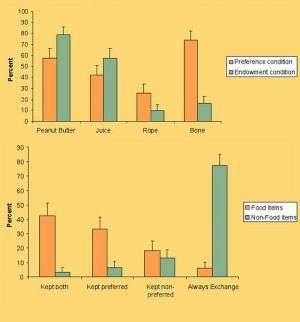
The top graph shows that when given food, chimpanzees as a group are much more likely to keep the food they have than trade for another, even if the other option is one that they prefer. The opposite is true for toys, in which case chimpanzees prefer interaction with the experimenter over the food items. This is shown graphically by the fact that the willingness to exchange when they had the opportunity to trade a food item in their possession for a different, sometimes more preferred, food item (the endowment condition) is stronger than predicted by the preference condition where subjects choose between the two foods. The bottom graph shows that this is true within individuals as well. Almost half the subjects keep both the preferred and the non-preferred food items, rather than exchange them for other options, although they continue to exchange toys at almost every opportunity.

In a long-standing enigma of economics and psychology, humans tend to immediately value an item they've just been given more highly than the maximum amount they would have paid if they had acquired it themselves. This tendency, known as the endowment effect, is something some economists consider a fluke, but new research finds that humans aren't the only ones exhibiting an endowment effect.

A new study co-authored by Vanderbilt professor Owen Jones, who is one of the nation's few professors of both law and biology, uncovered the first evidence that chimpanzees exhibit an endowment effect similar to people. Specifically, the study showed that chimpanzees favor items they just received more than items they normally prefer that they could get through exchange.

"These findings show that chimpanzees sometimes make irrational economic choices in the same specific patterns that humans do, suggesting a common evolutionary origin rather than, as is often assumed, quirks unique to human brains and experience," said Jones.

Drawing on prior theoretical work by Jones, the researchers were able to predict variations in the endowment effects the chimpanzees exhibited.

Here's how the study worked. Jones and his research partners, including primatologist Sarah Brosnan at Georgia State University, modified a study done on people in which one group of subjects was given a coffee mug, another group was given a chocolate bar and a third group was allowed to choose between the two items. The first two groups were then offered the opportunity to exchange their item for the other. Surprisingly, both groups were much more likely to keep the item they'd been originally given, compared to the expected preferences revealed by the group with a choice.

In the chimpanzee study, Jones replaced coffee mugs and chocolate with peanut butter sticks and frozen juice bars.

The researchers first examined data for the population of chimpanzees that showed the preference for peanut butter or juice was almost half and half. But when the chimpanzees were given or "endowed" with the peanut butter, almost 80 percent of them chose to keep the peanut butter, rather than exchange it for a juice bar.

"Our results support the conclusion that the frequent failure to exchange a less favored food for a more preferred food was an active choice and is similar to the endowment effect behavior seen in humans," said Jones. "But even more significant, using an evolutionary perspective on the phenomenon helped us to discover a pattern predicted by no other prior theory. This suggests the same perspective may provide a better understanding of the endowment effect in humans."

Jones said this study helps connect law and economics to biology by providing a deeper and more useful understanding of where law-relevant behavior comes from and what factors may affect it. This also has important implications for both economics and the law because when and how the endowment effect appears can impede the efficient flow of goods and tradable rights in the marketplace.

"To the extent that a deeper understanding of humans can aid law's efforts to pursue whatever goals society assigns it, biological perspectives are an essential part of the picture," said Jones. "We study chimpanzees to learn more about ourselves."

The full research study is published in the Oct. 9 issue of Current Biology.

Source: Vanderbilt University


print this article email this article download pdf blog this article bookmark this article     Digg this Stumble it share on Facebook share on Reddit add to delicious save to Yahoo! bookmarks
4.5/5 after 19 votes

Rank Filter

Move the slider to adjust rank threshold, so that you can hide some of the comments.


Display comments: newest first

  • HarryStottle - Oct 24, 2007
    • Rank: not rated yet
    I stopped believing that economists had any grasp at all of "rationality" once I fully understood the Prisoner's Dilemma game, their interpretation of it and their complete failure to understand the implications of real world experiments which quickly revealed that real people did not behave as their theory suggested.

    Their failure to understand the "endowment" effect shows that in 60 years, they haven't evolved much.

    First, even medieval writers recorded the simple truth that "a bird in the hand is worth two in the bush". Why? Because when confronted with a choice of two "goods" of unknown provenance, one isn't just selecting a preference. One is also speculating that the goods are "as advertised". This is a lesson I learnt as a 9 year old when I tried to pick up and eat one of my Gran's waxed bananas.

    Once you have a bird in hand, you now know that it is of known quality. This instantly makes it worth more than a remote alternative of unknown quality.

    Second, the psychology of being a recipient is emotionally processed through the memory of being a donor and remembering that giving implies sacrifice. That the donor is making a sacrifice by giving you the banana has values which the economist never accounts for - viz "relationship" values. The banana may be a peace offering, a bonding bid, a seduction attempt or whatever. But that deliberate "relationship building gesture" often has far more significance to both donor and recipient than the trivial economic value of the "gift"

    We feel this even as adult humans. If Aunty Mabel knits (or buys) us a hideous jumber for Xmas, we show a marked reluctance to part with it even for something we would much prefer just because it was a gift and to get rid of it would imply something negative about the relatioship between us and the donor.

October 15th, 2007 all stories
Biology /

Comments: 1
Rank: 4.5/5 after 19 votes

  • Stumble this up

  • Digg this

  • Share it:
  • share on Facebook
  • share on MySpace
  • share on Slashdot
  • rss-newsfeed
  • share on Google
  • share on Reddit
  • add to delicious
  • save to Yahoo! bookmarks
  • share on Windows Live
  • Add to Mixx!
Rating: 4.5/5 after 19 votes

  • Related Stories

  • Simian foamy virus found in several people living and working with monkeys in Asia
    created Jul 31, 2008 | popularity not rated yet | comments 0
  • Surgeon operates to rescue chimp with rare deformity
    created May 19, 2008 | popularity not rated yet | comments 0
  • Scientist: I don't talk to creationists
    created May 31, 2006 | popularity not rated yet | comments 0
  • Here's one I made earlier: Chimps learn from watching videos
    created Jul 01, 2009 | popularity not rated yet | comments 0
  • Humans related to orangutans, not chimps
    created Jun 18, 2009 | popularity not rated yet | comments 0

Tags


  • Physicists Demonstrate Quantum Memory with Matter Qubits
    Physicists Demonstrate Quantum Memory with Matter Qubits
    Physics / General Physics
    created Jul 03, 2009 | popularity 4.4 / 5 (17) | comments 1
  • 'Holey' Nanosheets for Wastewater Dye Removal
    Nanotechnology / Nanomaterials
    created Jul 01, 2009 | popularity 5 / 5 (5) | comments 1
  • Jellyfish Robot Swims Like its Biological Counterpart
    Jellyfish Robot Swims Like its Biological Counterpart
    Electronics / Robotics
    created Jun 26, 2009 | popularity 4.4 / 5 (8) | comments 1
  • Could Maxwell's Demon Exist in Nanoscale Systems?
    Could Maxwell's Demon Exist in Nanoscale Systems?
    Physics / General Physics
    created Jun 24, 2009 | popularity 4.4 / 5 (18) | comments 29
  • Living Safely with Robots, Beyond Asimov's Laws
    Living Safely with Robots, Beyond Asimov's Laws
    Electronics / Robotics
    created Jun 22, 2009 | popularity 4.6 / 5 (54) | comments 40
  • Other News

    New research shows key player in mitosis not required for chromosome alignment

    New research shows key player in mitosis not required for chromosome alignment

    Biology / Microbiology

    created 9 minutes ago | popularity not rated yet | comments 0

    (PhysOrg.com) -- K-fibers, structures long thought to play a key role in the alignment of chromosomes prior to cell division, are not required after all, say Indiana University and New York State Department ...


    Scientists are learning more about big birds from feathers

    Scientists are learning more about big birds from feathers

    Biology / Plants & Animals

    created 27 minutes ago | popularity not rated yet | comments 0

    (PhysOrg.com) -- Catching adult eagles for research purposes is no easy task, but a Purdue University researcher has found a way around the problem, and, in the process, gathered even more information about ...


    Battle of the sexes benefits offspring, says research

    Battle of the sexes benefits offspring, says research

    Biology / Plants & Animals

    created 6 hours ago | popularity 5 / 5 (1) | comments 0

    Parents compensate for a lazy partner by working harder to bring up their offspring, but not enough to completely make up for the lack of parenting, says research by bird biologists at the University of Bath.


    Hormone clue to root growth

    Biology / Plants & Animals

    created 2 hours ago | popularity not rated yet | comments 0

    (PhysOrg.com) -- Plant roots provide the crops we eat with water, nutrients and anchorage. Understanding how roots grow and how hormones control that growth is crucial to improving crop yields, which will be necessary to ...


    Final rules out for government stem cell research

    Biology / Other

    created 2 hours ago | popularity not rated yet | comments 0

    (AP) -- The government is creating a master list of which embryonic stem cells qualify for taxpayer-funded research, now that President Barack Obama has lifted restrictions on the field.