Gold nuggets reveal their inner secrets
October 16, 2007
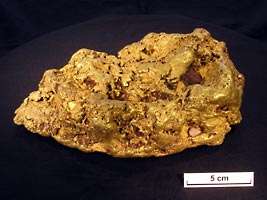
An 8 kg nugget from Victoria that was cut in two and a thin slice taken out of the middle (The gold is an alloy of gold and silver). Image credit – CSIRO
A study of the characteristics of gold nuggets from around Australia has overturned many years of accepted scientific wisdom on how nuggets form.
The research reveals the gold nuggets formed deep underground at high temperatures.
“Previously it was assumed that gold nuggets formed in place, where they were found, either precipitated from fluids or grown from microbial action,” CSIRO’s Dr Rob Hough said.
“But all of the gold nuggets we studied have a crystalline structure and silver content that shows they formed at high temperatures. Since these temperatures do not occur at the surface, the nuggets must have originated deep underground.
“Their presence near the surface is the result of geological process and weathering over vast periods of time.”
A better understanding of how gold nuggets form will help explorers decide where to search for the precious metal. If the nuggets are not formed where they are found, but weathered from gold-rich ore, the original source may still be nearby.
The researchers examined the external and internal characteristics of more than 30 nuggets from different locations in Western Australia, Queensland and Victoria, ranging from 1g to more than 8kg.
The research could not have been conducted without the assistance of Western Australian philanthropist and mineral explorer, Mr Mark Creasy.
“Mr Creasy donated more than a million dollars worth of gold nuggets for our research from a variety of sources around Australia. This is an extraordinarily valuable contribution toward furthering our understanding of gold nugget formation. Some of our activities, such as cutting an eight kilo gold nugget from Victoria in half, would simply not have been possible without his support,” Dr Hough said.
The research was conducted in association with the Cooperative Research Centre for Landscape Environments and Mineral Exploration involving scientists from CSIRO Exploration and Mining and Curtin University of Technology. It was published this month in the Australian Journal of Earth Sciences.
Source: CSIRO
-
White House tweeting spreads president's message
Mar 08, 2010 |
not rated yet |
0
-
Neuroscientist's discovery of new uses for old drug leads to patents, innovation award
Oct 27, 2009 |
4.7 / 5 (3) |
0
-
Bacterium helps formation of gold
Oct 07, 2009 |
4 / 5 (8) |
0
-
The Midas Bug -- the bacterial alchemy of gold
Aug 01, 2006 |
4.5 / 5 (19) |
0
-
Engineers build first sub-10-nm carbon nanotube transistor
Feb 01, 2012 |
4.9 / 5 (33) |
30
-
Something old, something new: Evolution and the structural divergence of duplicate genes
Jan 31, 2012 |
4.6 / 5 (7) |
1
-
The hidden nanoworld of ice crystals: Revealing the dynamic behavior of quasi-liquid layers
Jan 30, 2012 |
5 / 5 (4) |
1
-
Stock market network reveals investor clustering
Jan 27, 2012 |
3.9 / 5 (23) |
8
-
Of microchemistry and molecules: Electronic microfluidic device synthesizes biocompatible probes
Jan 26, 2012 |
5 / 5 (2) |
0
-
Do some geologists actually act a lot like Randy Marsh?
Feb 11, 2012
-
Discrepancy between oxygen and carbon-dioxide levels
Feb 09, 2012
-
where gems are found in the world
Feb 09, 2012
-
Wind Waves in Reservoir ~ Wind run-up and Wind set-up
Feb 08, 2012
-
Balance of oxygen in the atmosphere
Feb 01, 2012
-
The case for a methanol-based economy
Jan 30, 2012
- More from Physics Forums - Earth
More news stories
Salvage workers begin pumping fuel from Italian shipwreck
Salvage workers Sunday began pumping fuel from the shipwrecked Italian cruise liner Costa Concordia, a day ahead of schedule, officials said.
7 hours ago |
5 / 5 (1) |
0
Latin America mining boom clashes with conservation
Latin America is experiencing a mining boom as prices rise fuelled by a hike in global demand, but the region is also being hit by a wave of violent protests, strikes and rallies by environmentalists.
15 hours ago |
5 / 5 (1) |
1
Political leaders play key role in how worried Americans are by climate change: study
More than extreme weather events and the work of scientists, it is national political leaders who influence how much Americans worry about the threat of climate change, new research finds.
Feb 06, 2012 |
5 / 5 (7) |
73
NASA budget will axe Mars deal with Europe: scientists
US President Barack Obama's budget proposal to be submitted next week for 2013 will cut NASA's budget by 20 percent and eliminate a major partnership with Europe on Mars exploration, scientists said Thursday.
Space & Earth / Space Exploration
Feb 10, 2012 |
5 / 5 (3) |
58
Humans may have helped the decline of African rainforests 3000 years ago
(PhysOrg.com) -- Large areas of rainforests in Central Africa mysteriously disappeared over three thousand years ago, to be replaced by savannas. The prevailing theory has been that the cause was a change ...
Scientists discover molecular secrets of 2,000-year-old Chinese herbal remedy
For roughly two thousand years, Chinese herbalists have treated Malaria using a root extract, commonly known as Chang Shan, from a type of hydrangea that grows in Tibet and Nepal. More recent studies suggest that halofuginone, ...
New method to examine batteries -- MRI from the inside
There is an ever-increasing need for advanced batteries for portable electronics, such as phones, cameras, and music players, but also to power electric vehicles and to facilitate the distribution and storage of energy derived ...
A mitosis mystery solved: How chromosomes align perfectly in a dividing cell
Although the process of mitotic cell division has been studied intensely for more than 50 years, Whitehead Institute researchers have only now solved the mystery of how cells correctly align their chromosomes during symmetric ...
Google might launch Drive for cloud storage soon
(PhysOrg.com) -- Google's next big move, according to the Wall Street Journal, is a cloud storage service called Drive. Hardly first to the plate, Google is simply catching up to introducing its cloud reposi ...
Lab study raises questions over nano-particle impact
Tests involving chickens have raised questions about the impact on health from engineered nano-particles, the ultra-fine grains commonly used in drugs and processed foods, scientists said on Sunday.
Overeating may double risk of memory loss
New research suggests that consuming between 2,100 and 6,000 calories per day may double the risk of memory loss, or mild cognitive impairment (MCI), among people age 70 and older. The study was released today and will be ...