Researchers measure carbon nanotube interaction
October 16, 2007
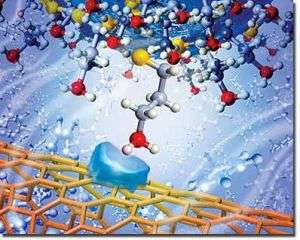
An artist's representation of an amine functional group attached to an AFM tip approaching a carbon nanotube surface in toluene solution. Translucent blue shape on the nanotube represents the polarization charge forming on the nanotube as the result of the interaction with the approaching molecule. Chemical force microscopy measures the tiny forces generated by this single functional group interaction. (Illustration by Scott Dougherty, LLNL)
Carbon nanotubes have been employed for a variety of uses including composite materials, biosensors, nano-electronic circuits and membranes.
While they have proven useful for these purposes, no one really knows much about what’s going on at the molecular level. For example, how do nanotubes and chemical functional groups interact with each other on the atomic scale? Answering this question could lead to improvements in future nano devices.
In a quest to find the answer, researchers for the first time have been able to measure a specific interaction for a single functional group with carbon nanotubes using chemical force microscopy – a nanoscale technique that measures interaction forces using tiny spring-like sensors. Functional groups are the smallest specific group of atoms within a molecule that determine the characteristic chemical reactions of that molecule.
A recent report by a team of Lawrence Livermore National Laboratory researchers and colleagues found that the interaction strength does not follow conventional trends of increasing polarity or repelling water. Instead, it depends on the intricate electronic interactions between the nanotube and the functional group.
“This work pushes chemical force microscopy into a new territory,” said Aleksandr Noy, lead author of the paper that appears in the Oct. 14 online issue of the journal, Nature Nanotechnology.
Understanding the interactions between carbon nanotubes (CNTs) and individual chemical functional groups is necessary for the engineering of future generations of sensors and nano devices that will rely on single-molecule coupling between components. Carbon nanotubes are extremely small, which makes it particularly difficult to measure the adhesion force of an individual molecule at the carbon nanotube surface. In the past, researchers had to rely on modeling, indirect measurements and large microscale tests.
But the Livermore team went a step further and smaller to get a more exact measurement. The scientists were able to achieve a true single function group interaction by reducing the probe-nanotube contact area to about 1.3 nanometers (one million nanometers equals one millimeter).
Adhesion force graphs showed that the interaction forces vary significantly from one functionality to the next. To understand these measurements, researchers collaborated with a team of computational chemists who performed ab initio simulations of the interactions of functional groups with the sidewall of a zig-zag carbon nanotube. Calculations showed that there was a strong dependence of the interaction strength on the electronic structure of the interacting molecule/CNT system. To the researchers delight, the calculated interaction forces provided an exact match to the experimental results.
“This is the first time we were able to make a direct comparison between an experimental measurement of an interaction and an ab initio calculation for a real-world materials system,” Noy said. “In the past, there has always been a gap between what we could measure in an experiment and what the computational methods could do. It is exciting to be able to bridge that gap.”
This research opens up a new capability for nanoscale materials science. The ability to measure interactions on a single functional group level could eliminate much of the guess work that goes into the design of new nanocomposite materials, nanosensors, or molecular assemblies, which in turn could help in building better and stronger materials, and more sensitive devices and sensors in the future.
Source: Lawrence Livermore National Laboratory
-
What does love look like?
Feb 10, 2012 |
1 / 5 (1) |
0
-
Further support for a role of synaptic proteins in autism spectrum disorders
Feb 09, 2012 |
not rated yet |
0
-
Potentially important new mechanisms found anti-aging effects of resveratrol
Feb 09, 2012 |
3.4 / 5 (7) |
0
-
Ultraviolet protection molecule in plants yields its secrets
Feb 09, 2012 |
5 / 5 (5) |
0
-
Growing up on a farm directly affects regulation of the immune system
Feb 08, 2012 |
5 / 5 (2) |
1
-
Engineers build first sub-10-nm carbon nanotube transistor
Feb 01, 2012 |
4.9 / 5 (33) |
30
-
Something old, something new: Evolution and the structural divergence of duplicate genes
Jan 31, 2012 |
4.6 / 5 (7) |
1
-
The hidden nanoworld of ice crystals: Revealing the dynamic behavior of quasi-liquid layers
Jan 30, 2012 |
5 / 5 (4) |
1
-
Stock market network reveals investor clustering
Jan 27, 2012 |
3.9 / 5 (23) |
8
-
Of microchemistry and molecules: Electronic microfluidic device synthesizes biocompatible probes
Jan 26, 2012 |
5 / 5 (2) |
0
-
Thermodynamics q
1 hour ago
-
what is electricity???
5 hours ago
-
Can Plasma Be Solid
5 hours ago
-
What is delta Δ ?
6 hours ago
-
Need some help understanding Hertz–Knudsen formula
6 hours ago
-
Anatomy of Fat man: implosion-critical bomb
8 hours ago
- More from Physics Forums - General Physics
More news stories
Lab study raises questions over nano-particle impact
Tests involving chickens have raised questions about the impact on health from engineered nano-particles, the ultra-fine grains commonly used in drugs and processed foods, scientists said on Sunday.
Nanotechnology / Bio & Medicine
10 hours ago |
5 / 5 (7) |
1
New kind of solar cell could capture significantly more energy than current cells
New solar cells could increase the maximum efficiency of solar panels by over 25%, according to scientists from the University of Cambridge.
Feb 08, 2012 |
4.5 / 5 (13) |
14
|
Nanoshell whispering galleries improve thin solar panels
Visitors to Statuary Hall in the U.S. Capitol Building may have experienced a curious acoustic feature that allows a person to whisper softly at one side of the cavernous, half-domed room and for another on ...
Nanotechnology / Nanomaterials
Feb 07, 2012 |
4.4 / 5 (7) |
6
|
'Dark plasmons' transmit energy
Microscopic channels of gold nanoparticles have the ability to transmit electromagnetic energy that starts as light and propagates via "dark plasmons," according to researchers at Rice University.
Feb 09, 2012 |
4.8 / 5 (10) |
1
|
Revealing how a battery material works
Since its discovery 15 years ago, lithium iron phosphate (LiFePO4) has become one of the most promising materials for rechargeable batteries because of its stability, durability, safety and ability to deliver ...
Nanotechnology / Nanomaterials
Feb 08, 2012 |
5 / 5 (6) |
0
|
Scientists discover molecular secrets of 2,000-year-old Chinese herbal remedy
For roughly two thousand years, Chinese herbalists have treated Malaria using a root extract, commonly known as Chang Shan, from a type of hydrangea that grows in Tibet and Nepal. More recent studies suggest that halofuginone, ...
New method to examine batteries -- MRI from the inside
There is an ever-increasing need for advanced batteries for portable electronics, such as phones, cameras, and music players, but also to power electric vehicles and to facilitate the distribution and storage of energy derived ...
Google might launch Drive for cloud storage soon
(PhysOrg.com) -- Google's next big move, according to the Wall Street Journal, is a cloud storage service called Drive. Hardly first to the plate, Google is simply catching up to introducing its cloud reposi ...
A mitosis mystery solved: How chromosomes align perfectly in a dividing cell
Although the process of mitotic cell division has been studied intensely for more than 50 years, Whitehead Institute researchers have only now solved the mystery of how cells correctly align their chromosomes during symmetric ...
Starve a virus, feed a cure? Findings show how some cells protect themselves against HIV
A protein that protects some of our immune cells from the most common and virulent form of HIV works by starving the virus of the molecular building blocks that it needs to replicate, according to research published online ...
Researchers find extensive RNA editing in human transcriptome
In a new study published online in Nature Biotechnology, researchers from BGI, the world's largest genomics organization, reported the evidence of extensive RNA editing in a human cell line by analysis of RNA-seq data, demons ...