Probing Question: What is a neutrino?
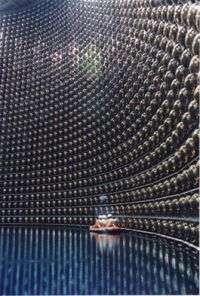
Neutrinos are tiny -- really, really tiny -- particles of matter. They are so small, in fact, that they pass between, and even through, atoms without interacting at all. Neutrinos are everywhere: If you start counting now, more than 10 quintillion (that's 10 trillion billions) of them will have passed through your body by the time you finish this article. Yet only one of those 10 quintillion neutrinos will likely interact with an atom in your body. The rest will go merrily on their way.
Staggering numbers of neutrinos constantly pass right through the earth and off into distant space. Detecting them carries the idea of searching for a needle in a haystack to ridiculous extremes. Fortunately for scientists, there are a lot of them to look for. Irina Mocioiu, assistant professor of physics at Penn State, studies evidence of the rare interactions between neutrinos and other, more accessible, subatomic particles, such as protons and electrons.
How does she know when an interaction is taking place? "Neutrinos carry no charge, so they cannot be observed directly," Mocioiu acknowledges. But each collision can cause a characteristic change in a proton or an electron and transfer some of the energy of the moving neutrino into the motion of these charged particles. "There are many ways to see charged particles in a detector," she explains.
A neutrino detector -- one of the devices designed to confirm the activity of these infinitesimal particles -- typically contains a large body of liquid, which increases the chances for particle interaction. For example, noted Mocioiu, the Super Kamiokande detector in Japan holds 12.5 million gallons of water surrounded by more than 11,000 photomultiplier tubes, light sensors arrayed to pick up the radiation caused by interactions between neutrinos and water molecules.
To prevent interference from other types of radiation, this detector, like the dozen or so others operating around the world, was built about a kilometer below ground. Every day that it operates, Super K picks up information from a small handful of the almost unimaginable number of neutrinos that pass through it.
Because they are so tiny, neutrinos were long thought to have no mass at all. "In the last 10 years, however," Mocioiu noted, "neutrino oscillation experiments have definitively proved that neutrinos have masses, just extremely tiny ones."
So where did all these ghostly particles come from in the first place? Most of the neutrinos in the universe are believed to have been formed billions of years ago, during the Big Bang, said Mocioiu. "We believe that the neutrinos coming from the Big Bang are almost stationary and that there are 10,000,000 such neutrinos in every cubic foot of space throughout the universe," she added. These stationary neutrinos are almost impossible to detect.
The more active neutrinos that Mocioiu studies are products of the nuclear reactions that fuel stars and high energy cosmic events such as the explosions of dying stars. Even with so many neutrinos around, they still don't add up to much mass. According to our present understanding, Mocioiu saids, neutrinos account for at most a few percent of the total energy density of the universe, and maybe as little as a fraction of a percent.
Why study something that, on its face, seems so insignificant? "Neutrinos play an important role in particle physics, astrophysics and cosmology," said Mocioiu. "Because neutrinos have no electric charge and have only weak interactions, they can travel much longer distances without being absorbed by matter or deflected by magnetic fields. So neutrinos can provide new information about astrophysical objects and events."
The streams of neutrinos careening away from distant collapsing stars or galaxies, Mocioiu says, carry with them bits of data about the extremely high-energy events that produced them. It's a reminder that even the tiniest of particles have a tale to tell about the universe of which they are part.
Source: by Steve Miller, Research Penn State


