Heaviest stellar black hole discovered in nearby galaxy
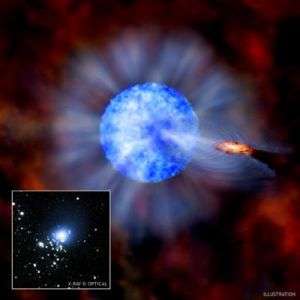
October 17, 2007 Illustration and Image of M33 X-7

The main component of this graphic is an artist's representation of M33 X-7, a binary system in the nearby galaxy M33. In this system, a star about 70 times more massive than the Sun (large blue object) is revolving around a black hole. This black hole is almost 16 times the sun's mass, a record for black holes created from the collapse of a giant star. Other black holes at the centers of galaxies are much more massive, but this object is the record-setter for a so-called "stellar mass" black hole. In the illustration, an orange disk surrounds the black hole. This depicts material, fed by a wind from the blue companion star, which has been swept into orbit around the black hole. Rather than flowing unimpeded and uniformly into space, wind from the star is pulled towards the black hole by its powerful gravity. The wind that does make it past the black hole is disrupted, causing turbulence and ripples beyond the disk. The companion star itself is also distorted by the gravity from the black hole. The star is stretched slightly in the direction of the black hole, causing it to become less dense in this region and to appear darker. The inset shows a composite of data from NASA’s Chandra X-ray Observatory and the Hubble Space Telescope. The bright objects in the inset image are young, massive stars around M33 X-7, and the bright, blue Chandra source is M33 X-7 itself. X-rays from Chandra reveals how long the black hole is eclipsed by the companion star, which indicates the size of the companion. Observations by the Gemini telescope on Mauna Kea, Hawaii track the orbital motion of the companion around the black hole, giving information about the mass of the two members of the binary. Other observed properties of the binary were also used to help constrain the mass estimates of both the black hole and its companion. Credit: Credit: Illustration: NASA/CXC/M.Weiss; X-ray: NASA/CXC/CfA/P.Plucinsky et al.; Optical: NASA/STScI/SDSU/J.Orosz et al.

Astronomers have located an exceptionally massive black hole in orbit around a huge companion star. This result has intriguing implications for the evolution and ultimate fate of massive stars.

The black hole is part of a binary system in M33, a nearby galaxy about 3 million light years from Earth. By combining data from NASA’s Chandra X-ray Observatory and the Gemini telescope on Mauna Kea, Hawaii, the mass of the black hole, known as M33 X-7, was determined to be 15.7 times that of the Sun. This makes M33 X-7 the most massive stellar black hole known. A stellar black hole is formed from the collapse of the core of a massive star at the end of its life.

"This discovery raises all sorts of questions about how such a big black hole could have been formed,” said Jerome Orosz of San Diego State University, lead author of the paper appearing in the October 18th issue of the journal Nature.

M33 X-7 orbits a companion star that eclipses the black hole every three and a half days. The companion star also has an unusually large mass, 70 times that of the Sun. This makes it the most massive companion star in a binary system containing a black hole.

"This is a huge star that is partnered with a huge black hole," said coauthor Jeffrey McClintock of the Harvard-Smithsonian Center for Astrophysics in Cambridge, Mass. "Eventually, the companion will also go supernova and then we’ll have a pair of black holes."

The properties of the M33 X-7 binary system – a massive black hole in a close orbit around a massive companion star – are difficult to explain using conventional models for the evolution of massive stars. The parent star for the black hole must have had a mass greater than the existing companion in order to have formed a black hole before the companion star.

Such a massive star would have had a radius larger than the present separation between the stars, so the stars must have been brought closer while sharing a common outer atmosphere. This process typically results in a large amount of mass being lost from the system, so much that the parent star should not have been able to form a 15.7 solar-mass black hole.

The black hole's progenitor must have shed gas at a rate about 10 times less than predicted by models before it exploded. If even more massive stars also lose very little material, it could explain the incredibly luminous supernova seen recently as SN 2006gy. The progenitor for SN 2006gy is thought to have been about 150 times the mass of the Sun when it exploded.

"Massive stars can be much less extravagant than people think by hanging onto a lot more of their mass toward the end of their lives," said Orosz. “This can have a big effect on the black holes that these stellar time-bombs make.”

Coauthor Wolfgang Pietsch was also the lead author of an article in the Astrophysical Journal that used Chandra observations to report that M33 X-7 is the first black hole in a binary system observed to undergo eclipses. The eclipsing nature enables unusually accurate estimates for the mass of the black hole and its companion.

"Because it's eclipsing and because it has such extreme properties, this black hole is an incredible test-bed for studying astrophysics," said Pietsch.

The length of the eclipse seen by Chandra gives information about the size of the companion. The scale of the companion's motion, as inferred from the Gemini observations, gives information about the mass of the black hole and its companion. Other observed properties of the binary were used to constrain the mass estimates.

Source: Chandra X-ray Center


print this article email this article download pdf blog this article bookmark this article     Stumble it Digg this share on Facebook retweet share on Reddit add to delicious
Rate this story - 4.8 /5 (39 votes)


October 17, 2007 all stories

Comments: 0

4.8 /5 (39 votes)
  • Stumble this up

  • Digg this

  • share this

  • hide
  • Related Stories

  • Chinese scientists create metamaterial black hole
    created Oct 16, 2009 | popularity not rated yet | comments 0
  • Sky merger yields sparkling dividends
    created Oct 13, 2009 | popularity not rated yet | comments 0
  • Cosmic entropy could be 100 times greater than previously thought
    created Oct 06, 2009 | popularity not rated yet | comments 0
  • New Vista of Milky Way Center Unveiled
    created Sep 22, 2009 | popularity not rated yet | comments 0
  • Researchers explain the activity of black holes at the centre of galaxy clusters
    created Sep 04, 2009 | popularity not rated yet | comments 0


  • hide
  • Relevant PhysicsForums posts

  • The shape of our solar system's orbits.
    created Nov 07, 2009
  • Above or Below the Line of Nodes
    created Nov 07, 2009
  • Supernova vs. Nova?
    created Nov 07, 2009
  • Supernova's Gamma Rays and Comets
    created Nov 06, 2009
  • More from Physics Forums - General Astronomy

Other News

NASA satellites make a movie and get rainfall, wind info on Ida

NASA satellites make a movie and get rainfall, wind info on Ida (w/ Video)

Space & Earth / Earth Sciences

created 37 minutes ago | popularity not rated yet | comments 0

NASA satellites are amazing examples of technology. The TRMM satellite peers into tropical cyclones and can tell how much rain is falling per hour and where. QuikScat uses microwave technology to measure Ida's ...


L-R: Chiwetel Ejiofor, Amanda Peet and John Cusack at the premiere of "2012"

NASA on crusade to debunk 2012 apocalypse myths

Space & Earth / Space Exploration

created 27 minutes ago | popularity not rated yet | comments 0

The world is not coming to an end on December 21, 2012, the US space agency insisted Monday in a rare campaign to dispel widespread rumors fueled by the Internet and a new Hollywood movie.


NASA's GOES Project offers real-time hurricane alley movies

NASA's GOES Project offers real-time hurricane alley movies

Space & Earth / Earth Sciences

created 17 minutes ago | popularity not rated yet | comments 0

People love to get the big picture of hurricane alleys, and thanks to the GOES Project at NASA's Goddard Space Flight Center in Greenbelt, Md., they can now get real-time satellite animations of the eastern ...


Antarctica glacier retreat creates new carbon dioxide store

Antarctica glacier retreat creates new carbon dioxide store

Space & Earth / Earth Sciences

created 5 hours ago | popularity 5 / 5 (2) | comments 0

Large blooms of tiny marine plants called phytoplankton are flourishing in areas of open water left exposed by the recent and rapid melting of ice shelves and glaciers around the Antarctic Peninsula. This ...


NASA's TRMM Satellite sees most of Ida's heaviest rain stayed off coasts

NASA's TRMM Satellite sees most of Ida's heaviest rain stayed off coasts

Space & Earth / Earth Sciences

created 1hour ago | popularity not rated yet | comments 0

NASA and the Japanese Space Agency's Tropical Rainfall Measuring Mission (TRMM) satellite flew over Ida and captured her rainfall when she passed by Nicaragua, Honduras and Belize this weekend. TRMM data revealed ...