Physicists Build Unparticle Models Guided by Big Bang and Supernovae
October 17, 2007 By Lisa Zyga feature
Physicists Build Unparticle Models Guided by Big Bang and Supernovae

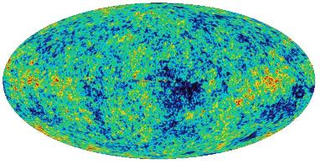
Unparticles and their interactions with neutrinos and other standard model particles might cause distortions in the cosmic microwave background. (WMAP image of the CMB temperature anisotropy)

Cosmology and astrophysics may help guide physicists in building a model of “unparticles,” a newly proposed sector of physics. Recently, Hooman Davoudiasl of Brookhaven National Laboratory has investigated some basic requirements that unparticles must fulfill to ensure that our standard picture of the universe remains intact.

Davoudiasl is one of a quickly growing number of physicists that have become intrigued by Harvard University professor Howard Georgi’s suggestion earlier this year that there might exist a new type of substance that cannot be described in terms of particles because its components are scale-invariant. This characteristic means that these unparticles don’t change appearance when viewed at different scales—which is very different from objects we’re familiar with. However, unparticles might be observed interacting with the standard model particles through suppressed operators.

“Georgi's proposal has motivated many physicists to inquire whether we could have missed something so exotic, in our current or future experiments, if we did not consider its signatures,” Davoudiasl told PhysOrg.com.

Now, Davoudiasl has tried to place constraints on what unparticles might be so that physicists might have an idea of where to look for them in new experiments, notably in the Large Hadron Collider.

“My work points to stringent cosmological and astrophysical constraints that could shape how we view the viable parameter space of unparticle models,” he explained.

One of the strongest constraints, Davoudiasl says, might be imposed by Big Bang nucleosynthesis (BBN), the model that describes the creation of light elements after the universe cooled during its first few minutes. By the time the first particles coupled with each other to form light atomic nuclei, the unparticles must have already separated themselves out from the particles if they were to not interfere with BBN (a model that works very well).

Davoudiasl explains that this decoupling of unparticles and particles would likely have occurred during some earlier and hotter seconds of the universe when temperatures reached at least 1 GeV. After the transition to BBN, latent heat would only heat up the particles, leaving the unparticles much cooler. As in previously studied extra-dimensional models, although unparticles might cool the hot particle plasma to a degree, most of the cooling must still be caused by expansion.

Although unparticles would have to be decoupled during BBN, they might be able to recouple later, where they might interact with neutrinos. If so, then Davoudiasl predicts that the resulting fluid might lead to nonstandard shifts in the location of the acoustic peaks of the cosmic microwave background.

Another possibility is that unparticles may couple to dark matter such as WIMPS (Weakly Interacting Massive Particles). Possibly, unstable dark matter produced in the early universe could have decayed into unparticles, WIMPS, and/or other types of dark matter. Davoudiasl explains that about 5-10% of the original WIMP population could have decayed into unparticles, and still fit within today’s measured cosmological parameters. If so, then unparticles would have about the same energy density as baryonic matter.

If unparticles are to make up any part of the cosmic energy density, they could be able to decay back into standard model particles, Davoudiasl explains. He assumes that such a cold scale-invariant gas could return back into the visible sector by leaking energy into massless photons. If this leakage occurs on very short time scales compared with Hubble time, it could again distort the cosmic microwave background.

Together with BBN cosmology, astrophysical processes such as supernovae could constrain unparticle models, as they have helped constrain other types of light physics (such as axions). Davoudiasl hopes that these constraints may serve as guides for building unparticle models and ultimately observing them--if possible--in experiments.

“So far, unparticle physics does not seem to address any urgent problems, and as such its discovery is not generally anticipated,” he explained. “However, considering novel possibilities is worthwhile when you are searching for the unknown. To quote Louis Pasteur, ‘Chance favors the prepared mind.’”

Citation: Davoudiasl, Hooman. “Constraining Unparticle Physics with Cosmology and Astrophysics.” Physical Review Letters 99, 141301 (2007).

Copyright 2007 PhysOrg.com.
All rights reserved. This material may not be published, broadcast, rewritten or redistributed in whole or part without the express written permission of PhysOrg.com.

Filter


Move the slider to adjust rank threshold, so that you can hide some of the comments.


Display comments: newest first

Quantum_Conundrum
Oct 17, 2007

Rank: 1 / 5 (3)
Yay, another "Theory of Nothing".
earls
Oct 17, 2007

Rank: 1.3 / 5 (3)
Amen, brother. Unparticales. More like unscientists. Give me a break.

Particles Unparticles = ?!?!?

Yet again we're back to Aether. Lets get real here. Hoverboard real.
Ragtime
Oct 18, 2007

Rank: 1 / 5 (1)
Yep. I don't know, how the uniparticle theory was invented, but it's pretty consistent with Aether concept composed of recursive/fractal density fluctuations of inertial environment. After all, can it be derived by some other way?
fredrick
Oct 20, 2007

Rank: 5 / 5 (1)
Ragtime, I've been away for a while... have you admitted that you are zephir yet?

and to quantum_conundrum and earls, I always like to wonder if the people on this site who like to say things like "more like unscientists" - are those people actually scientists themselves? Personally I'm willing to bet otherwise. "Lets get real here"... yeah, lets stop trashing the work of professional physicists from the safety of an anonymous internet comment.

By the way, don't talk about "what science is" and all that... unparticles are a hypothesis, and these guys are attempting to find ways to verify or falsify that hypothesis. You will note that none of them hold faithlike belief in unparticles without any evidence, like as though it was religious dogma - they are treating it as a hypothesis. You'll also note that if they did find unparticles, it would be a major advance in our knowledge of the universe. With these things in mind, what is so unscientific about testing the unparticle hypothesis?

keep it hoverboard real.
Rank 4 /5 (65 votes)
Tags

Related Stories
Relevant PhysicsForums posts
  • Strength of induced magnetic field inside an inductor
    created1 hour ago
  • Physical laws .... are they material?!!
    created2 hours ago
  • increasing time of daylight
    created2 hours ago
  • Light & Sight
    created3 hours ago
  • Wind Turbine Power
    created6 hours ago
  • Steam Table issues
    created8 hours ago
  • More from Physics Forums - General Physics

More news stories

Putting the squeeze on planets outside our solar system

(PhysOrg.com) -- Using high-powered lasers, scientists at Lawrence Livermore National Laboratory and collaborators discovered that molten magnesium silicate undergoes a phase change in the liquid state, abruptly ...

Physics / Condensed Matter

created 1 hour ago | popularity 5 / 5 (1) | comments 0 | with audio podcast

Hovering not hard if you're top-heavy, researchers find

Top-heavy structures are more likely to maintain their balance while hovering in the air than are those that bear a lower center of gravity, researchers at New York University's Courant Institute of Mathematical Sciences ...

Physics / General Physics

created 3 hours ago | popularity 5 / 5 (1) | comments 1 | with audio podcast

SLAC, Stanford team focuses on high-energy electrons to treat cancer

Accelerator physicists at SLAC and cancer specialists from Stanford are working on a new technology that could dramatically reduce the time needed for cancer radiation treatments. The team ran an initial experiment ...

Physics / General Physics

created 6 hours ago | popularity 5 / 5 (1) | comments 0

Measurements from high-energy collisions lead to better understanding of why meson particles disappear

For several years, physicists at the Relativistic Heavy Ion Collider (RHIC) at Brookhaven National Laboratory (BNL), USA, have studied an unusual state of matter called the quark–gluon plasma, which they ...

Physics / General Physics

created 6 hours ago | popularity 5 / 5 (1) | comments 0

Quantum physicist explains $100K offer for proof scaled-up quantum computing is impossible

(PhysOrg.com) -- MIT researcher Scott Aaronson has certainly riled the physics community with his offer this past Friday, of $100,000 to anyone who can prove that scaled-up quantum computing is impossible. ...

Physics / Quantum Physics

created Feb 08, 2012 | popularity 4.1 / 5 (11) | comments 32 | with audio podcast weblog


Human cognitive performance suffers following natural disasters, researchers find

Not surprisingly, victims of a natural disaster can experience stress and anxiety, but a new study indicates that it might also cause them to make more errors - some serious - in their daily lives. In their upcoming Human Fa ...

The power of estrogen -- male snakes attract other males

A new study has shown that boosting the estrogen levels of male garter snakes causes them to secrete the same pheromones that females use to attract suitors, and turned the males into just about the sexiest ...

New error-correcting codes guarantee the fastest possible rate of data transmission

Error-correcting codes are one of the triumphs of the digital age. They’re a way of encoding information so that it can be transmitted across a communication channel — such as an optical fiber o ...

Both maternal and paternal age linked to autism

Older maternal and paternal age are jointly associated with having a child with autism, according to a recently published study led by researchers at The University of Texas Health Science Center at Houston (UTHealth).

Curry spice component may help slow prostate tumor growth

Curcumin, an active component of the Indian curry spice turmeric, may help slow down tumor growth in castration-resistant prostate cancer patients on androgen deprivation therapy (ADT), a study from researchers ...

Humans may have helped the decline of African rainforests 3000 years ago

(PhysOrg.com) -- Large areas of rainforests in Central Africa mysteriously disappeared over three thousand years ago, to be replaced by savannas. The prevailing theory has been that the cause was a change ...