Researchers Develop Wireless Bridge Sensors Without Batteries
October 17, 2007
Researchers Develop Wireless Bridge Sensors Without Batteries

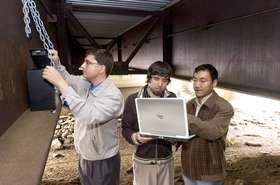
Clarkson University Assistant Professor Edward S. Sazonov and graduate students Darrell Curry and Haodong Li check data from a wireless bridge sensor on the Route 11 bridge in Potsdam, N.Y. Clarkson researchers have developed technology that uses the vibrations caused by passing traffic to power wireless bridge monitoring sensors.

Clarkson University researchers have developed technology that uses the vibrations caused by passing traffic to power wireless bridge monitoring sensors.

Wireless battery-powered sensors that monitor bridges and report changes that may lead to failure are easy to install, but it is unwieldy to provide power for the sensors.

Each bridge needs at least several sensors, many installed in hard-to-access locations. Replacing millions of batteries could become a problem, adding to the expense of maintaining the bridges. The Clarkson researchers have found a way around this problem.

"We have completely eliminated the battery from the equation," says Assistant Professor Edward S. Sazonov, who developed the technology along with Professor Pragasen Pillay. "Hermetically sealed wireless sensors powered by bridge vibration can remain on the bridge without need of maintenance for decades, providing continuous monitoring of such parameters as ice conditions, traffic flows and health status."

The two electrical and computer engineering professors, along with graduate students Darrell Curry and Haodong Li, used the New York State Route 11 bridge, a steel girder structure, which runs over the Raquette River in Potsdam, N.Y., as a case study.

Energy was harvested by locating an electromagnetic generator on a girder. The harvester responded to one of the natural vibration frequencies of the bridge. Each time a car or a truck passed over the bridge, even in a different lane from the sensor installation, the whole structure vibrated and excited the mover in the generator, producing electrical energy. Harvested electrical energy powered unique wireless sensors that increased energy output of the harvester and consumed only microwatts of power while performing useful tasks.

Sazonov and Pillay have been invited to present their work at the Transportation Research Board of the National Academies Meeting in Washington, D.C., in January. The board provides support for their research.

They are also working on using the energy harvesting technology to power the various sensors in passenger cars.

Wireless monitoring of bridges and overpasses has gained much attention in the past few years. Bridge collapses happen suddenly and unpredictably, often leading to tragic loss of human life. In 2006, the Federal Highway Administration listed 25.8 percent of the nation's 596, 842 bridges as either structurally deficient or functionally obsolete. While many of these bridges will remain in service for years, they need monitoring and rehabilitation. Currently, bridge monitoring is performed through periodic visual inspections. In the tragic example of I-35W Mississippi River bridge collapse, the bridge passed a visual inspection a year prior to failure.

Read more about this research at http://www.intelli … o/bridge.htm

Source: Clarkson University

4.8 /5 (5 votes)  

Rank 4.8 /5 (5 votes)
Tags

Related Stories
Relevant PhysicsForums posts
  • Force free body diagram problem on gym equipment
    created1 hour ago
  • Empirical data regarding shower heads and water
    created9 hours ago
  • feed hold button on CNC lathe
    createdFeb 09, 2012
  • RFAC in Fortran
    createdFeb 09, 2012
  • dynamics 2/32
    createdFeb 08, 2012
  • dynamics
    createdFeb 08, 2012
  • More from Physics Forums - General Engineering

More news stories

Netflix light on flicks as viewers soak up TV shows

Like most fresh faces that arrive in Hollywood, Netflix wanted to be a movie star. But now it's learning what many in Tinseltown have known for decades: Movies are sexy, but the real money is in television.

Technology / Business

created 6 minutes ago | popularity not rated yet | comments 0

Sony's Hirai refuses to abandon dire TV business

Struggling Japanese entertainment giant Sony will not abandon its cash-bleeding television business, its incoming CEO says, but he acknowledges tough decisions lie ahead including over redundancies.

Technology / Business

created 36 minutes ago | popularity not rated yet | comments 0

New error-correcting codes guarantee the fastest possible rate of data transmission

Error-correcting codes are one of the triumphs of the digital age. They’re a way of encoding information so that it can be transmitted across a communication channel — such as an optical fiber o ...

Technology / Computer Sciences

created 3 hours ago | popularity 5 / 5 (3) | comments 2 | with audio podcast

Small modular reactor design could be a 'SUPERSTAR'

(PhysOrg.com) -- Though most of today's nuclear reactors are cooled by water, we've long known that there are alternatives; in fact, the world's first nuclear-powered electricity in 1951 came from a reactor ...

Technology / Energy & Green Tech

created 2 hours ago | popularity 5 / 5 (4) | comments 9 | with audio podcast

Advanced power-grid model finds low-cost, low-carbon future in West

(PhysOrg.com) -- The least expensive way for the Western U.S. to reduce greenhouse gas emissions enough to help prevent the worst consequences of global warming is to replace coal with renewable and other ...

Technology / Energy & Green Tech

created 2 hours ago | popularity 5 / 5 (1) | comments 3 | with audio podcast


Experts reveal how plants don't get sunburn

(PhysOrg.com) -- Experts at the University of Glasgow have discovered how plants survive the harmful rays of the sun.

Fool's gold may prove an unlikely alternative to overexploited catalytic materials

Catalytic materials, which lower the energy barriers for chemical reactions, are used in everything from the commercial production of chemicals to catalytic converters in car engines. However, with current catalytic materials ...

Curry spice component may help slow prostate tumor growth

Curcumin, an active component of the Indian curry spice turmeric, may help slow down tumor growth in castration-resistant prostate cancer patients on androgen deprivation therapy (ADT), a study from researchers ...

Unpicking HIV’s invisibility cloak

Drug researchers hunting for alternative ways to treat human immunodeficiency virus (HIV) infections may soon have a novel target—its camouflage coat. HIV hides inside a cloak unusually rich in a sugar ...

What lies beneath: Mapping hidden nanostructures

The ability to diagnose and predict the properties of materials is vital, particularly in the expanding field of nanotechnology. Electron and atom-probe microscopy can categorize atoms in thin sheets of material, ...

To avoid early labor and delivery, weight and diet changes not the answer

One of the strongest known risk factors for spontaneous or unexpected preterm birth – any birth that occurs before the 37th week of pregnancy, most often without a known cause – is already having had one. For women ...