First Analysis of the Water Requirements of a Hydrogen Economy
October 18, 2007 By Lisa Zyga
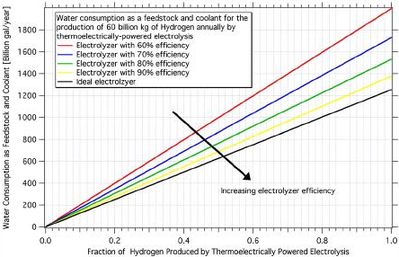
This graph shows the annual water consumption as a feedstock and coolant for generating 60 billion kg of hydrogen, which is influenced by both the fraction of hydrogen that is produced by thermoelectrically powered electrolysis and electrolyzer efficiencies. Image credit: Michael E. Webber.
One of the touted benefits of the futuristic US hydrogen economy is that the hydrogen supply—in the form of water—is virtually limitless. This assumption is taken for granted so much that no major study has fully considered just how much water a sustainable hydrogen economy would need.
Michael Webber, Associate Director at the Center for International Energy and Environmental Policy at the University of Texas at Austin, has recently filled that gap by providing the first analysis of the total water requirements with recent data for a “transitional” hydrogen economy. While the hydrogen economy is expected to be in full swing around 2050 (according to a 2004 report by the National Research Council [NRC]), a transitional hydrogen economy would occur in about 30 years, in 2037.
At that time, the NRC predicts an annual production of 60 billion kg of hydrogen. Webber’s analysis estimates that this amount of hydrogen would use about 19-69 trillion gallons of water annually as a feedstock for electrolytic production and as a coolant for thermoelectric power. That’s 52-189 billion gallons per day, a 27-97% increase from the 195 billion gallons per day (72 trillion gallons annually) used today by the thermoelectric power sector to generate about 90% of the electricity in the US. During the past several decades, water withdrawal has remained stable, suggesting that this increase in water intensity could have unprecedented consequences on the natural resource and public policy.
“The greatest significance of this work is that, by shifting our fuels production onto the grid, we can have a very dramatic impact on water resources unless policy changes are implemented that require system-wide shifts to power plant cooling methods that are less water-intensive or to power sources that don’t require cooling,” Webber told PhysOrg.com. “This analysis is not meant to say that hydrogen should not be pursued, just that if hydrogen production is pursued through thermoelectrically-powered electrolysis, the impacts on water are potentially quite severe.”
Webber’s estimate accounts for both the direct and indirect uses of water in a hydrogen economy. The direct use is water as a feedstock for hydrogen, where water undergoes a splitting process that separates hydrogen from oxygen. Production can be accomplished in several ways, such as steam methane reforming, nuclear thermochemical splitting, gasification of coal or biomass, and others. But one of the dominant production methods in the transitional stage, as predicted in a 2004 planning report from the Department of Energy (DOE), will likely be electrolysis.
Based on the atomic properties of water, 1 kg of hydrogen gas requires about 2.4 gallons of water as feedstock. In one year, 60 billion kilograms of hydrogen would require 143 billion gallons of fresh, distilled water. This number is similar to the amount of water required for refining an equivalent amount of petroleum (about 1-2.5 gallons of water per gallon of gasoline).
The biggest increase in water usage would come from indirect water requirements, specifically as a cooling fluid for the electricity needed to supply the energy that electrolysis requires. Since electrolysis is likely to use existing infrastructure, it would pull from the grid and therefore depend on thermoelectric processes.
At 100% efficiency, electrolysis would require close to 40 kWh per kilogram of hydrogen—a number derived from the higher heating value of hydrogen, a physical property. However, today’s systems have an efficiency of about 60-70%, with the DOE’s future target at 75%.
Depending on the fraction of hydrogen produced by electrolysis (Webber presents estimates for values from 35 to 85%), the amount of electricity required based on electrolysis efficiency of 75% would be between 1134 and 2754 billion kWh—and up to 3351 billion kWh for a lower electrolysis efficiency of 60%. For comparison, the current annual electricity generation in the US in 2005 was 4063 billion kWh.
In 2000, thermoelectric power generation required an average of 20.6 gallons of water per kWh, leading Webber to estimate that hydrogen production through electrolysis, at 75% efficiency, would require about 1100 gallons of cooling water per kilogram of hydrogen. That’s 66 trillion gallons per year just for cooling.
By 2050, the NRC report predicts that hydrogen demand could exceed 100 billion kg—nearly twice the 60 billion kg that Webber’s estimates are based on. By then, researchers may find better ways of producing hydrogen, with assistance from the DOE’s large-scale investments, which will exceed $900 million in 2008.
“That most of the water use is for cooling leaves hope that we can change the way power plants operate, which would significantly ease up the potential burden on water resources, or that we can find other means of power production at a large scale to satisfy the demands of electrolysis,” said Webber.
If electrolysis becomes a widespread method of hydrogen production, Webber suggests that researchers may want to look for an electricity-generating method other than thermoelectric processes to power electrolysis. With this perspective, he suggests hydrogen pathways such as wind or solar sources, as well as water-free cooling methods such as air cooling.
“Each of the energy choices we can make, in terms of fuels and technologies, has its own tradeoffs associated with it,” Webber said. “Hydrogen, just like ethanol, wind, solar, or other alternative choices, has many merits, but also has some important impacts to keep in mind, as this paper tries to suggest. I would encourage the continuation of research into hydrogen production as part of a comprehensive basket of approaches that are considered for managing the transition into the green energy era. But, because of some of the unexpected impacts—for example on water resources—it seems premature to determine that hydrogen is the answer we should pursue at the exclusion of other options.”
More information can be found at the Webber Energy Group, an organization which seeks to bridge the divide between policymakers and engineers & scientists for issues related to energy and the environment.
Citation: Webber, Michael E. “The water intensity of the transitional hydrogen economy.” Environmental Research Letters, 2 (2007) 034007 (7pp).
Copyright 2007 PhysOrg.com.
All rights reserved. This material may not be published, broadcast, rewritten or redistributed in whole or part without the express written permission of PhysOrg.com.


Not to mention that in many cases the actual use of hydrogen has the direct by product of creating pure water!
There is more hype in this work that fact.
Atlanta and others facing drought and great lakes dropping due to ethanol production.
I think there are some serious issues with hydrogen and ethanol.
Ever hear of wind, solar, and wave generators ?
I guess not, or it must not be backed by the big rubber and big oil.
I personally believe, based on elementary chemistry and physics, that the "carbon economy" will be a disaster which produces more air and water pollution than oil ever has.
Using aluminum and gallium to take hydrogen directly from water would be great.
http://www.physor....html
/>
Steam reforming of methane (to make CO2 and hydrogen) doesn't make sense energetically, since energy is used to boil the water to make steam, and more energy could be obtained by simply burning the methane. A "hydrogen economy" is only feasible if electricity for electrolysis is obtained from nuclear power plants, or eventually from hydroelectric power from dams.
If a water-electrolysis plant was built next to a nuclear power plant, some of the waste heat from the electrolysis could be recovered by using cooling water from the electrolysis plant as preheated boiler-feedwater for the steam boiler at the nuclear power plant, thereby increasing the amount of steam (and electricity) produced for the amount of nuclear fuel consumed.
Regarding "cybrbeast's" comment about using salt water for electrolysis, electrolysis of salt water produces chlorine gas, the process commonly used to manufacture bleach and caustic soda. However, if hydrogen is produced on a massive scale by electrolysis of salt water, the process will produce 35 times more mass of chlorine than hydrogen, and some means of capturing and neutralizing the toxic chlorine would need to be used. If the hydrogen was produced as a transport fuel on a large scale, the industrial market for chlorine could never absorb such a huge amount of free chlorine.
Salt water could eventually be used for cooling, but most engineers tend to avoid it, due to problems of fouling and corrosion of heat exchangers and cooling towers.
I might be wrong, but I keep thinking that the amount of electrical power needed to generate enough hydrogen to move a fuel-cell car one mile, is greater than the amount of electrical power needed to move a plug-in battery-electric car the same distance. So to my mind, hydrogen is just an alternative solution to the problem of storing electric power. I don't feel right about shaping the public infrastructure around what might be just a band-aid fix for the short-comings of battery storage. I have more faith in future developments in battery technologies, which only require the purchase of 220 volt battery chargers to complete the delivery of energy to individuals.
And now I get to add in consideration, the amount of cooling water. Thanks!
ps - big fuel distributors are trying to break it slowly to the public that the ea-85 fuel is going to need more trips to the pump to drive the same miles every day. of course, the price per gallon is fixed...
Hydroelectric dams also produce a lot of co2 and methane. Not from the generators themselves, but because they cause the water level around the dam to raise and lower. Letting plants grow, then drowning and decomposing them. Leeching nutrients from the soil around the damn and turning it into gases. Tidal, wave and continuous flow systems don't cause this problem.
You are right about the Chlorine though. The other half of that problem is the sodium getting turned into Sodium Hydroxide (Lye). So on top of the chlorine gas, the lye would also need to be neutralized and removed. Although we can somewhat cheat with that (adding aluminum neutrlizes the lye and releases more h2) the problem then becomes, where do we get enuogh aluminum, since that takes even more power to create.
In the end, h2 is just too much of a PITA to deal with as an energy transport. A carbon neutral power plant batteries and maybe super capacitors is going to end up being the way to go. Batteries are where we really need to be putting some research. Mainly in getting the mass per kilowatt down.
I see a big future for nuclear and solar power, but I'm not a big fan of the hydrogen idea in general. There are already some electric cars that are practical for medium distance daily commuting. Like Shadetree said batteries are a much better option. They are also less dangerous than hydrogen tanks. I think the nanotech industry will be able to greatly increase the capacity of batteries, and decrease the charging time in the near future.
1. Does the exhaust gas assume complete and perfect combustion producing only pure H2O vapor? If not, then what possible pollutants can come from an incomplete combustion? Bleach comes to mind.
2. What will happen to cities full of cars emitting water vapor into an atmosphere at 14F.
I fear it may be possible to ice skate from Montreal to Providence.
As said many times, "Hydrogen is the fuel of the future...and always will be".
If anyone would like to discuss this feel free to contact me.
Carpe Diem
2. Electrolysing sea water is probably a last resort. Ideally, water should be purified or distilled to reduce any contamination of the fuel cell and environment and avoid productions of HCL.
3. Most hydrogen can be made from wind, sun and tidal action in areas of the world that possess these qualities in abundance. Nuclear can alos be used to both produce hydrogen and distill sea water. Shipping/transport of the hydrogen produced to areas not able to produce it can then be made in a similar way to how oil is now done (ie. ship/truck/pipeline). Cost of generating hydrogen in those areas will be free for operators once equipment is capitalized. Forget about the cost of producing hydrogen. It will be much less than producing oil once infrastructure is in place. Cost of transportation will be on the consumer, as it is now for petroleum.
Shadetree Engineer is quite right about ethanol. It's much less efficient as a fuel than gasoline, and it's causing tremendous increases in worldwide food prices.
Chlorine gas produced from electrolyzing sea water can be collected by well proven methods on industrial scales, as it has been for decades, as an valuable chemical. No industrialist will waste it, and by safety laws and regulations, you are not allow it goes free to choke/kill/poison the trees and people in the neighborhood anyway!
To be effective, the energy sources for electrolyzing obviously can't be oil. That leaves solar, nuclear, wind, geothermal and tidal power production. Solar-electric power is currently not favorable competitively due to high costs of semiconductor materials and production costs. Solar-thermal-electric approaches are limited by the scale and technology of mirrors/collectors, associated heat transfer loops and thermodynamics limits. Direct dissociation of water by extremely high temperatures produced by concentrating sunlight is constrained by the inefficiency of the process and thermal limits on materials. Nuclear power, while easily the most powerful and up scalable,is both politically and environmentally explosive. Natural wind, tidal and geothermal power are subjected to the vagaries of geography, not to mention the aesthetic impact on surrounding inhabitants, who are usually influential enough to derail any plans to have eyesore in their views, whether it is good for the planet or not.
So, all of them are compromises. We just have to accept and choose each for the available resources,location and (political) wind.
I envision a massive tank-like installation rigidly anchored off shore off the sea bed. The rise and fall of water would provide the water potential to drive electric generators, the strains on the anchors even be used for piezoelectric generation or a source of high oltage source for other uses. The massive surface area of the tank top will be used for solar power generation. By electrolyzing sea water, NaOH is produced. Its solution in sea water is denser than than water, so you can use that fact too. NaOH-rich water will sink, a reservoir of it with outlets will draw in sea water, generating extra power. Heck, if the tank is BIG enough and goes deep enough, the tank can be of two concentric layers, with the outer wall an osmotic membrane type, and fresh water is produced between the membrane by osmotic pressure for free!
All we need are pipelines...:-)
It appears that maybe the Kanzius RF experiment is taking advantage of the dynamics within a catalyzed reaction. The RF energy, at the 13.56 MHz frequency, is freeing the hydrogen from its bonds to oxygen. This is facilitated by the salt within the water. So the salt and the RF energy work in conjunction to allow less energy to create free hydrogen. One of the things about catalyzed reactions is that they are not well understood. That is because they operate within the dynamics of molecular physics. So, what the thermodynamic criticism fails to address is the fact that in catalyzed reactions the energy to put the atoms back together as a water molecule are also much less. This is impossible to prove for this particular reaction, but can be done so for other reactions, thus proving the hypothesis that the second law of thermodynamics is not violated in this instance either.
However, we don't care about putting the atoms back together in the presence of the catalyst(s) anyway. We care that we've reduced substantially the amount of energy required to break apart the bonds of the molecule.
One is for the world's first ever Hydrogen-Production-Storage-Transport Ships the Hydrogen Challenger
http://www.hydrog...lish.htm
(a very clever idea for creating hydrogen via a renewable resource; especially interesting since the production and storage and transport of the hydrogen happens in the same place)
The second is an excellent interview/documentary with Hydrogen Energy Expert David Sanborn Scott on the wonderful CBC radio show Ideas.
http://www.cbc.ca...ast.html
part 1: http://podcast.cb...4089.mp3
part 2:
http://podcast.cb...4165.mp3
it's nice to see when an internet forum doesn't devolve into ridiculousness and name-calling...
i'll be checking in this site from time to time, thanks.
1) we don't have to convert everything to hydrogen today. More efficient engine design (check out the Revetek engine) more efficient solar and wind (there's a lot just around the corner) more efficient electolysis (resonant frequencies, etc.);
2) use solar, the sun is free, panel's are getting more efficient every year anyway;
3) five years ago the GAO was estimating the actual cost of a gallon of gas between 5 and 7 dollars considering the efforts to secure oil in all the hotspots around the globe.
Recover the exhaust and "re-burn" it so the vapor doesn't contribute to global warming.
What's easier and less costly? To build an electric car using batteries or to convert a gasoline engine that already exists to use hydrogen to supplement the gasoline it's already using or switch all the way to hydrogen as needed? Gasoline engines can already burn hydrogen.
Yes there are tons of details, just like with oil. The economic growth opportunites are phenomenal. I suggest that not moving to hydrogen as at least a substantial part of the equation is folly.
What are the costs of not trying? Perhaps our favorite buddy Hugo Chavez has some ideas where we can spend our money!