Columbus hatch closed for last time
October 19, 2007
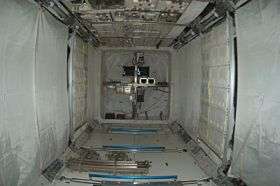
Preparations of the European Columbus laboratory took an important step on 16 October 2007 with the final closure of the module’s hatch ahead of the December launch to the International Space Station. The European Columbus laboratory is the cornerstone of ESA’s contribution to the ISS and the first European laboratory dedicated to long-term research in space. Columbus will be carried into orbit in the cargo bay of Space Shuttle Atlantis on the STS-122 mission, scheduled for launch on 6 December 2007. Credits: ESA
Preparations of the European Columbus laboratory took an important step earlier this week with the final closure of the module’s hatch ahead of the December launch to the International Space Station.
Although there was no formal ceremony to mark the occasion, the hatch closure is an important milestone for all involved. “This means we are 99% ready for flight,” explains Bernardo Patti, ESA’s Columbus Project Manager. “All the activities related to the pressurised volume are finished. The work left to be done on the exterior is considered to be minor.”
The 8-metre long Columbus laboratory is currently under preparation for flight at the Space Station Processing Facility (SSPF) at NASA’s Kennedy Space Center (KSC), in Florida.
The team at KSC has worked hard over the past weeks to meet the schedule. “The last checkouts were completed - the module worked perfectly and all the health checks were successful,” says Patti.
After power shutdown the team performed a meticulous check of each zone inside the module. The hatch was then closed to 80%, leaving a gap to allow for final air purge, before being fully closed late on Tuesday afternoon. Patti: “The next time the hatch is opened will be in orbit, allowing the astronauts to enter the module for the very first time.”
Next up for Columbus is a Payload Readiness Review which is expected to give the green light for moving the module to the canister – a large container in which Columbus will be taken to the launch pad early in November ready to be placed inside the Space Shuttle’s cargo bay.
The European Columbus laboratory is the cornerstone of ESA’s contribution to the ISS and the first European laboratory dedicated to long-term research in space. Columbus will be carried into orbit in the cargo bay of Space Shuttle Atlantis on the STS-122 mission, scheduled for launch on 6 December 2007.
The STS-122 crew includes ESA astronauts Hans Schlegel and Leopold Eyharts. Eyharts will remain on the ISS for two months as a member of the Expedition 16 crew to oversee the in-orbit commissioning of Columbus and its experimental facilities.
Source: European Space Agency
-
Space station on to the 2nd decade
Oct 29, 2010 |
5 / 5 (4) |
1
-
Space Station gains a new room: Node-3 installed
Feb 15, 2010 |
5 / 5 (1) |
0
-
Jules Verne ATV reveals unexpected capabilities
Jun 16, 2008 |
4.6 / 5 (34) |
1
-
Columbus installed in new home on ISS
Feb 11, 2008 |
4.2 / 5 (10) |
1
-
Shuttle Discovery Returns to Earth After Successful Mission
Nov 07, 2007 |
5 / 5 (7) |
0
-
Engineers build first sub-10-nm carbon nanotube transistor
Feb 01, 2012 |
4.9 / 5 (33) |
30
-
Something old, something new: Evolution and the structural divergence of duplicate genes
Jan 31, 2012 |
4.6 / 5 (7) |
1
-
The hidden nanoworld of ice crystals: Revealing the dynamic behavior of quasi-liquid layers
Jan 30, 2012 |
5 / 5 (4) |
1
-
Stock market network reveals investor clustering
Jan 27, 2012 |
3.9 / 5 (23) |
8
-
Of microchemistry and molecules: Electronic microfluidic device synthesizes biocompatible probes
Jan 26, 2012 |
5 / 5 (2) |
0
-
Never ending outer space.....
Feb 11, 2012
-
Neutron Star fragments?
Feb 11, 2012
-
stationary or not?
Feb 11, 2012
-
Scale of the Universe
Feb 10, 2012
-
Titan's lack of impact craters
Feb 09, 2012
-
Real pictures of black hole eating a star?
Feb 08, 2012
- More from Physics Forums - General Astronomy
More news stories
Latin America mining boom clashes with conservation
Latin America is experiencing a mining boom as prices rise fuelled by a hike in global demand, but the region is also being hit by a wave of violent protests, strikes and rallies by environmentalists.
20 hours ago |
5 / 5 (1) |
1
Salvage workers begin pumping fuel from Italian shipwreck
Salvage workers Sunday began pumping fuel from the shipwrecked Italian cruise liner Costa Concordia, a day ahead of schedule, officials said.
12 hours ago |
5 / 5 (2) |
0
Political leaders play key role in how worried Americans are by climate change: study
More than extreme weather events and the work of scientists, it is national political leaders who influence how much Americans worry about the threat of climate change, new research finds.
Feb 06, 2012 |
5 / 5 (8) |
75
NASA budget will axe Mars deal with Europe: scientists
US President Barack Obama's budget proposal to be submitted next week for 2013 will cut NASA's budget by 20 percent and eliminate a major partnership with Europe on Mars exploration, scientists said Thursday.
Space & Earth / Space Exploration
Feb 10, 2012 |
5 / 5 (4) |
58
Humans may have helped the decline of African rainforests 3000 years ago
(PhysOrg.com) -- Large areas of rainforests in Central Africa mysteriously disappeared over three thousand years ago, to be replaced by savannas. The prevailing theory has been that the cause was a change ...
Scientists discover molecular secrets of 2,000-year-old Chinese herbal remedy
For roughly two thousand years, Chinese herbalists have treated Malaria using a root extract, commonly known as Chang Shan, from a type of hydrangea that grows in Tibet and Nepal. More recent studies suggest that halofuginone, ...
New method to examine batteries -- MRI from the inside
There is an ever-increasing need for advanced batteries for portable electronics, such as phones, cameras, and music players, but also to power electric vehicles and to facilitate the distribution and storage of energy derived ...
A mitosis mystery solved: How chromosomes align perfectly in a dividing cell
Although the process of mitotic cell division has been studied intensely for more than 50 years, Whitehead Institute researchers have only now solved the mystery of how cells correctly align their chromosomes during symmetric ...
Google might launch Drive for cloud storage soon
(PhysOrg.com) -- Google's next big move, according to the Wall Street Journal, is a cloud storage service called Drive. Hardly first to the plate, Google is simply catching up to introducing its cloud reposi ...
Lab study raises questions over nano-particle impact
Tests involving chickens have raised questions about the impact on health from engineered nano-particles, the ultra-fine grains commonly used in drugs and processed foods, scientists said on Sunday.
Starve a virus, feed a cure? Findings show how some cells protect themselves against HIV
A protein that protects some of our immune cells from the most common and virulent form of HIV works by starving the virus of the molecular building blocks that it needs to replicate, according to research published online ...