The solution to a 7-decade mystery is crystal-clear to FSU chemist
October 19, 2007
Ammonium Dihyrogen Phosphate

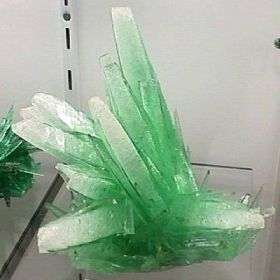
Ammonium dihyrogen phosphate, or ADP, crystals, which have applications in computer memory, laser and fiber optic technology. Credit: Florida State University

A Florida State University researcher has helped solve a scientific mystery that stumped chemists for nearly seven decades. In so doing, his team’s findings may lead to the development of more-powerful computer memories and lasers.

Naresh S. Dalal, the Dirac Professor of Chemistry and Biochemistry at FSU, recently collaborated with three colleagues, Jorge Lasave, Sergio Koval and Ricardo Migoni, all of the Universidad Nacional de Rosario in Argentina, to determine why a certain type of crystal known as ammonium dihydrogen phosphate, or ADP, behaves the way it does.

“ADP was discovered in 1938,” Dalal said. “It was observed to have some unusual electrical properties that weren’t fully understood -- and for nearly 70 years, scientists have been perplexed by these properties. Using the supercomputer at SCRI (FSU’s Supercomputer Computations Research Institute), we were able to perform in-depth computational analyses that explained for the very first time what causes ADP to have these unusual properties.”

ADP, like many crystals, exhibits an electrical phenomenon known as ferroelectricity. Ferroelectric materials are analogous to magnets in that they maintain a positively charged and a negatively charged pole below a certain temperature that is characteristic for each compound.

“Ferroelectric materials can stay in a given state of charge for a long time -- they retain their charge after the external electrical source is removed,” Dalal said. “This has made ADP and other materials like it very useful for storing and transmitting data.

ADP is commonly used in computer memory devices, fiber optic technology, lasers and other electro-optic applications.”

What researchers found perplexing about ADP was that it often displays a very different electrical phase -- one known as antiferroelectricity.

“With antiferroelectricity, one layer of molecules in a crystal has a plus and a minus pole, but in the next layer, the charges are reversed,” Dalal said. “You see this reversal of charges, layer by layer, throughout the crystal.”

Using the supercomputer at SCRI enabled Dalal and his colleagues to perform numerous highly complex calculations that couldn’t be duplicated in a laboratory environment. For example, they were able to theoretically alter the angles of ADP’s ammonium ions and then measure the effects on the crystal’s electrical charge. That approach ultimately led to their solution to the seven-decade mystery.

“We found that the position of the ammonium ions in the compound, as well as the presence of stresses or defects in the crystal, determine whether it behaves in a ferroelectric or antiferroelectric manner,” Dalal said.

The team’s research is important for two main reasons, Dalal said: “First, this allows us to further understand how to design new materials with both ferroelectric and antiferroelectric properties. Doing so could open new doors for computer memory technology -- and possibly play a role in the development of quantum computers.

“Second, our research opens up new ways of testing materials,” Dalal said. “Using supercomputers, we can quickly perform tests to see how materials would react under a variety of conditions. Many such tests can’t even be performed in the lab.”

Source: Florida State University

4.6 /5 (56 votes)  

Rank 4.6 /5 (56 votes)
Tags

Relevant PhysicsForums posts

More news stories

Scientists discover molecular secrets of 2,000-year-old Chinese herbal remedy

For roughly two thousand years, Chinese herbalists have treated Malaria using a root extract, commonly known as Chang Shan, from a type of hydrangea that grows in Tibet and Nepal. More recent studies suggest that halofuginone, ...

Chemistry / Biochemistry

created 3 hours ago | popularity 5 / 5 (10) | comments 4 | with audio podcast

New method to examine batteries -- MRI from the inside

There is an ever-increasing need for advanced batteries for portable electronics, such as phones, cameras, and music players, but also to power electric vehicles and to facilitate the distribution and storage of energy derived ...

Chemistry / Analytical Chemistry

created 3 hours ago | popularity 5 / 5 (4) | comments 0 | with audio podcast

Hydrogen from acidic water: Researchers develop potential low cost alternative to platinum for splitting water

A technique for creating a new molecule that structurally and chemically replicates the active part of the widely used industrial catalyst molybdenite has been developed by researchers with the Lawrence Berkeley ...

Chemistry / Materials Science

created Feb 09, 2012 | popularity 4.8 / 5 (16) | comments 21 | with audio podcast

Fool's gold may prove an unlikely alternative to overexploited catalytic materials

Catalytic materials, which lower the energy barriers for chemical reactions, are used in everything from the commercial production of chemicals to catalytic converters in car engines. However, with current catalytic materials ...

Chemistry / Materials Science

created Feb 10, 2012 | popularity 4.4 / 5 (8) | comments 8 | with audio podcast

Research provides octagonal window of opportunity for carbon capture

(PhysOrg.com) -- Filtering carbon dioxide, a greenhouse gas, from factory smokestacks is a necessary, but expensive part of many manufacturing processes. However, a collaborative research team from the National ...

Chemistry / Materials Science

created Feb 08, 2012 | popularity 5 / 5 (2) | comments 5 | with audio podcast


Overeating may double risk of memory loss

New research suggests that consuming between 2,100 and 6,000 calories per day may double the risk of memory loss, or mild cognitive impairment (MCI), among people age 70 and older. The study was released today and will be ...

Google might launch Drive for cloud storage soon

(PhysOrg.com) -- Google's next big move, according to the Wall Street Journal, is a cloud storage service called Drive. Hardly first to the plate, Google is simply catching up to introducing its cloud reposi ...

Lab study raises questions over nano-particle impact

Tests involving chickens have raised questions about the impact on health from engineered nano-particles, the ultra-fine grains commonly used in drugs and processed foods, scientists said on Sunday.

Injured boomers beware: Know when to see doctor

(AP) -- It happened to nurse Jane Byron years after an in-line skating fall, business owner Haralee Weintraub while doing "men's" push-ups, and avid cyclist Gene Wilberg while lifting a heavy box.

A mitosis mystery solved: How chromosomes align perfectly in a dividing cell

Although the process of mitotic cell division has been studied intensely for more than 50 years, Whitehead Institute researchers have only now solved the mystery of how cells correctly align their chromosomes during symmetric ...

Starve a virus, feed a cure? Findings show how some cells protect themselves against HIV

A protein that protects some of our immune cells from the most common and virulent form of HIV works by starving the virus of the molecular building blocks that it needs to replicate, according to research published online ...