Discovery of rare moss boosts research
October 19, 2007
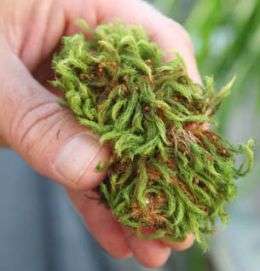
Haller’s apple moss only grows in areas with high precipitation and low elevation.
René Belland has a soft spot for moss - especially Haller's apple moss. "It's so soft. If you found a field full of it, you'd just want to lie down in it," said the assistant director of research at the University of Alberta's Devonian Botanic Garden.
A field full of the moss is not likely to turn up, as it's a rare, endangered species. Belland, however, has discovered the largest population of Haller's apple moss ever in Alberta and in North America.
Belland discovered the moss this summer in the western side of Jasper National Park. The moss is listed as threatened under the federal government's Species At Risk Act. There are two other known locations for this moss in the national park, and other sites with numerous colonies in British Columbia, but this is the largest find by far.
The moss is so-named for its tiny, apple-shaped spore capsules which grow on a stalk that is only two millimetres long. "It's quite a beautiful and distinctive moss, and but not easy to find," said Belland. "It has a very specific habitat. It only grows in areas that are really, really wet, in terms of precipitation and in low elevations."
It also grows in parts of Britain, Scandinavia and east Asia, but was first discovered in Canada in 1825 by Thomas Drummond, a naturalist who travelled along the Hudson's Bay trade route where he discovered the species on the Wood River in British Columbia. In North America, Haller's apple moss only grows in the western slopes of the Rocky Mountains in B.C. and Alberta, hugging the Continental Divide. The next Canadian sighting wasn't until 1960 in Mount Robson Park, and then another small site was found in the 1980s by U of A researcher Dale Vitt. Belland and a colleague found more in B.C. a few years ago, as part of a targeted search program.
"It forms part of our natural heritage, the biodiversity of Canada," said Belland. "Even though it's just one species, we have to preserve that one species. If we don't' care about this one, and we don't care about the next one, eventually Canada will be a country with very, very few species."
The Jasper discovery is a rich find, Belland said.
"Generally, one of the problems with rare species is that there's not a lot of it to work with to figure out what its biology is. This population is big enough that we can actually say that there's lots of it here, and figure out why it's here," he said. "We may be able to determine the environmental parameters important to its survival, and then apply that knowledge to predicting the occurrence of colonies at new locations."
The Jasper park colonies are also the only ones on federally protected land; most of the B.C. colonies are either on private or Crown land and are therefore potentially at greater risk, Belland added.
These findings will help play an important role building a federal recovery plan for this fragile species.
Source: University of Alberta
-
Engineers build first sub-10-nm carbon nanotube transistor
Feb 01, 2012 |
4.9 / 5 (31) |
30
-
Something old, something new: Evolution and the structural divergence of duplicate genes
Jan 31, 2012 |
4.6 / 5 (7) |
1
-
The hidden nanoworld of ice crystals: Revealing the dynamic behavior of quasi-liquid layers
Jan 30, 2012 |
5 / 5 (3) |
1
-
Stock market network reveals investor clustering
Jan 27, 2012 |
3.9 / 5 (23) |
8
-
Of microchemistry and molecules: Electronic microfluidic device synthesizes biocompatible probes
Jan 26, 2012 |
5 / 5 (1) |
0
More news stories
Entire genome of extinct human decoded from fossil
(PhysOrg.com) -- In 2010, Svante Pääbo and his colleagues presented a draft version of the genome from a small fragment of a human finger bone discovered in Denisova Cave in southern Siberia. The ...
Feb 07, 2012 |
4.7 / 5 (58) |
47
|
Why are there so few fish in the Earth's oceans?
(PhysOrg.com) -- A Stony Brook University researcher has found that, contrary to popular belief, there are not plenty of fish in the sea.
Feb 08, 2012 |
4.3 / 5 (17) |
26
|
Miami battling invasion of giant African snails
No one knows how they got there. But an invasion of African giant snails has southern Florida in a panic over potential crop damage, disease and general yuckiness surrounding the slimy gastropods.
Feb 10, 2012 |
4.7 / 5 (3) |
5
Deciding to go left or right: Researchers use device to determine that lower animals can navigate too
For decades, scientists have associated binary decision making opting to go left or right with higher-ranking animals, including humans. A team of Harvard researchers, however, is rewriting that ...
Feb 09, 2012 |
4 / 5 (1) |
4
|
Study shows chimps able to understand needs of others
(PhysOrg.com) -- By setting up a unique experiment, a small team of researchers has found that chimpanzees are able to understand need in other chimps, despite their general disinclination to offer aid when ...
Injured boomers beware: Know when to see doctor
(AP) -- It happened to nurse Jane Byron years after an in-line skating fall, business owner Haralee Weintraub while doing "men's" push-ups, and avid cyclist Gene Wilberg while lifting a heavy box.
Google might launch Drive for cloud storage soon
(PhysOrg.com) -- Google's next big move, according to the Wall Street Journal, is a cloud storage service called Drive. Hardly first to the plate, Google is simply catching up to introducing its cloud reposi ...
Latin America mining boom clashes with conservation
Latin America is experiencing a mining boom as prices rise fuelled by a hike in global demand, but the region is also being hit by a wave of violent protests, strikes and rallies by environmentalists.
Love a click away in Indonesia's Twitter Republic
He was a geeky kid from Yogyakarta, she a glamorous city girl in Jakarta. In a country with one of the world's most vibrant social networking scenes they fell in love on Twitter.
Europeans protest controversial Internet pact
Tens of thousands of people marched in protests in more than a dozen European cities Saturday against a controversial anti-online piracy pact that critics say could curtail Internet freedom.
Walney offshore wind farm is world's biggest (for now)
(PhysOrg.com) -- The Walney wind farm on the Irish Sea--characterized by high tides, waves and windy weather--officially opened this week. The farm is treated in the press as a very big deal as the Walney ...