By the Light of the Moon
October 19, 2007 Moon

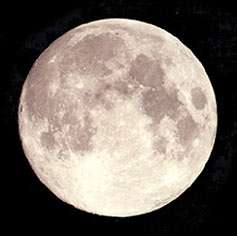
The image of the moon is courtesy of NASA.

The gently glowing moon is more than just a pretty ball in the sky—for gamma-ray astronomers, the moon could become a unique target for calibrating instruments such as the Gamma-ray Large Area Space Telescope (GLAST).

Once GLAST is up and running, scientists will need a way to confirm that it's working properly. Fortunately, the moon provides a big, bright "standard candle"—an object with an absolutely known gamma-ray output.

In a December Astrophysical Journal paper, that candle's exact brightness is derived by Stanford's physicist Igor Moskalenko, a member of the GLAST collaboration and the Kavli Institute for Particle Astrophysics and Cosmology, and Troy Porter of UC Santa Cruz and the Santa Cruz Institute for Particle Physics, also a GLAST collaboration member.

Having such a standard provides a unique tool to calibrate GLAST, and will prove a useful cross-check with other calibration methods. If the moon through GLAST matches Moskalenko and Porter's calculations, then images of the rest of the galaxy are probably correct. If the moon looks funny, then it's time to adjust the instrument's response.

Unlike any other object in the sky, the moon has a known composition and the flux of incident particles producing the gamma-ray emission is well understood, which makes it possible to calculate how many gamma rays it ought to emit. The fact that the moon is nearby means that we can see the gamma rays coming from its surface quite well.

"For the moon, we know absolutely everything," Moskalenko said.

Moskalenko and Porter aren't the first to calculate the moon's capacity for emitting gamma radiation, but Moskalenko said their results incorporate the most recent data and state-of-the-art simulation tools; the scientists computed how cosmic-ray particles would interact with moon rock and produce gamma rays. They then applied that data to the levels of cosmic rays that bombard the moon.

The moon would be especially useful for calibrating GLAST, Moskalenko said, because of the inclination of its orbit with respect to the plane of the Milky Way. "It visits different areas of the sky," he said. "Using the moon as a calibrator, you can always be sure that your data are accurate."

Source: by Amber Dance, SLAC Today


print this article email this article download pdf blog this article bookmark this article     Stumble it Digg this share on Facebook retweet share on Reddit add to delicious
Rate this story - 4.4 /5 (8 votes)


October 19, 2007 all stories

Comments: 0

4.4 /5 (8 votes)
  • Stumble this up

  • Digg this

  • share this

  • hide
  • Related Stories

  • Looking for New Light
    created Jun 19, 2008 | popularity not rated yet | comments 0
  • NASA's GLAST gets shades, blankets for the beach
    created May 13, 2008 | popularity not rated yet | comments 0
  • What Will GLAST Tell Us?
    created Jan 23, 2007 | popularity not rated yet | comments 0
  • NASA Outlines FY 2006 Operating Plan
    created Feb 14, 2006 | popularity not rated yet | comments 0
  • Cassini Sends Back Images of Enceladus as Winter Nears
    created 16 hours ago | popularity not rated yet | comments 0


  • hide
  • Relevant PhysicsForums posts

  • Question about 2-body gravity
    created 1hour ago
  • life on Mars
    created 4 hours ago
  • Semi-major axis from cartesian co-ordinates
    created 16 hours ago
  • Primary Mirror grinding
    created 19 hours ago
  • More from Physics Forums - General Astronomy

Other News

Researchers Establish Common Seasonal Patterns Among Bacterial Communities in Arctic Rivers

Researchers Establish Common Seasonal Patterns Among Bacterial Communities in Arctic Rivers

Space & Earth / Earth Sciences

created 1minute ago | popularity not rated yet | comments 0

(PhysOrg.com) -- New research on bacterial communities throughout six large Arctic river ecosystems reveals predictable temporal patterns, suggesting that scientists could use these communities as markers ...


From Greenhouse to Icehouse

From Greenhouse to Icehouse

Space & Earth / Earth Sciences

created 3 hours ago | popularity 4 / 5 (2) | comments 5

A new study that reconstructed ocean temperatures from millions of years ago could provide new insight into how the Earth responds to climate change.


'Cosmic fruit machine' matches collisions

'Cosmic fruit machine' matches collisions

Space & Earth / Astronomy

created 5 hours ago | popularity 5 / 5 (1) | comments 1

(PhysOrg.com) -- A new website will give everyone the chance to contribute to science by playing a 'cosmic fruit machine' and compare images of colliding galaxies with millions of simulated images of galactic ...


Humanity would need five Earths to create the resources needed if everyone lived as like Americans, a report has stated

Mankind using Earth's resources at alarming rate

Space & Earth / Environment

created 3 hours ago | popularity 2.6 / 5 (5) | comments 6

Humanity would need five Earths to produce the resources needed if everyone lived as profligately as Americans, according to a report issued Tuesday.


Supervolcano eruption -- in Sumatra -- deforested India 73,000 years ago

Supervolcano eruption -- in Sumatra -- deforested India 73,000 years ago

Space & Earth / Earth Sciences

created 20 hours ago | popularity 4.4 / 5 (12) | comments 2

A new study provides "incontrovertible evidence" that the volcanic super-eruption of Toba on the island of Sumatra about 73,000 years ago deforested much of central India, some 3,000 miles from the epicenter, ...