Engineer aims to regulate varying wind power
October 19, 2007
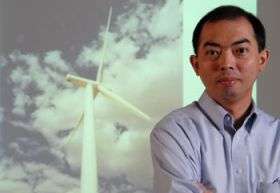
Dr. Surya Santoso stands in front of a photograph of a Siemens wind turbine at King Mountain Wind Ranch in McCamey, Texas. These towers can measure up to 68 meters in height, with blades as long as 30 meters, generating one to two megawatts (million watts) of power. Photo: Erin McCarley
As Texas' electric grid operator prepares to add power lines for carrying future wind-generated energy, an electrical engineer at The University of Texas at Austin is developing improved methods for determining the extent to which power from a wind farm can displace a conventional power plant, and how best to regulate varying wind power.
"The cost of wind energy has become competitive with that of energy from fossil fuels because of technology improvements," said Assistant Professor Surya Santoso. "Unfortunately, electric power generated from wind energy is intermittent and variable. That means we need to have better measurements of wind power plants' output as we integrate wind energy into existing power systems. We also need to develop a way of managing wind power so it can be more readily called upon when needed."
Texas has outstripped California since 2006 as the leading national producer of wind power, with most of the state's renewable energy goal by 2025 focused on wind power. To help meet this goal, the state's Electric Reliability Council of Texas is expected to add about 1,500 megawatts of new wind generation this year alone. In late September, Texas also awarded four offshore tracts along the Gulf Coast for wind power projects with a generating capacity of 1,150 megawatts.
Santoso is developing two strategies to manage and overcome the intermittent and variable behavior of wind power. With a two-year, $200,000 grant from the National Science Foundation, he and his students are developing computational methods to measure the actual capacity contribution of wind farms. This will allow system planners to calculate how much a wind farm can contribute to meeting expected power needs.
Santoso's lab is also using the funding to establish the technical requirements of energy storage systems that would serve as temporary "batteries" for releasing stored wind energy at optimal times.
"Having a proper energy storage system would allow you to harness free wind when it's available, but release that energy at the time of your choosing with a desired power profile," Santoso said. He noted that a wind energy storage system would also increase wind farms' overall capacity contribution and reduce the likelihood of overloading transmission power lines that must carry energy from different power sources.
Source: University of Texas at Austin
-
Screening Africa's renewable energies potential
Feb 08, 2012 |
not rated yet |
1
-
When worlds collide: Researchers harness supercomputers to understand solar storm, magnetosphere
Feb 07, 2012 |
3 / 5 (1) |
6
-
U.S. to lease waters off Mid-Atlantic for wind farms
Feb 07, 2012 |
1 / 5 (1) |
1
-
California hits wind energy milestone: About 5 percent of power from wind
Feb 07, 2012 |
5 / 5 (4) |
33
-
Progress and promise in DIAL LIDAR
Feb 06, 2012 |
5 / 5 (4) |
0
-
Engineers build first sub-10-nm carbon nanotube transistor
Feb 01, 2012 |
4.9 / 5 (33) |
30
-
Something old, something new: Evolution and the structural divergence of duplicate genes
Jan 31, 2012 |
4.6 / 5 (7) |
1
-
The hidden nanoworld of ice crystals: Revealing the dynamic behavior of quasi-liquid layers
Jan 30, 2012 |
5 / 5 (4) |
1
-
Stock market network reveals investor clustering
Jan 27, 2012 |
3.9 / 5 (23) |
8
-
Of microchemistry and molecules: Electronic microfluidic device synthesizes biocompatible probes
Jan 26, 2012 |
5 / 5 (2) |
0
-
How to tilt a object
5 hours ago
-
How to calculate total compressibility in liquid porous solid system
11 hours ago
-
Need help reading 3-D
Feb 11, 2012
-
A way to send and receive wireless data
Feb 11, 2012
-
Calling function with no input argument
Feb 10, 2012
-
Force free body diagram problem on gym equipment
Feb 10, 2012
- More from Physics Forums - General Engineering
More news stories
Google might launch Drive for cloud storage soon
(PhysOrg.com) -- Google's next big move, according to the Wall Street Journal, is a cloud storage service called Drive. Hardly first to the plate, Google is simply catching up to introducing its cloud reposi ...
Iran blocks email, restricts net access: reports
Iran has further restricted access to the Internet and blocked popular email services for the past few days, in a move a top lawmaker said could "cost the regime dearly," media reports said on Sunday.
12 hours ago |
5 / 5 (2) |
5
Walney offshore wind farm is world's biggest (for now)
(PhysOrg.com) -- The Walney wind farm on the Irish Sea--characterized by high tides, waves and windy weather--officially opened this week. The farm is treated in the press as a very big deal as the Walney ...
Navy to begin tests on electromagnetic railgun prototype launcher
The Office of Naval Research (ONR)'s Electromagnetic (EM) Railgun program will take an important step forward in the coming weeks when the first industry railgun prototype launcher is tested at a facility ...
Feb 06, 2012 |
4.6 / 5 (20) |
95
|
New power source discovered
(PhysOrg.com) -- Researchers at the Massachusetts Institute of Technology (MIT) and RMIT University have made a breakthrough in energy storage and power generation.
Technology / Energy & Green Tech
Feb 10, 2012 |
4.6 / 5 (52) |
51
|
Scientists discover molecular secrets of 2,000-year-old Chinese herbal remedy
For roughly two thousand years, Chinese herbalists have treated Malaria using a root extract, commonly known as Chang Shan, from a type of hydrangea that grows in Tibet and Nepal. More recent studies suggest that halofuginone, ...
New method to examine batteries -- MRI from the inside
There is an ever-increasing need for advanced batteries for portable electronics, such as phones, cameras, and music players, but also to power electric vehicles and to facilitate the distribution and storage of energy derived ...
A mitosis mystery solved: How chromosomes align perfectly in a dividing cell
Although the process of mitotic cell division has been studied intensely for more than 50 years, Whitehead Institute researchers have only now solved the mystery of how cells correctly align their chromosomes during symmetric ...
Lab study raises questions over nano-particle impact
Tests involving chickens have raised questions about the impact on health from engineered nano-particles, the ultra-fine grains commonly used in drugs and processed foods, scientists said on Sunday.
Starve a virus, feed a cure? Findings show how some cells protect themselves against HIV
A protein that protects some of our immune cells from the most common and virulent form of HIV works by starving the virus of the molecular building blocks that it needs to replicate, according to research published online ...
Researchers find extensive RNA editing in human transcriptome
In a new study published online in Nature Biotechnology, researchers from BGI, the world's largest genomics organization, reported the evidence of extensive RNA editing in a human cell line by analysis of RNA-seq data, demons ...