People identify fearful faces before happy ones

October 19, 2007

A new study proves that the brain becomes aware of fearful faces more quickly than faces showing other emotions: a capability that may have evolved to direct attention to potential threats.

You may not be fully dressed without a smile, but a look of horror will make a faster first impression. Vanderbilt University researchers have confirmed what previous research had hinted at: the brain becomes aware of fearful faces more quickly than those showing other emotions.

"There are reasons to believe that the brain has evolved mechanisms to detect things in the environment that signal threat. One of those signals is a look of fear," David Zald, associate professor of psychology and a co-author of the new study, says "We believe that the brain can detect certain cues even before we are aware of them, so that we can direct our attention to potentially threatening situations in our environment."
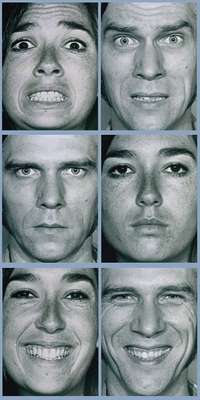
People identify fearful faces before happy ones

Examples of the fearful, neutral and happy faces used in the experiment. Paul Ekman Group (www.paulekman.com)

Randolph Blake, Centennial Professor of Psychology, and Eunice Yang, doctoral student, were co-authors of the study, which will appear in the November 2007 issue of Emotion.

The researchers set out to determine if we become aware of fearful, neutral or happy expressions at the same speed, or if one of these expressions reaches our awareness faster than the others. To do this, they needed to find a way to slow down the speed at which subjects processed facial information — which usually takes less than 40 milliseconds. At those high speeds it is difficult to tell which images rise to awareness the fastest.

Yang, the lead author of the study, realized that a technique being used in Blake's lab might provide a solution to the problem. The technique, continuous flash suppression, keeps people from becoming aware of what they are seeing for up to 10 seconds. Using this technique, the team had research subjects look at a screen through a viewer, similar to the eyepieces on a microscope, which allowed different images to be presented to each eye.

Many images were rapidly presented to one eye while a static image of a face was presented to the other. The multiple images served as visual "noise," suppressing the image of the face. The subjects indicated when they first became aware of seeing a face, enabling the researchers to determine if the expression on the face had any impact on how quickly the subject became aware of it.

The team found that subjects became aware of faces that had fearful expressions before neutral or happy faces. The researchers believe that a brain area called the amygdala, an area of the brain outside of the regions in the cortex that process visual information, may be responsible.

"The amygdala registers information about an image even before cortical areas involved in vision have finished their job. We think the amygdala has some crude ability to process stimuli and that it can cue some other visual areas to what they need to focus on," Blake says.

Zald and his colleagues believe the eyes of the fearful face play a key role.

"Fearful eyes are a particular shape, where you get more of the whites of the eye showing," Zald says. "That may be the sort of simple feature that the amygdala can pick up on, because it's only getting a fairly crude representation. That fearful eye may be something that's relatively hardwired in there."

A surprising finding was that subjects perceived happy faces the slowest. "What we believe is happening is that the happy faces signal safety. If something is safe, you don't have to pay attention to it," Zald says.

Next, the researchers will explore how this information influences our behavior. "We are interested in now exploring what this means for behavior," Yang says. "Since these expressions are being processed without our awareness, do they affect our behavior and our decision making? If so, how?"

The research was supported by funding from the National Institutes of Health. Blake and Zald are Vanderbilt Kennedy Center for Research on Human Development investigators.

Source: Vanderbilt University

4.6 /5 (7 votes)  

Rank 4.6 /5 (7 votes)
Tags

Relevant PhysicsForums posts
  • Is Everyday Technology Killing Us?
    createdFeb 08, 2012
  • Exercise and weight loss
    createdFeb 08, 2012
  • Why do we have head aches? Our brains can't feel anything.
    createdFeb 07, 2012
  • "The end of diseases" by David Agus, interview from Daily Show with Jon Stewart
    createdFeb 04, 2012
  • Oncolytic adenovirus
    createdFeb 04, 2012
  • Nutrition label stuffs and diets
    createdFeb 02, 2012
  • More from Physics Forums - Medical Sciences

More news stories

Discovery paves way for salmonella vaccine

(Medical Xpress) -- An international research team led by a University of California, Davis, immunologist has taken an important step toward an effective vaccine against salmonella, a group of increasingly antibiotic-resistant ...

Medicine & Health / Research

created 42 minutes ago | popularity 5 / 5 (2) | comments 0 | with audio podcast

First-of-its-kind stem cell study re-grows healthy heart muscle in heart attack patients

Results from a Cedars-Sinai Heart Institute clinical trial show that treating heart attack patients with an infusion of their own heart-derived cells helps damaged hearts re-grow healthy muscle.

Medicine & Health / Cardiology

created 48 minutes ago | popularity 5 / 5 (1) | comments 2 | with audio podcast

Ovarian cancer arises in fallopian tube of knockout mice

(Medical Xpress) -- The most deadly form of "ovarian" cancer arises in the fallopian tubes – not the ovaries – of knockout mice that lack two genes associated with the disease, said researchers led by Baylor College ...

Medicine & Health / Cancer

created 43 minutes ago | popularity not rated yet | comments 0 | with audio podcast

Smoking bans lead to less, not more, smoking at home: study

Smoking bans in public/workplaces don't drive smokers to light up more at home, suggests a study of four European countries with smoke free legislation, published online in Tobacco Control.

Medicine & Health / Health

created 48 minutes ago | popularity not rated yet | comments 0

UK cases of progressive sight loss condition set to rise a third by 2020

New cases of the progressive sight loss condition, known as age-related macular degeneration, or AMD for short, are set to rise by a third in the UK over the next decade, reveals research published online in the British Jo ...

Medicine & Health / Diseases

created 47 minutes ago | popularity not rated yet | comments 0


Time of year important in projections of climate change effects on ecosystems

(PhysOrg.com) -- Does it matter whether long periods of hot weather, such as last year's heat wave that gripped the U.S. Midwest, happen in June or July, August or September?

Medical school link to wide variations in pass rate for specialist exam

Wide variations in doctors' pass rates, for a professional exam that is essential for one type of specialty training, seem to be linked to the particular medical school where the student graduated, indicates research published ...

Scientists discover reason for Mt. Hood's non-explosive nature

(PhysOrg.com) -- For a half-million years, Mount Hood has towered over the landscape, but unlike some of its cousins in Oregon’s Cascade Mountains and many other volcanoes around the Pacific “Rim ...

Missing dark matter located: Intergalactic space is filled with dark matter

Researchers at the University of Tokyo’s Institute for the Physics and Mathematics of the Universe (IPMU) and Nagoya University used large-scale computer simulations and recent observational data of gravitational ...

Plants use circadian rhythms to prepare for battle with insects

In a study of the molecular underpinnings of plants' pest resistance, Rice University biologists have shown that plants both anticipate daytime raids by hungry insects and make sophisticated preparations to ...

Sensing self and non-self: New research into immune tolerance

At the most basic level, the immune system must distinguish self from non-self, that is, it must discriminate between the molecular signatures of invading pathogens (non-self antigens) and cellular constituents that usually ...