October 22, 2007 feature
Plants live, die according to their size
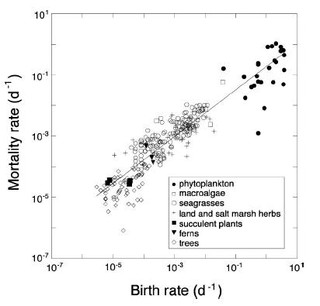
Plants self-regulate their populations to maintain stability and optimize their lives, with the lengths of their lives directly related to their mass, a recent study has found. Further, a single scaling power for lifespan holds true across the entire spectrum of plants, from single-celled phototrophs to giant redwoods.
Scientists have long known that animals’ lifespans are closely scaled to the species’ body size, with elephants living longer than mice. But while plant biologists have predicted such a connection in plants, a full study has never been performed until now.
Researchers Núria Marbà, Carlos Duarte and Susana Agustí at the Mediterranan Institute for Advanced Studies—a joint institute between the CSIC (Spanish Council for Scientific Research) and the University of the Balearic Islands in Esporles, Spain—have recently examined more than 1,000 reports of plant birth and mortality rates across a wide spectrum of species, discovering that the connection holds with extreme precision.
The researchers found that both population mortality rates and population birth rates of all plant species scale as the –¼ power of plant mass. In other words, the smaller a plant, the higher its mortality and birth rates, meaning the shorter its lifespan. Hence, plant lifespan scales as almost exactly the ¼ power of plant mass.
“The functioning of biological systems depends to a large extent on their metabolism, i.e., on how they process energy and materials, such as light, water, and nutrients,” Marbà explained to PhysOrg.com. “Small plants require fewer resources per unit of time than large ones, and, therefore, they are able to turn over the individuals of their populations faster than large plants. As plant size increases, more resources and time are needed to produce a fully grown individual, and thus their lifespan increases, resulting in small plants having shorter life spans than larger ones.”
An interesting aspect of these relationships is that mortality and birth rates are nearly identical within a species, keeping the population extremely stable. Nature has additional reasons for this perfect balance, too, which include stabilizing carbon cycling, optimizing plant life histories, and stabilizing the ecosystems the plants inhabit. The scientists suggest that, to achieve this balance, plant mortality rates have evolved to match the birth rates.
The group also investigated whether temperature entered the equation. According to the metabolic theory of ecology, metabolic rates (which determine lifespan) should be temperature-dependent. However, the researchers found that, unlike animals, plants’ mortality and birth rates are independent of temperature, or at least within the variation of their data. This finding contrasts with previous evidence that mortality rates of phytoplankton, macroalgae, and land plants increase with increasing temperature when the response of single species to temperature is examined. The researchers explain that resolving this issue could have a fundamental impact on predictions of global warming.
“Plant metabolism increases with increasing temperature, and, thus, plant life span and birth and mortality rates are expected to increase with temperature as well,” explained Marbà. “Hence, global warming may have consequences for the stability of plant populations. If temperature increases mortality and birth rates equally, plant populations will turn over faster but they would remain stable. Otherwise, plant populations will decline. In any case, a faster plant turnover, coupled with higher metabolic rates of decomposing microorganims with warming, may lead to a reduction in the CO2 sink capacity of vegetation.”
Despite the delicate balance between mortality and birth rates, the actual mechanisms governing plant life and death are still unclear to biologists. Most certainly, controls include an assortment of metabolic processes interacting at all levels, from molecular to organismal, and include respiration, reproduction, cellular damage, and structural imbalances. Because plants, unlike animals, retain their reproductive capacity throughout their lives, evolution might put greater selective pressure on plants’ lifespans. The researchers plan to continue investigating how these processes combine to influence plant life histories.
Citation: Marbà, Núria, Duarte, Carlos M., and Agustí, Susana. “Allometric scaling of plant life history.” Proceedings of the National Academy of Sciences, October 2, 2007, vol. 104, no. 40, 15777-15780.
Copyright 2007 PhysOrg.com.
All rights reserved. This material may not be published, broadcast, rewritten or redistributed in whole or part without the express written permission of PhysOrg.com.


