Caltech Electronic Nose Innovation

October 22, 2007 by Mary Anne Simpson Cal Tech Electronic Nose Innovation

Enlarge

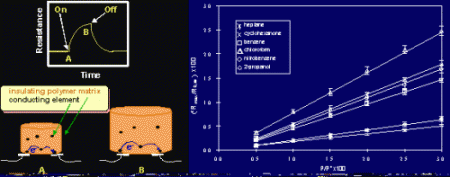
Smelling occurs as an odorant partitions into the polymer. Credit: Cal Tech Graph

Research Scientists at Caltech Developing Electronic Nose. The Chemistry and Chemical Engineering Division at Caltech are combining efforts with NASA and other engineers at Caltech to test ranges of applications.

The Lewis Group a division of Chemistry and Chemical Engineering at Caltech have a working model of an electronic nose. The efforts of Cal Tech scientists has led to an array of simple, readily fabricated chemically sensitive conducted polymer film.

An array of broadly-cross reactive sensors respond to a variety of odors. However, the pattern of differential responses across the array produces a unique pattern for each odorant. The electronic nose can identify, classify and quantify when necessary the vapor or odor that poses a concern or threat.

The electronic nose responds much like the mammalian olfactory sense produces diagnostic patterns and then transmits the information to the brain for processing and analysis. The range of uses for the electronic nose in a commercial setting is phenomenal. The electronic nose could provide a remote sensing device for oil and gas exploration, generators, electrical generators and any type of manufacturing setting where an odor or vapor may be the first signal of a malfunction.

The Caltech Nose has shown the ability to function well in normal room temperatures and varied setting. It can detect an odor and then by robotics turn its attention to the odor or vapor it identifies as a concern.

The research with the Caltech Nose is continuing and currently is combining efforts with NASA and other engineering groups who specialize in VLSI and integrated chip design. A series of queries are being tested by the Caltech Nose team. One inquiry is can one assign a numeric factor for the human judgment of smell. Other inquiries involve calibration and sophisticated application of the innovation.


print this article email this article download pdf blog this article bookmark this article     Stumble it Digg this share on Facebook retweet share on Reddit add to delicious
Rate this story - 4.3 /5 (24 votes)

Rank Filter

Move the slider to adjust rank threshold, so that you can hide some of the comments.


Display comments: newest first

  • jimw - Oct 23, 2007
    • Rank: not rated yet
    Looks like a hyphen did a little jumping around. Surely that was "an array of broadly cross-reactive sensors"?


October 22, 2007 all stories

Comments: 1

4.3 /5 (24 votes)
  • Stumble this up

  • Digg this

  • share this

  • hide
  • Related Stories

  • The 'e-Nose': Scientists try to develop an electronic sniffer
    created Nov 02, 2009 | popularity not rated yet | comments 0
  • FBI delves into DMV photos in search for fugitives
    created Oct 13, 2009 | popularity not rated yet | comments 0
  • Electronic nose sniffs out toxins
    created Sep 13, 2009 | popularity not rated yet | comments 0
  • Electronic Nose to Return from Space Station (w/ Video)
    created Sep 11, 2009 | popularity not rated yet | comments 0
  • iCub, the Toddler Robot (w/ Videos, Pictures)
    created Sep 09, 2009 | popularity not rated yet | comments 0


Other News

Sandia CR5

Machine Converts CO2 into Gasoline, Diesel, and Jet Fuel

Chemistry / Biochemistry

created 8 hours ago | popularity 4.3 / 5 (9) | comments 8

(PhysOrg.com) -- Researchers at Sandia National Laboratories have built a machine that uses the sun's energy to convert carbon dioxide waste from power plants into transportation fuels such as gasoline, diesel, ...


Rescuing male turkey chicks

Chemistry / Biochemistry

created 4 hours ago | popularity not rated yet | comments 0

A novel approach to classify the gender of six-week-old turkey poults could save millions of male chicks from being killed shortly after birth, according to Dr. Gerald Steiner from the Dresden University of Technology in ...


New hydrogen-storage method discovered

New hydrogen-storage method discovered

Chemistry / Materials Science

created Nov 22, 2009 | popularity 4.4 / 5 (37) | comments 11

Scientists at the Carnegie Institution have found for the first time that high pressure can be used to make a unique hydrogen-storage material. The discovery paves the way for an entirely new way to approach ...


Accidental discovery produces durable new blue pigment for multiple applications

Accidental discovery produces durable new blue pigment for multiple applications

Chemistry / Biochemistry

created Nov 16, 2009 | popularity 4.5 / 5 (32) | comments 6

An accidental discovery in a laboratory at Oregon State University has apparently solved a quest that over thousands of years has absorbed the energies of ancient Egyptians, the Han dynasty in China, Mayan ...


One word: bioplastics

One word: bioplastics

Chemistry / Materials Science

created Nov 17, 2009 | popularity 4.6 / 5 (13) | comments 4

(PhysOrg.com) -- Every year, more than 250 billion pounds of plastic are produced worldwide. Much of it ends up in the world's oceans, a fact that troubles MIT biology professor Anthony Sinskey.