Tiny capers pack big disease-fighting punch
October 22, 2007 Capers

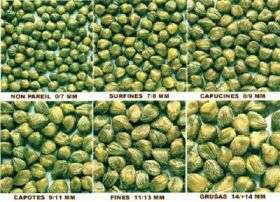
Tiny capers, shown in different sizes, are rich in disease-fighting antioxidants. Credit: Courtesy of Victoria Packing Corp.

Capers, used in such culinary delights as chicken piccata and smoked salmon, may be small. But they are an unexpectedly big source of natural antioxidants that show promise for fighting cancer and heart disease when added to meals, particularly meats, researchers in Italy are reporting in the current (Oct. 17) issue of ACS' Journal of Agricultural and Food Chemistry.

The flower buds of a small bush, capers have been used for centuries in Mediterranean cuisine, where they provide a salty tang and decorative flair to a variety of meats, salads, pastas and other foods.

In the new study, Maria A. Livrea and colleagues note that other foods in the so-called Mediterranean diet have gotten plenty of attention for their health benefits. Capers, however, have been largely overlooked.

Their laboratory study involved adding caper extracts to grilled ground-turkey, and analyzing byproducts formed during simulated digestion. The scientists found that caper-extract helped prevent the formation of certain byproducts of digested meat that have been linked by others to an increased risk of cancer and heart disease.

That beneficial effect occurred even with the small amounts of caper typically used to flavor food. "Caper may have beneficial health effects, especially for people whose meals are rich in fats and red meats," the study concluded.

Source: ACS


print this article email this article download pdf blog this article bookmark this article     Stumble it Digg this share on Facebook retweet share on Reddit add to delicious
Rate this story - 4.1 /5 (10 votes)

Rank Filter

Move the slider to adjust rank threshold, so that you can hide some of the comments.


Display comments: newest first

  • Elenneth - Oct 22, 2007
    • Rank: not rated yet
    Antioxidants. Red wine, green tea, tomatos, etc. Who knows how many other seemingly unimportant substances may hold the next big breakthrough in heart healthy, cancer-preventative eating?

October 22, 2007 all stories

Comments: 1

4.1 /5 (10 votes)
  • Stumble this up

  • Digg this

  • share this

  • hide
  • Related Stories

  • Museum experts ID birds that bring down planes
    created Jun 14, 2009 | popularity not rated yet | comments 0
  • Out-of-this-world cuisine
    created Dec 01, 2006 | popularity not rated yet | comments 0


Other News

Tracing the traces: Nanogram concentrations of a toxic compound detected in chlorinated tap water

Chemistry / Analytical Chemistry

created Dec 23, 2009 | popularity 5 / 5 (4) | comments 6

(PhysOrg.com) -- Drinking water can transmit a number of diseases, including typhoid, dysentery, cholera, and diarrhea, which can then spread explosively throughout an entire service area. To avoid this problem, drinking ...


Frederic Scheer, head of the plastics manufacturer Cereplast

Potatoes, algae replace oil in US company's plastics

Chemistry / Materials Science

created Dec 21, 2009 | popularity 3.9 / 5 (18) | comments 6

Frederic Scheer is biding his time, convinced that by 2013 the price of oil will be so high that his bio-plastics, made from vegetables and plants, will be highly marketable.


Method makes refineries more efficient

Chemistry / Other

created Dec 22, 2009 | popularity 4.5 / 5 (6) | comments 0

(PhysOrg.com) -- Refineries could trim millions of dollars in energy costs annually by using a new method developed at Purdue University to rearrange the distillation sequence needed to separate crude petroleum into products.


Molecular freight: Synthetic nanoscale transport system modeled on nature

Chemistry / Biochemistry

created Dec 21, 2009 | popularity 4.4 / 5 (5) | comments 0

(PhysOrg.com) -- Just like our roads, there is a lot of traffic within the cells in our bodies, because cell components, messenger molecules, and enzymes must also be brought to the right places in the cell. One of these ...


Chemical energy influences tiny vibrations of red blood cell membranes

Chemical energy influences tiny vibrations of red blood cell membranes

Chemistry / Biochemistry

created Dec 21, 2009 | popularity 4.8 / 5 (6) | comments 0

(PhysOrg.com) -- Much like a tightly wound drum, red blood cells are in perpetual vibration. Those vibrations help the cells maintain their characteristic flattened oval or disc shape, which is critical to ...