Sleep loss linked to psychiatric disorders
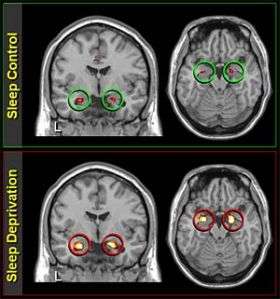
It has long been assumed that sleep deprivation can play havoc with our emotions. This is notably apparent in soldiers in combat zones, medical residents and even new parents. Now there's a neurological basis for this theory, according to new research from the University of California, Berkeley, and Harvard Medical School.
In the first neural investigation into what happens to the emotional brain without sleep, results from a brain imaging study suggest that while a good night's rest can regulate your mood and help you cope with the next day's emotional challenges, sleep deprivation does the opposite by excessively boosting the part of the brain most closely connected to depression, anxiety and other psychiatric disorders.
"It's almost as though, without sleep, the brain had reverted back to more primitive patterns of activity, in that it was unable to put emotional experiences into context and produce controlled, appropriate responses," said Matthew Walker, director of UC Berkeley's Sleep and Neuroimaging Laboratory and senior author of the study, which will be published today (Monday, Oct. 22) in the journal Current Biology.
"Emotionally, you're not on a level playing field, "Walker added.
That's because the amygdala, the region of the brain that alerts the body to protect itself in times of danger, goes into overdrive on no sleep, according to the study. This consequently shuts down the prefrontal cortex, which commands logical reasoning, and thus prevents the release of chemicals needed to calm down the fight-or-flight reflex.
If, for example, the amygdala reacts strongly to a violent movie, the prefrontal cortex lets the brain know that the scene is make-believe and to settle down. But instead of connecting to the prefrontal cortex, the brain on no sleep connects to the locus coeruleus, the oldest part of the brain which releases noradrenalin to ward off imminent threats to survival, posing a volatile mix, according to the study.
The study's findings lay the groundwork for further investigation into the relationship between sleep and psychiatric illnesses. Clinical evidence has shown that some form of sleep disruption is present in almost all psychiatric disorders.
"This is the first set of experiments that demonstrate that even healthy people's brains mimic certain pathological psychiatric patterns when deprived of sleep, "Walker said."Before, it was difficult to separate out the effect of sleep versus the disease itself. Now we're closer to being able to look into whether the person has a psychiatric disease or a sleep disorder."
Using functioning Magnetic Resonance Imaging (fMRI), Walker and his team found that the amygdala, which is also a key to processing emotions, became hyperactive in response to negative visual stimuli - mutilated bodies, children with tumors and other gory images - in study participants who stayed awake for 35 hours straight. Conversely, brain scans of those who got a full night's sleep in their own beds showed normal activity in the amygdala.
"The emotional centers of the brain were over 60 percent more reactive under conditions of sleep deprivation than in subjects who had obtained a normal night of sleep," Walker said.
The team studied 26 healthy participants aged 18 to 30, breaking them into two groups of equal numbers of males and females. The sleep-deprived group stayed awake during day 1, night 1 and day 2, while the sleep-control group stayed awake both days and slept normally during the night. During the fMRI brain scanning, which was performed at the end of day 2, each was shown 100 images that ranged from neutral to very negative. Using this emotional gradient, the researchers were able to compare the increase in brain response to the increasingly negative pictures.
Since 1998, Walker, an assistant professor of psychology at UC Berkeley and a former sleep researcher at Harvard Medical School, has been studying sleep's impact on memory, learning and brain plasticity.
During his research, he was struck with the consistency of how graduate students in his studies would turn from affable, rational beings into what he called "emotional JELL-O" after a night without sleep. He and his assistants searched for research that would explain the effect of sleep deprivation on the emotional brain and found none, although there is countless anecdotal evidence that lack of sleep causes emotional swings.
"You can see it in the reaction of a military combatant soldier dealing with a civilian, a tired mother to a meddlesome toddler, the medical resident to a pushy patient. It's these everyday scenarios that tell us people don't get enough sleep." Walker said.
The body alternates between two different phases of sleep during the night: Rapid Eye Movement (REM), when body and brain activity promote dreams, and Non-Rapid Eye Movement (NREM), when the muscles and brain rest.
"All signs point to sleep doing something for emotional regulation and emotional processing," Walker said. "My job now is to figure out what kind of sleep."
Source: UC Berkeley


