Critically endangered Amur leopard captured
October 23, 2007 Critically endangered Amur leopard captured

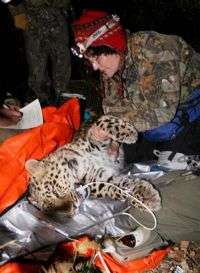
Conservationist examing a recently captured Amur leopard in Russia. Credit: Wildlife Conservation Society

A rare Amur leopard (Panthera pardus orientalis), one of only an estimated 30 left in the wild has been captured and health-checked by experts from a consortium of conservation organizations, before being released.

Representatives from a group of organizations, including the Russian Academy of Sciences Institute of Biology and Soils, the Wildlife Conservation Society (WCS) and the Zoological Society of London (ZSL) captured the female in a remote location in south-west Primorye as part of their work to save the critically endangered leopard. The animal was tranquilized and an extensive and high-tech medical examination undertaken by the veterinary team.

Alexei Kostyria, biologist from the Institute of Biology and Soils in Vladivostok and co-leader of the project, commented, “This capture represents a new benchmark in assessing health of wild animals in Russia. We have brought together top experts from Russia and around the world and taken state-of-the-art equipment deep into the taiga to conduct medical assessments of the Far Eastern leopard. We have an unprecedented level of collaboration and remarkable effort that is essential if we are to save this critically endangered leopard.”

Kostyria’s counterpart, John Goodrich of the Wildlife Conservation Society, commented, “Catching this female was a big step forward in our efforts to understand the status of this population, and to better define necessary conservation actions needed to conserve this population.”

There are estimated to be between 24 and 32 Amur leopards living in the wild, making this population the rarest big cat on the planet. The animals are found in a corner of the Russian Far East on the Chinese border, in an area where their range is restricted by human activity. As the wild population is so small, it is likely that inbreeding (breeding between close relatives) is taking place and it is important to find out if this is having damaging effects on the cats in order to plan conservation action for the future. The Wildlife Conservation Society and the Zoological Society of London are working with local organizations to initiate a wildlife health monitoring program involving leopards and other wildlife in the region.

Initial findings from the veterinary examination of the leopard include the presence of a heart murmur, which could be indicative of inbreeding depression. Remarkably given the remote location, the team was able to capture footage of the heart, using a portable sonogram device, which has already been sent out for review by heart specialists. Further results are expected once laboratory analysis has been carried out, which will provide more information about the reproductive condition of the leopard as well as any illnesses or parasites that she may have been suffering from.

Source: Wildlife Conservation Society


print this article email this article download pdf blog this article bookmark this article     Stumble it Digg this share on Facebook retweet share on Reddit add to delicious
Rate this story - not rated yet


October 23, 2007 all stories

Comments: 0

not rated yet
  • Stumble this up

  • Digg this

  • share this

  • hide
  • Related Stories

  • No place like home: Africa's big cats show postcode preference
    created Oct 09, 2009 | popularity not rated yet | comments 0
  • Are tigers 'brainier' than lions?
    created Sep 03, 2009 | popularity not rated yet | comments 0
  • Where science feeds action, leopards win
    created Aug 11, 2009 | popularity not rated yet | comments 0
  • Bangladesh leopard renews hopes for species survival
    created Jul 23, 2009 | popularity not rated yet | comments 0
  • Afghanistan releases its first-ever list of protected species
    created Jun 04, 2009 | popularity not rated yet | comments 0


Other News

Iowa State University researcher discovers key to vital DNA, protein interaction

Researchers discover key to vital DNA, protein interaction

Biology / Other

created 4 hours ago | popularity not rated yet | comments 0

(PhysOrg.com) -- A researcher at Iowa State University has discovered how a group of proteins from plant pathogenic bacteria interact with DNA in the plant cell, opening up the possibility for what the scientist ...


Scientists successfully reprogram blood cells

Biology / Cell & Microbiology

created 9 hours ago | popularity 5 / 5 (2) | comments 0

Researchers have transplanted genetically modified hematopoietic stem cells into mice so that their developing red blood cells produce a critical lysosomal enzyme -preventing or reducing organ and central nervous system damage ...


UK starts study on using human DNA in animals

Biology / Biotechnology

created 5 hours ago | popularity not rated yet | comments 0

(AP) -- British scientists begin a new study on Tuesday to consider how human DNA is used in animal experiments and to determine what the boundaries of such controversial science might be.


Study shows that some malignant tumors can be shut down after all

Biology / Cell & Microbiology

created 12 hours ago | popularity 5 / 5 (3) | comments 1

Oncologists have had their hands tied because more than half of all human cancers have mutations that disable a protein called p53. As a critical anti-cancer watchdog, p53 masterminds several cancer-fighting operations within ...


The bizarre lives of bone-eating worms

Biology / Plants & Animals

created 4 hours ago | popularity 4 / 5 (1) | comments 0

The females of the recently discovered Osedax marine worms feast on submerged bones via a complex relationship with symbiotic bacteria, and they are turning out to be far more diverse and widespread than scientists expected. ...