October 23, 2007 feature
Researchers Uncover Physics of Coiling Ropes
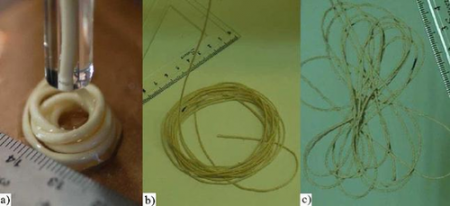
When a mountain climber drops a rope, it often forms a series of coils on the ground. Not only thick ropes, but also sewing thread and even cooked spaghetti behave in a similar way. Recently, scientists have carried out the first controlled laboratory experiments on the peculiar phenomenon of coiling ropes, revealing the surprising dynamics behind it.
Researchers Mehdi Habibi, Neil Ribe, and Daniel Bonn, together representing the Institute for Advanced Studies in Basic Sciences in Iran, the École Normale Supérieure and the Institut de Physique du Globe in Paris, and the University of Amsterdam, have published their results on the coiling of elastic ropes in a recent issue of Physical Review Letters.
“With the results of this work, we -- finally -- are able to understand such a widespread phenomenon as rope coiling,” Bonn told PhysOrg.com. “Understanding coiling is important, for instance, in the food industry, where one needs to fill jars with visco-elastic materials such as yogurt or mayonnaise. Coiling has also been used to make pottery.”
The scientists used two experimental setups to investigate the different conditions under which coiling occurs. In the first setup, they wound sewing thread onto a wheel, which was rotated by an electric motor to feed the thread down through a hole at a fixed rate (with tests from 0.3 – 200 cm/sec-1) onto a flat surface 2 – 200 cm below. In the second setup, they softened long pieces of spaghetti in water, and used a syringe or a rod to eject the noodles downward from a vertical glass tube.
By comparing their laboratory measurements with the predictions of a numerical model, the group developed a phase diagram showing the different styles of coiling that occur depending on the fall height and velocity. Depending on these variables, there are three basic regimes where coiling can occur.
“For the lowest fall heights and velocities, the coil frequency and radius are dictated by the geometry: the coiling frequency, for instance follows simply from the fall height and rope velocity,” Bonn explained. “For intermediate heights and velocities, there is a balance between the gravity force and the rope's elasticity that uniquely determines the frequency and radius of coiling. For very high velocities and heights, it's mainly the inertia of the rope that dictates its behavior, but the elasticity of the rope remains important: this is the inertial regime.”
Habibi, Ribe and Bonn found that the inertial regime in particular is surprisingly complex. First, they observed that a thin thread fed at very high velocities becomes unstable to form a “figure of eight” pattern that persists for the length of the thread.
Second, they found that coiling in the inertial regime can occur with different frequencies for a given feed rate and fall height. The different frequencies correspond to resonant oscillations of the nearly vertical upper part of the rope, which can vibrate either as a weak “string” or as a stiff “shaft” depending on the feed rate and the fall height. These oscillations are excited when their natural frequencies happen to match the basic “inertial regime” frequency dictated by the coiled part of the rope just above the ground.
The scientists noted that other examples of coiling “elastic rods” include phenomena such as the kinking of telephone cables on the ocean floor, the coiled tendrils of climbing plants exhibiting handedness reversal, and the supercoiling of DNA strands. The coiling of liquid ropes, such as a thread of honey falling onto toast, has also received recent attention, and shares some similarities with the coiling of elastic ropes.
Citation: Habibi, M., Ribe, N. M., and Bonn, Daniel. “Coiling of Elastic Ropes.” Physical Review Letters 99, 154302 (2007).
Copyright 2007 PhysOrg.com.
All rights reserved. This material may not be published, broadcast, rewritten or redistributed in whole or part without the express written permission of PhysOrg.com.


