Scientists Create Quantum Cascade Laser Nanoantenna
October 23rd, 2007 Scientists Create Quantum Cascade Laser Nanoantenna

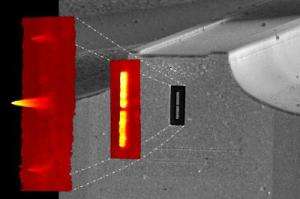
The device consists of an optical antenna fabricated on the facet of a quantum cascade laser emitting infrared light with a wavelength of 7 microns. The Harvard team used nanofabrication techniques to form the optical antenna, which consists of two gold rectangles, each 1.2 microns long, separated by a narrow gap (100 nm). Light from the laser illuminates the antenna, resulting in an intense spot of light in the gap of size seventy times smaller than the wavelength. This is far smaller than what would be possible with the conventional approach of forming a spot of light by focusing with a lens. Due to the wave nature of light, such a spot would have a diameter of more than 7 microns. The figure is an electron microscope micrograph of the facet of the QC laser with the built-in nanoantenna. Shown are also an atomic force microscope topographic image of the antenna and an optical image obtained with a near field scanning optical microscope, showing the highly localized light spot in the antenna gap. Credit: Harvard University

In a major feat of nanotechnology engineering researchers from Harvard University have demonstrated a laser with a wide-range of potential applications in chemistry, biology and medicine. Called a quantum cascade (QC) laser nanoantenna, the device is capable of resolving the chemical composition of samples, such as the interior of a cell, with unprecedented detail.

Spearheaded by graduate students Nanfang Yu, Ertugrul Cubukcu, and Federico Capasso, Robert L. Wallace Professor of Applied Physics, all of Harvard's School of Engineering and Applied Sciences, the findings will be published as a cover feature of the October 22 issue of Applied Physics Letters. The researchers have also filed for U.S. patents covering this new class of photonic devices.

The laser's design consists of two gold rods separated by a nanometer gap (a device known as an optical antenna) built on the facet of a quantum cascade laser, which emits invisible light in the region of the spectrum where most molecules have their tell tale absorption fingerprints. The nanoantenna creates a light spot of nanometric size about fifty to hundred times smaller than the laser wavelength; the spot can be scanned across a specimen to provide chemical images of the surface with superior spatial resolution.

"There's currently a major push to develop powerful tabletop microscopes with spatial resolution much smaller than the wavelength that can provide images of materials, and in particular biological specimens, with chemical information on a nanometric scale," says Federico Capasso.

While infrared microscopes, based on the detection of molecular absorption fingerprints, are commercially available and widely used to map the chemical composition of materials, their spatial resolution is limited by the range of available light sources and optics to well above the wavelength. Likewise the so-called near field infrared microscopes, which rely on an ultra sharp metallic tip scanned across the sample surface at nanometric distances, can provide ultrahigh spatial resolution but applications are so far strongly limited by the use of bulky lasers with very limited tunability and wavelength coverage.

"By combining Quantum Cascade Lasers with optical antenna nanotechnology we have created for the first time an extremely compact device that will enable the realization of new ultrahigh spatial resolution microscopes for chemical imaging on a nanometric scale of a wide range of materials and biological specimens," says Capasso.

Quantum cascade (QC) lasers were invented and first demonstrated by Capasso and his group at Bell Labs in 1994. These compact millimeter length semiconductor lasers, which are now commercially available, are made by stacking nanometer thick layers of semiconductor materials on top of each other. By varying the thickness of the layers one can select the wavelength of the QC laser across essentially the entire infrared spectrum where molecules absorb, thus custom designing it for a specific application.

In addition by suitable design the wavelength of a particular QCL can be made widely tunable. The range of applications of QC laser based chemical sensors is very broad, including pollution monitoring, chemical sensing, medical diagnostics such as breath analysis, and homeland security.

Source: Harvard University


print this article email this article download pdf blog this article bookmark this article     Digg this Stumble it share on Facebook share on Reddit add to delicious save to Yahoo! bookmarks
4.8/5 after 54 votes

Rank Filter

Move the slider to adjust rank threshold, so that you can hide some of the comments.


Display comments: newest first

  • nilbud - Oct 25, 2007
    • Rank: 5 / 5 (1)
    A scale would be nice
  • NanoStuff - Oct 28, 2007
    • Rank: not rated yet
    Quantum, Laser and Nano all in one name, this thing must be good.
  • guytron - Oct 30, 2007
    • Rank: not rated yet
    Somebody needs to tell the folks over in the "optical tweezer" department about this. Stanford has some good work, they could surely use this for nanomanipulation of molecules.

October 23rd, 2007 all stories
Nanotechnology / Nanophysics

Comments: 3
Rank: 4.8/5 after 54 votes

  • Stumble this up

  • Digg this

  • Share it:
  • share on Facebook
  • share on MySpace
  • share on Slashdot
  • rss-newsfeed
  • share on Google
  • share on Reddit
  • add to delicious
  • save to Yahoo! bookmarks
  • share on Windows Live
  • Add to Mixx!
Rating: 4.8/5 after 54 votes


Tags


  • Physicists Demonstrate Quantum Memory with Matter Qubits
    Physicists Demonstrate Quantum Memory with Matter Qubits
    Physics / General Physics
    created Jul 03, 2009 | popularity 4.4 / 5 (16) | comments 1
  • 'Holey' Nanosheets for Wastewater Dye Removal
    Nanotechnology / Nanomaterials
    created Jul 01, 2009 | popularity 5 / 5 (5) | comments 1
  • Jellyfish Robot Swims Like its Biological Counterpart
    Jellyfish Robot Swims Like its Biological Counterpart
    Electronics / Robotics
    created Jun 26, 2009 | popularity 4.4 / 5 (8) | comments 1
  • Could Maxwell's Demon Exist in Nanoscale Systems?
    Could Maxwell's Demon Exist in Nanoscale Systems?
    Physics / General Physics
    created Jun 24, 2009 | popularity 4.4 / 5 (18) | comments 29
  • Living Safely with Robots, Beyond Asimov's Laws
    Living Safely with Robots, Beyond Asimov's Laws
    Electronics / Robotics
    created Jun 22, 2009 | popularity 4.6 / 5 (52) | comments 40
  • Other News

    A 'quantum of sol' -- how nanotechnology could hold the key to a solar-powered future

    A 'quantum of sol' -- how nanotechnology could hold the key to a solar-powered future

    Nanotechnology / Nanomaterials

    created Jun 30, 2009 | popularity 3.7 / 5 (12) | comments 16

    (PhysOrg.com) -- A new generation of 'nano-structured' millimetre-sized solar cells that could convert the sun's energy to electricity more than twice as efficiently as current technology, is the subject of ...


    Australian researchers are set to begin human trials of a tiny nano-cell that acts as a "Trojan horse" against cancer

    Hi-tech 'Trojan horse' can kill cancer cells: researchers

    Nanotechnology / Bio & Medicine

    created Jun 29, 2009 | popularity 4.6 / 5 (11) | comments 7

    Australian researchers are set to begin human trials of a tiny nano-cell that acts as a "Trojan horse" against cancer cells, a breakthrough they say may curb the need for debilitating chemotherapy.


    Harnessing Nanoparticles To Track Cancer Cell Changes

    Nanotechnology / Bio & Medicine

    created Jul 03, 2009 | popularity not rated yet | comments 1

    The more dots there are, the more accurate a picture you get when you connect them. Cancer researchers adopting that philosophy have developed a new imaging technology that could give scientists the ability to simultaneously ...


    'Holey' Nanosheets for Wastewater Dye Removal

    Nanotechnology / Nanomaterials

    created Jul 01, 2009 | popularity 5 / 5 (5) | comments 1

    (PhysOrg.com) -- Researchers have discovered that extremely thin sheets of nickel oxide with hexagonally shaped holes can absorb hazardous dyes from wastewater nearly as well as the best traditional methods, but are recyclable. ...


    Computer-Guided Nanoparticle Therapy Destroys Tumors

    Nanotechnology / Bio & Medicine

    created Jun 29, 2009 | popularity 5 / 5 (11) | comments 0

    Gold nanoshells are among the most promising new nanoscale therapeutics being developed to kill tumors, acting as antennas that turn light energy into heat that cooks cancer to death. Now, a multi-institutional research team ...