Balancing act protects vulnerable cells from cancer
When a cell loses some of its weapons to fight cancer, it can still look healthy and act normally — if not forever, at least for a while. In research published in the October 15 issue of Cancer Cell, Rockefeller University scientists show how cells lacking a key receptor in a tumor-suppressing pathway maintain a balance between cell growth and cell death, how they lose this balance and why this loss happens more frequently in some tissues than in others.
Scientists led by Elaine Fuchs at The Rockefeller University have found that conditionally knocking out a gene that encodes a receptor called TβRII in the tumor-suppressing pathway TGFβ, or transforming growth factor β, does not trigger tumor growth in the outermost layer of the skin, or epidermis, unless other cancer-causing genes are activated.
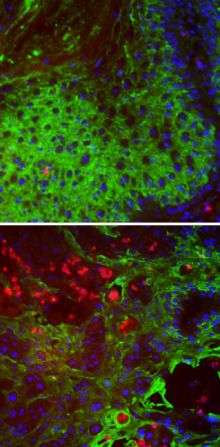
However, when this receptor is missing in regions where multilayered and simple epithelial cells meet, called transition zones, the mice remain healthy for a while and develop spontaneously with age one of the very few cancers that is increasing in prevalence: invasive squamous cell carcinoma.
Skin cells that lack TβRII begin to proliferate at a much faster rate, but the researchers found that higher levels of cell death cancel out this potentially tumor-forming process. These cells look and function the same as they do before the knockout, but are on overdrive, an observation that may explain why they move more and travel faster than other cells to heal wounded skin. But the researchers found that when mutations appear in a gene called Ras, this balance between cell growth and cell death breaks down in TβRII-deficient cells. While rapid proliferation persists, it is unopposed by elevated levels of cell death. “This results in the formation of tumors and in the rapid progression to aggressive cancer,” says first author Gйraldine Guasch, a research associate in Fuchs’s Laboratory of Mammalian Cell Biology and Development.
Other cells are not so lucky.
Even without these additional strikes against them, epithelial cells at transition zones, especially in the anogenital region, spontaneously develop invasive squamous cell carcinoma with age. At these junctures, cells continue to proliferate at the same rate but these cells do not die as fast as before, a finding the researchers confirmed by a significant decrease in caspases, “executioner” proteins that are involved in the cell-death program. When the researchers tested 80 male and 41 female squamous cell carcinoma samples in humans, 73 percent of the males and 76 percent of the females showed reduced or absent levels of TβRII, raising the possibility that these patients also have Ras mutations.
“These specialized regions may express genes that are not expressed in other areas,” says author Markus Schober, a research fellow in the Fuchs Laboratory. “At this point, we don’t know how that contributes to the formation of these tumors, but we suspect it has something to do with balance.”
Citation: Cancer Cell: October 16, 2007
Source: Rockefeller University


