Secret lives of two elements uncovered
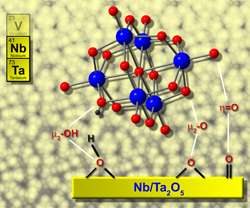
Unexpected differences recently discovered between the elements niobium and tantalum may lead to more optimized electronic materials and photocatalysts.
Sandia researcher May Nyman and colleagues reported on the new-found disparities in a cover story of the Oct. 28 Dalton Transactions, an international inorganic chemistry journal published by the Royal Society of Chemistry, the British equivalent of the American Chemical Society. The research paper also received the distinction of being picked among “the hottest science” by referees of that journal on its web page.
Tantalum oxides are used in medical implants, hypoallergenic surgical tools, and ceramics that hold nuclear waste because of their inertness in liquid media, says Nyman. They resist destruction by radioactivity and do not poison the body by deteriorating in its tissues, but are hard to work with because they precipitate out of solution in an uncontrolled and undesirable way.
Niobium is easier to work with, but less inert for reasons formerly not well understood.
“Tantalum and niobium are in the same column on the periodic table,” says Nyman. “Their electronic configurations are related and their ions are virtually identical in size. Generally, the prevailing belief has been that their characteristics are very similar. They are described that way in chemistry textbooks. But we found that tantalum oxides are considerably more inert and less soluble than niobium oxides, and we wanted to understand why.”
The unexpected difference, as well as a new “soft chemistry” method of forming compounds containing them, means that new materials with tailored properties may be formed more simply. The old method, called “the volcano method,” involved melting oxides together at very high temperatures. The “soft” method was published by Nyman and others this past summer and involves chemical finesse rather than brute force.
To explore differences between the two elements, Nyman’s group used the soluble Lindqvist “cluster” ions.
The ion is composed of tantalum and oxygen or niobium and oxygen, and contains only 25 atoms each. The predictable and repetitive structure of these collections of ions lends itself to study more than do tantalum or niobium oxide surfaces, which are formed of a disordered collection of oxygen and tantalum or niobium atoms. Therefore the ion was a possible model to study the surface — if they behaved the same way. ”Much to our surprise, the Lindqvist ions proved to be ideal models for both the structural features and the chemical reactivity of the tantalum and niobium oxide surfaces,” notes postdoc colleague and first author Travis Anderson.
“We did one of the few studies of both oxide surfaces and cluster ions where both behave the same way,” Nyman said, “and the study revealed unprecedented differences in the behavior of niobium and tantalum oxides.”
The difference was in the way that water exchanges with oxygen atoms in both the clusters and at the surfaces of these materials. In the tantalum materials it exchanges in a way that makes it unstable. Precipitating itself onto a surface is one way it stabilizes. In niobium materials, the reaction with water results in stable species that can stay in solution more easily.
Understanding how these oxides behave in aqueous media should lead to the production of new and better tantalum and niobium oxide materials.
Other authors on the paper include Sandia’s Mark A. Rodriguez and Todd Alam; Sandia summer student Joel Bixler from U.T. Austin; and Francois Bonhomme of the Ecole Centrale de Paris. The work was done in collaboration with Bill Casey, a professor at UC Davis.
Source: Sandia National Laboratory


