The sensitive side of carbon nanotubes: Creating powerful pressure sensors
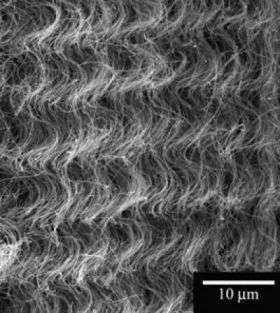
Blocks of carbon nanotubes can be used to create effective and powerful pressure sensors, according to a new study by researchers at Rensselaer Polytechnic Institute.
Taking advantage of the material’s unique electrical and mechanical properties, researchers repeatedly squeezed a 3-millimeter nanotube block and discovered it was highly suitable for potential applications as a pressure sensor. No matter how many times or how hard they squeezed the block, it exhibited a constant, linear relationship between how much force was applied and electrical resistance.
“Because of the linear relationship between load and stress, it can be a very good pressure sensor,” said Subbalakshmi Sreekala, a postdoctoral researcher at Rensselaer and author of the study.
A sensor incorporating the carbon nanotube block would be able to detect very slight weight changes and would be beneficial in any number of practical and industrial applications, Sreekala said. Two potential applications are a pressure gauge to check the air pressure of automobile tires, and a microelectromechanical pressure sensor that could be used in semiconductor manufacturing equipment.
Despite extensive research over the past decade into the mechanical properties of carbon nanotube structures, this study is the first to explore and document the material’s strain-resistance relationship. The paper, titled “Effects of compressive strains on electrical conductivities of a macroscale carbon nanotube block,” was published in a recent issue of Applied Physics Letters.
Over the course of the experiment, the researchers placed the carbon nanotube block in a vice-like machine and applied different levels of stress. They took note of the stress applied and measured the corresponding strain put on the nanotube block. As it was being squeezed, the researchers also sent an electrical charge through the block and measured its resistance, or how easily the charge moved from one end of the block to the other.
The research team discovered that the strain they applied to the block had a linear relationship with the block’s electrical resistance. The more they squeezed the block, the more its resistance decreased. On a graph, the relationship is represented by a neat, straight line. This means every time one exposes the block to a load of X, they can reliably expect the block’s resistance to decrease by Y.
This reliability and predictability of this relationship makes the carbon nanotube block an ideal material for creating a highly sensitive pressure sensor, Sreekala said.
The pressure sensor would function similarly to a typical weight scale. By placing an object with an unknown weight onto the carbon nanotube block, the block would be squeezed down and its electrical resistance would decrease. The sensor would then send an electrical charge through the nanotube block, and register the resistance. The exact weight of the object could then be easily calculated, thanks to the linear, unchanging relationship between the block’s strain and resistance.
A study published earlier this year (news.rpi.edu/update.do"artcenterkey=2217), written by Rensselaer senior research specialist Victor Pushparaj, who is also an author of the pressure sensor paper, showed that carbon nanotubes are able to withstand repeated stress yet retain their structural and mechanical integrity. Electrical resistance decreases as the block is squeezed, as the charged electrons have more pathways to move from one end of the block to the other.
In the new study, Sreekala and the research team found that the nanotube block’s linear strain-resistance relationship holds true until the block is squeezed to 65 percent of its original height. Beyond that, the block’s mechanical properties begin to fail and the linear relationship breaks down.
The team is currently thinking of ways to boost the nanotubes’ strength by mixing them with polymer composites, to make a new material with a longer-lived strain-resistance relationship.
“The challenge will be to choose the correct polymer so we don’t lose efficiency, but retain the same response in all directions,” Sreekala said.
Source: Rensselaer Polytechnic Institute


