Dwarf galaxies need dark matter too
October 24, 2007 Stars

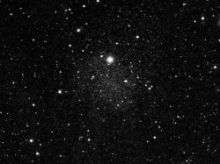
Stars in dwarf spheroidal galaxies behave in a way that suggests the galaxies are utterly dominated by dark matter, University of Michigan astronomers have found.

Astronomy professor Mario Mateo and post-doctoral researcher Matthew Walker measured the velocity of 6,804 stars in seven dwarf satellite galaxies of the Milky Way: Carina, Draco, Fornax, Leo I, Leo II, Sculptor and Sextans. They found that, contrary to what Newton's law of gravity predicts, stars in these galaxies do not move slower the farther they are from their galaxy's core.

"These galaxies show a problem right from the center," Mateo said. "The velocity doesn't get smaller. It just stays the same, which is eerie."

Astronomers already know stars in spiral galaxies behave in a similar way. This research dramatically increases the available information about smaller galaxies, making it possible to confirm that the distribution of light and stars in them is not the same as the distribution of mass.

"We have more than doubled the amount of data having to do with these galaxies, and that allows us to study them in an unprecedented manner. Our research shows that dwarf galaxies are utterly dominated by dark matter, so long as Newtonian gravity adequately describes these systems," Walker said. Walker received his doctorate from U-M earlier this year and currently has a post-doctoral position at the University of Cambridge in the United Kingdom.

Dark matter is a substance astronomers have not directly observed, but they deduce it exists because they detect its gravitational effects on visible matter. Based on these measurements, the prevailing theory in astronomy and cosmology is that the visible parts of the universe make up only a fraction of its total matter and energy.

The planet Neptune was once "dark matter," Mateo said. Before the term was even coined, astronomers predicted its existence based on an anomaly in the orbit of Neptune's neighbor Uranus. They knew just where to look for Neptune.

For the past quarter century, astronomers have been looking for the Neptune of the universe, so to speak. Dark matter could take the form of dwarf stars and planets, elementary particles including neutrinos, or hypothetical and as-yet undetected particles that don't interact with visible light or other parts of the electromagnetic spectrum.

Dark matter is believed to hold galaxies together. The gravitational force of the visible matter is not considered strong enough to prevent stars from escaping. Other theories exist to explain these discrepancies, though. For example, Modified Newtonian Dynamics, Mateo said, proposes that gravitational forces become stronger when accelerations are very weak. While their results align with current dark matter models, Mateo and Walker say they also bolster this less-popular explanation.

"These dwarf galaxies are not much to look at," Mateo continued, "but they may really alter our fundamental views on the nature of dark matter and, perhaps, even gravity."

Walker will present a paper on these findings on Oct. 30 at the Magellan Science Meeting in Cambridge, Mass. The paper he will present is Velocity Dispersion Profiles of Seven Dwarf Spheroidal Galaxies. It was published in the Sept. 20 edition of Astrophysical Journal Letters.

Source: University of Michigan


print this article email this article download pdf blog this article bookmark this article     Stumble it Digg this share on Facebook retweet share on Reddit add to delicious
Rate this story - 4.6 /5 (21 votes)


October 24, 2007 all stories

Comments: 0

4.6 /5 (21 votes)
  • Stumble this up

  • Digg this

  • share this

  • hide
  • Related Stories

  • Rapid supernova could be new class of exploding star
    created Nov 05, 2009 | popularity not rated yet | comments 0
  • Stars Fueled by Dark Matter Could Hold Secrets to the Universe
    created Nov 03, 2009 | popularity not rated yet | comments 0
  • Dark Matter in a Galaxy
    created Oct 30, 2009 | popularity not rated yet | comments 0
  • Dark matter sleuths to design world's largest WIMP catcher
    created Oct 29, 2009 | popularity not rated yet | comments 0
  • Scientists use world's fastest supercomputer to model origins of the unseen universe
    created Oct 26, 2009 | popularity not rated yet | comments 0


  • hide
  • Relevant PhysicsForums posts

  • The shape of our solar system's orbits.
    created Nov 07, 2009
  • Above or Below the Line of Nodes
    created Nov 07, 2009
  • Supernova vs. Nova?
    created Nov 07, 2009
  • Supernova's Gamma Rays and Comets
    created Nov 06, 2009
  • More from Physics Forums - General Astronomy

Other News

Antarctica glacier retreat creates new carbon dioxide store

Antarctica glacier retreat creates new carbon dioxide store

Space & Earth / Earth Sciences

created 55 minutes ago | popularity 5 / 5 (1) | comments 0

Large blooms of tiny marine plants called phytoplankton are flourishing in areas of open water left exposed by the recent and rapid melting of ice shelves and glaciers around the Antarctic Peninsula. This ...


Deep creep means milder, more frequent earthquakes along Southern California's San Jacinto fault

Deep creep means milder, more frequent earthquakes along Southern California's San Jacinto fault

Space & Earth / Earth Sciences

created 22 hours ago | popularity 4.5 / 5 (4) | comments 0

With an average of four mini-earthquakes per day, Southern California's San Jacinto fault constantly adjusts to make it a less likely candidate for a major earthquake than its quiet neighbor to the east, the ...


Success in 'space elevator' competition (AP)

Success in 'space elevator' competition (Update 3)

Space & Earth / Space Exploration

created Nov 05, 2009 | popularity 4.3 / 5 (33) | comments 51

(AP) -- A robot powered by a ground-based laser beam climbed a long cable dangling from a helicopter on Wednesday to qualify for prize money in a $2 million competition to test the potential reality of the ...


In a Galaxy Far, Far Away...

In a Galaxy Far, Far Away...

Space & Earth / Astronomy

created Nov 06, 2009 | popularity 4.8 / 5 (5) | comments 15

(PhysOrg.com) -- Astronomers have published the discovery of the farthest known object in the cosmos: a star that exploded when the universe was only 630 million years old -- only 4.6% of its current age. ...


'Dropouts' pinpoint earliest galaxies

'Dropouts' pinpoint earliest galaxies

Space & Earth / Astronomy

created Nov 06, 2009 | popularity 4.2 / 5 (10) | comments 13

Astronomers, conducting the broadest survey to date of galaxies from about 800 million years after the Big Bang, have found 22 early galaxies and confirmed the age of one by its characteristic hydrogen signature ...