Life, the Remake: Scientist says evolution 'predictable'
February 27, 2006 Life, the Remake: Scientist says evolution 'predictable'

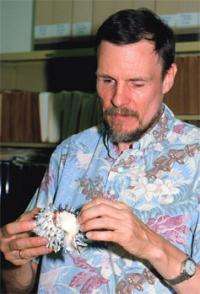
UC Davis paleontologist Geerat Vermeij says evolution at this level, like the rest of history, is predictable.

If the history of life were to play out again from the beginning, it would have a similar plot and outcomes, although with a different cast and timing, argues UC Davis paleontologist Geerat Vermeij in a new paper in the Proceedings of the National Academy of Sciences.

"Evolution at this level, like the rest of history, is predictable, perhaps more predictable than people want to imagine," Vermeij said. "Many traits are so advantageous under so many circumstances that you are likely to see the same things again and again."

Vermeij's view contrasts with that put forward by the late Stephen Jay Gould and others, who argued that the history of life is so dependent on improbable events and includes so many possible paths that the chances of repetition are vanishingly small. Vermeij argues that some innovations, such as photosynthesis, plant seeds, mineralized bones and even human language are just such good ideas that they would reappear, although at different times and in somewhat different forms.

Barnacles, for example, "desperately want to be mollusks," Vermeij said, although they are actually crustaceans related to crabs and lobsters. As adults, they have evolved a lifestyle similar to that of clams, mussels and another entire group of animals, the brachiopods.

Vermeij reviewed 23 evolutionary innovations thought to be unique, including the genetic code, sex, human language and feathers, and another 55 that turn up repeatedly. Most of the unique innovations -- with the exception of human language -- are ancient, more than half a billion years old. Many of the repeated innovations are known only from a few specimens that were part of much larger groups. Vermeij said that many of life's "unique" developments might just appear to be so because other species died out and were not preserved as fossils.

A "unique" innovation might also be the result of intense natural selection. For example, once the genetic code appeared, primitive organisms readily swapped genes, as bacteria still do today. Any variants or competitors to the genetic code that arose later would have been unable to spread and establish.

Vermeij thinks that these principles are universal.

"If we had an Earth-like planet, I think we'd see phenotypes and outcomes that parallel those on Earth," he said.

Source: UC Davis


print this article email this article download pdf blog this article bookmark this article     Stumble it Digg this share on Facebook retweet share on Reddit add to delicious
Rate this story - 4.7 /5 (21 votes)


February 27, 2006 all stories

Comments: 0

4.7 /5 (21 votes)
  • Stumble this up

  • Digg this

  • share this

  • hide
  • Related Stories

  • Pacific shellfish ready to invade Atlantic
    created Aug 07, 2008 | popularity not rated yet | comments 0
  • Holes in Fossil Shells Show Effects of Competition and Evolution
    created Jan 04, 2005 | popularity not rated yet | comments 0


Other News

Scientists: New dinosaur species found in SAfrica (AP)

Scientists: New dinosaur species found in SAfrica

Other Sciences / Archaeology & Fossils

created 18 hours ago | popularity 4.2 / 5 (6) | comments 0

(AP) -- Scientists say they've discovered a new dinosaur species in South Africa that may help explain how the creatures evolved into the largest animals on land.


Israel displays coins from ancient Jewish revolt (AP)

Israel displays coins from ancient Jewish revolt

Other Sciences / Archaeology & Fossils

created 11 hours ago | popularity 4.3 / 5 (3) | comments 0

(AP) -- Israel displayed for the first time Wednesday a collection of rare coins charred and burned from the Roman destruction of the Jewish Temple nearly 2,000 years ago.


Rice sociologist looks at pediatric physicians' views on religion, spirituality

Other Sciences / Social Sciences

created 9 hours ago | popularity not rated yet | comments 0

(PhysOrg.com) -- Pediatricians and pediatric oncologists express differing views on religion and spirituality, largely based on the types of patients they treat, according to a survey that will appear in the current edition ...


Aisle placements affect grocery sales, research shows

Other Sciences / Economics

created 13 hours ago | popularity 3 / 5 (2) | comments 0

Supermarkets could increase their sales of related items, such as chips and soft drinks, by moving the items closer to each other in their stores, according to research by Ram Bezawada, assistant professor of marketing in ...


Underground lines that bypass monuments

Underground lines that bypass monuments

Other Sciences / Mathematics

created 16 hours ago | popularity 5 / 5 (1) | comments 0

A team of mathematicians from the Engineering and Architecture Schools of the University of Seville has created a method to design underground lines whereby a city's historical buildings are unaffected. The ...