Japanese Device Uses Laser Plasma to Display 3D Images in the Air
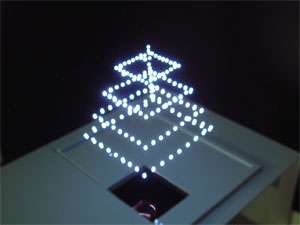
February 27, 2006 A 3D-object displayed using a 3D-image spatial drawing device

A 3D-object displayed using a 3D-image spatial drawing device. Credit: National Institute of Advanced Industrial Science and Technology.

A collaboration of the Japanese National Institute of Advanced Industrial Science and Technology (AIST), Keio University and Burton Inc. has produced a device to display "real 3D images" consisting of dot arrays in empty space.

Many previous displays in 3D have been virtual images on 2D planes which, due to human binocular disparity, appear as 3D. However, the limitation of our visual field and the physical discomfort caused by wrongly identifying virtual images makes these displays less than perfect.

The new device uses the plasma emission phenomenon near the focal point of focused laser light. By controlling the position of the focal point in the direction of the x-, y-, and z-axes, real 3D-images in air (3D-space) can be displayed.
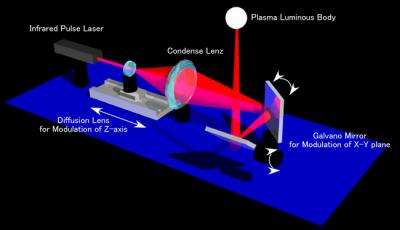
Overview of the 3D-image spatial drawing device

Overview of the 3D-image spatial drawing device. Credit: National Institute of Advanced Industrial Science and Technology.

Our living space and the objects within it are three-dimensional but while 3D imaging is well documented on the Internet, we don’t see "real 3D-images" on our computer screens. This is because our monitors are unable to display them.

Keio University and Burton Inc. noticed that, when laser beams are strongly focused, air plasma emission can only be induced near the focal point. So, they experimented by fabricating a device to display 2D-images in the air. The images are constructed from dot arrays produced by a technique combining a laser light source and galvanometric mirrors. To form 3D-images in the air, the scanning of the focal point in the depth direction along the laser optical axis is essential. However, to do this, the quality of the laser and the technique for varying the position of the focal point must be improved. This explains why we do not yet have the technology to display 3D images.

By modifying the 2D image device with a linear motor system and a high-quality and high-brightness infrared pulse, the AIST, Keio University and Burton Inc. created a spatial display of "real 3D images" consisting of dot arrays.

The linear motor system can vary the position of the laser focal point by high-speed scanning of a lens set on the motor orbit. Incorporation of this system makes the image scanning in the direction of the z-axis possible. For scanning in the x and y axis directions, conventional galvanometric mirrors are used.

The high-quality and high–brightness infrared pulsed laser (repetition frequency of pulse: approximately 100 Hz), enables plasma production to be more precisely controlled, resulting in brighter and higher contrast image drawing. Furthermore, the distance between the device and drawing points can be extended by several meters.

The emission time of the laser pulse light is approximately a nanosecond (10-9 sec). The device uses one pulse for each dot. The human eye will recognize the after-image effect of plasma emission from displays up to 100 dot/sec. By synchronizing these pulses and controlling them with software, the device can draw any 3D objects in air.
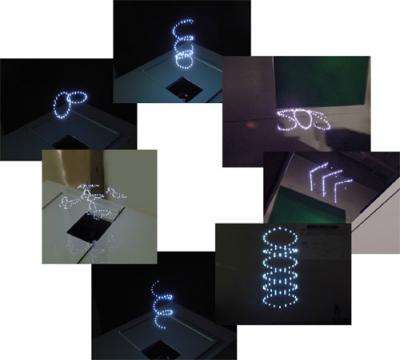
Various 2D and 3D objects drawn by the display device

Various 2D and 3D objects drawn by the display device. Credit: National Institute of Advanced Industrial Science and Technology

Copyright 2006 PhysOrg.com


print this article email this article download pdf blog this article bookmark this article     Stumble it Digg this share on Facebook retweet share on Reddit add to delicious
Rate this story - 4.3 /5 (453 votes)

Rank Filter

Move the slider to adjust rank threshold, so that you can hide some of the comments.


Display comments: newest first

  • subbu - Jun 16, 2008
    • Rank: not rated yet
    if nice and fantastic

    i am doing a project i need ur helpcan u help in diaplaying iamages in air and the instruments and the design of the prodect details and cost to me
  • subbu - Jun 16, 2008
    • Rank: not rated yet
    can u help me in designing the instrument to display the image in air through the computer
  • bijel - May 02, 2009
    • Rank: not rated yet
    hey i got an incridable invention to make more better 3d picture in space with a simple technic using this japanese technology

February 27, 2006 all stories

Comments: 3

4.3 /5 (453 votes)
  • Stumble this up

  • Digg this

  • share this

  • hide
  • Related Stories

  • Liquid lens creates tiny flexible laser on a chip
    created May 11, 2009 | popularity not rated yet | comments 0
  • Tweezers Trap Nanotubes by Color
    created Sep 26, 2008 | popularity not rated yet | comments 0
  • A fine-tooth comb to measure the accelerating universe
    created Sep 04, 2008 | popularity not rated yet | comments 0
  • Scientists search for answers from the carbon in the clouds
    created Jul 25, 2008 | popularity not rated yet | comments 0
  • New microscope peers into secret lives of cells
    created Nov 21, 2007 | popularity not rated yet | comments 0


Other News

In the Brain, Seven Is A Magic Number

In the Brain, Seven Is A Magic Number

Physics / General Physics

created 2 hours ago | popularity 4.1 / 5 (8) | comments 0

Having a tough time recalling a phone number someone spoke a few minutes ago or forgetting items from a mental grocery list is not a sign of mental decline; in fact, it's natural.


Scientists react as they stand in front of a screen at CERN

First atoms reported smashed in Large Hadron Collider (Update)

Physics / General Physics

created 4 hours ago | popularity 4.8 / 5 (13) | comments 2

Two circulating beams on Monday produced the first particle collisions in the world's biggest atom smasher, the Large Hadron Collider (LHC), three days after its restart, scientists announced.


A mechanical model of vocalization

Physics / General Physics

created 1hour ago | popularity not rated yet | comments 0

When people speak, sing, or shout, they produce sound by pushing air over their vocal folds -- bits of muscle and tissue that manipulate the air flow and vibrate within it. When someone has polyps or some other problem with ...


Visual assistance for cosmic blind spots

Visual assistance for cosmic blind spots

Physics / General Physics

created 5 hours ago | popularity 4 / 5 (2) | comments 0

A bit of imagination on the part of a measuring instrument wouldn't be a bad thing. It could help to add data from areas where the instrument is unable to measure. However, it must do so constructively. In ...


Big Bang atom smasher sends beams in 2 directions (AP)

Large Hadron Collider sends beams in 2 directions

Physics / General Physics

created 8 hours ago | popularity 4.9 / 5 (8) | comments 0

(AP) -- The world's largest atom smasher made another leap forward Monday by circulating beams of protons in opposite directions at the same time in the $10 billion machine after more than a year of repairs, ...