Hubble spies shells of sparkling stars around quasar
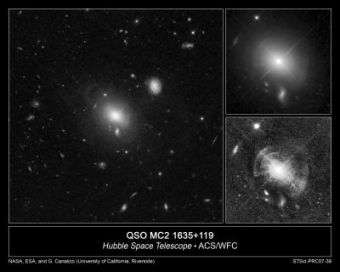
New images taken with NASA’s Hubble Space Telescope – part of a research project led by UC Riverside’s Gabriela Canalizo – have revealed the wild side of an elliptical galaxy, nearly two billion light-years away, that previously had been considered mild-mannered.
The Hubble photos show shells of stars around a bright quasar, known as MC2 1635+119, which dominates the center of the galaxy. The presence of the shells is an indication of a titanic clash with another galaxy in the relatively recent past.
The collision, which is funneling gas into the galaxy’s center, is feeding a supermassive black hole. The accretion onto the black hole is the quasar’s energy-source.
“This observation supports the idea that some quasars are born from interactions between galaxies,” said Canalizo, an assistant professor of astrophysics in the Department of Physics and Astronomy, and a member of the Institute of Geophysics and Planetary Physics. “It also provides more evidence that mergers are crucial for triggering quasars. Most quasars were active in the early universe, which was smaller, so galaxies collided more frequently.
“Astronomers have long speculated that quasars are fueled by interactions that bring an inflow of gas to the black holes in the centers of galaxies. Since this quasar is relatively nearby, it is a great laboratory for studying how more distant quasars are turned on.”
Study results will appear in the Nov. 10 issue of The Astrophysical Journal.
Canalizo explained that the period of time when the central black hole of a galaxy is actively accreting material as a quasar is believed to be an essential phase in the evolution of most galaxies.
“For many decades now, there has been much debate regarding whether galaxy mergers or collisions are responsible for fueling their central black holes and turning them into quasars,” she said.
Discovered nearly 50 years ago, quasars are among the brightest objects in the universe. They reside in the centers of galaxies and are powered by supermassive black holes.
Previous studies of the MC2 1635+119 galaxy with ground-based telescopes showed a normal-looking elliptical containing an older population of stars. It took the razor-sharp vision of Hubble’s Advanced Camera for Surveys and the spectroscopic acuity of the W.M. Keck Observatory in Hawaii to uncover the faint, thin shells.
The new Hubble observations reveal at least five inner shells and additional debris traveling away from the galaxy’s center. The shells, which sparkle with stars, resemble ripples forming in a pond when a stone is tossed in. They formed when a galaxy was shredded by tidal forces during the collision. Some of the galaxy’s stars were swept up in the elliptical galaxy’s gravitational field, creating the outward-moving shells. The farthest shell is about 40,000 light-years away from the center.
“This is the most spectacular shell galaxy seen at this distance,” said team member Francois Schweizer of the Carnegie Observatories in Pasadena, California.
Computer simulations estimate that the encounter happened 1.7 billion years ago. The merger itself occurred over a few hundred million years and stoked a flurry of star birth. Spectroscopic data from Keck reveal that many of the stars in the galaxy are 1.4 billion years old, consistent with the age of the merger.
The shell stars are mixing with the stars in the galaxy as they travel outward. Eventually, the shells will dissipate and the stars will be scattered throughout the galaxy.
“This could be a transitory phase, common to most ellipticals, that lasts only 100 million to a billion years,” Canalizo said. “So, seeing these shells tells us that the encounter occurred in the relatively recent past. Hubble caught the shells at the right time.”
Canalizo and her team have yet to determine the type of merger responsible for the shells and the quasar activity. Their evidence, however, points to two possible collision scenarios.
“The shells’ formation and the current quasar activity may have been triggered by an interaction between two large galaxies or between a large galaxy and a smaller galaxy,” explained team member Nicola Bennert of UCR, who did all of the data processing and quantitative measurements, as well as a large fraction of the analysis. “We need high-resolution spectroscopic observations of the quasar host galaxy to determine the type of merger.”
The quasar is part of an Advanced Camera for Surveys study of five galaxies, all roughly 2 billion light-years away, that are known to harbor quasars. According to Canalizo, the other four galaxies analyzed also display evidence of encounters. Her team also is using Hubble’s Wide Field Planetary Camera 2 to sample 14 more galaxies with quasars.
“We want to know whether most quasars at current epochs begin their lives as mergers, or whether they simply occur in old ellipticals to which nothing very interesting has happened recently,” Canalizo said.
Canalizo, Bennert and Schweizer were joined in the study by UCR’s Bruno Jungwiert, who was in charge of the numerical simulations; Alan Stockton of the University of Hawaii, Honolulu; Mark Lacy of the California Institute of Technology, Pasadena; and Chien Peng of the Herzberg Institute of Astrophysics in Victoria, British Columbia.
Source: University of California - Riverside


