Ancient DNA reveals that some Neanderthals were redheads
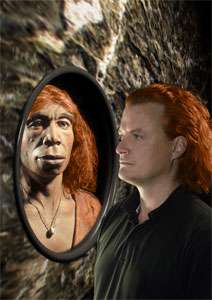
Ancient DNA retrieved from the bones of two Neanderthals suggests that at least some of them had red hair and pale skin, scientists report this week in the journal Science. The international team says that Neanderthals' pigmentation may even have been as varied as that of modern humans, and that at least 1 percent of Neanderthals were likely redheads.
The scientists -- led by Holger Römpler of Harvard University and the University of Leipzig, Carles Lalueza-Fox of the University of Barcelona, and Michael Hofreiter of the Max Planck Institute for Evolutionary Anthropology in Leipzig -- extracted, amplified, and sequenced a pigmentation gene called MC1R from the bones of a 43,000-year-old Neanderthal from El Sidrón, Spain, and a 50,000-year-old individual from Monti Lessini, Italy.
"Together with other genes, this MC1R gene dictates hair and skin color in humans and other mammals," says Römpler, a postdoctoral researcher working with Hopi E. Hoekstra in Harvard's Department of Organismic and Evolutionary Biology. "The two Neanderthal individuals we studied showed a point mutation not seen in modern humans. When we induced such a mutation in human cells, we found that it impaired MC1R activity, a condition that leads to red hair and pale skin in modern humans."
To ensure that the MC1R point mutation was not due to contamination from modern humans, the scientists checked some 3,700 people, including those previously sequenced for the gene as well as everyone involved in the excavation and genetic analysis of the two Neanderthals. None showed the mutation, suggesting that Neanderthals and Homo sapiens followed different evolutionary paths to the same redheaded appearance.
With Neanderthals' surviving bones providing few clues, scientists have long sought to flesh out the appearance of this hominid species found across Eurasia some 28,000 to 400,000 years ago. While anthropologists had predicted that Neanderthals might have had pale skin or red hair, the new work by Römpler and colleagues offers the first strong evidence to support this hunch.
Found in cell membranes, MC1R is a receptor that acts as a switch between production of the red-and-yellow pigment pheomelanin and the black-and-brown pigment eumelanin. Modern humans with mutations that cause complete or partial loss of MC1R function tend to be pale and red-haired, although many other pigmentation genes can also result in this phenotype.
In 2006, a team led by Römpler found a mutation in woolly mammoths that may lead to some blond mammoths; together with her colleagues, Hoekstra, the John L. Loeb Associate Professor of the Natural Sciences at Harvard and curator in mammalogy in Harvard's Museum of Comparative Zoology, has shown that this same mutation causes light coloration in mice. Römpler and Hoekstra are now collaborating to identify genetic changes responsible for pigment variation in other extant and extinct species.
"It has only recently become possible to decipher the genomes of species which became extinct thousands of years ago," Römpler says. "The methods used in these Neanderthal and mammoth studies could provide new insights into the coloration of other extinct hominids, animals, and plants."
Source: Harvard University


