Missing Black Hole Report: Hundreds Found!
October 25, 2007
Missing Black Holes Found

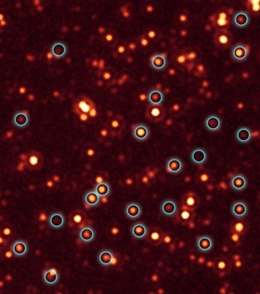
This image, taken with Spitzer´s infrared vision, shows a fraction of the black holes, which are located deep in the bellies of distant, massive galaxies (circled in blue). Credit: NASA/JPL-Caltech/Commissariat a l´Energie Atomique

Astronomers have unmasked hundreds of black holes hiding deep inside dusty galaxies billions of light-years away.

The massive, growing black holes, discovered by NASA's Spitzer and Chandra space telescopes, represent a large fraction of a long-sought missing population. Their discovery implies there were hundreds of millions of additional black holes growing in our young universe, more than doubling the total amount known at that distance.

"Active, supermassive black holes were everywhere in the early universe," said Mark Dickinson of the National Optical Astronomy Observatory in Tucson, Ariz. "We had seen the tip of the iceberg before in our search for these objects. Now, we can see the iceberg itself." Dickinson is a co-author of two new papers appearing in the Nov. 10 issue of the Astrophysical Journal. Emanuele Daddi of the Commissariat a l'Energie Atomique in France led the research.

The findings are also the first direct evidence that most, if not all, massive galaxies in the distant universe spent their youths building monstrous black holes at their cores.

For decades, a large population of active black holes has been considered missing. These highly energetic structures belong to a class of black holes called quasars. A quasar consists of a doughnut-shaped cloud of gas and dust that surrounds and feeds a budding supermassive black hole. As the gas and dust are devoured by the black hole, they heat up and shoot out X-rays. Those X-rays can be detected as a general glow in space, but often the quasars themselves can't be seen directly because dust and gas blocks them from our view.

"We knew from other studies from about 30 years ago that there must be more quasars in the universe, but we didn't know where to find them until now," said Daddi.

Daddi and his team initially set out to study 1,000 dusty, massive galaxies that are busy making stars and were thought to lack quasars. The galaxies are about the same mass as our own spiral Milky Way galaxy, but irregular in shape. At 9 to 11 billion light-years away, they existed at a time when the universe was in its adolescence, between 2.5 and 4.5 billion years old.

When the astronomers peered more closely at the galaxies with Spitzer's infrared eyes, they noticed that about 200 of the galaxies gave off an unusual amount of infrared light. X-ray data from Chandra, and a technique called "stacking," revealed the galaxies were, in fact, hiding plump quasars inside. The scientists now think that the quasars heat the dust in their surrounding doughnut clouds, releasing the excess infrared light.

"We found most of the population of hidden quasars in the early universe," said Daddi. Previously, only the rarest and most energetic of these hidden black holes had been seen at this early epoch.

The newfound quasars are helping answer fundamental questions about how massive galaxies evolve. For instance, astronomers have learned that most massive galaxies steadily build up their stars and black holes simultaneously until they get too big and their black holes suppress star formation.

The observations also suggest that collisions between galaxies might not play as large a role in galaxy evolution as previously believed. "Theorists thought that mergers between galaxies were required to initiate this quasar activity, but we now see that quasars can be active in unharassed galaxies," said co-author David Alexander of Durham University, United Kingdom.

"It's as if we were blindfolded studying the elephant before, and we weren't sure what kind of animal we had," added co-author David Elbaz of the Commissariat a l'Energie Atomique. "Now, we can see the elephant for the first time."

The new observations were made as part of the Great Observatories Origins Deep Survey, the most sensitive survey to date of the distant universe at multiple wavelengths.

Consistent results were recently obtained by Fabrizio Fiore of the Osservatorio Astronomico di Roma, Italy, and his team. Their results will appear in the Jan. 1, 2008, issue of Astrophysical Journal.

Source: NASA

4.5 /5 (34 votes)  

Filter


Move the slider to adjust rank threshold, so that you can hide some of the comments.


Display comments: newest first

Ragtime
Oct 25, 2007

Rank: 2 / 5 (5)
The collisions between galaxies aren't important in quasar formation at all, because by aether theory the spherical dust galaxies are the product of quasars evaporation, instead. The frequency of quasars presence inside of distant galaxies excludes such model completelly, because the distant galaxies are very sparse.
Trippy
Oct 25, 2007

Rank: 1 / 5 (2)
Don't you ever get tired of being wrong Zephir?
fredrick
Oct 25, 2007

Rank: 2.3 / 5 (3)
yay zephir. personally I always look forward to your posts, those pictures are always awesome (and completely irrrelevent)
Trippy
Oct 26, 2007

Rank: 3 / 5 (2)
Personally they give me a headache, but as far as the article foes, it's pretty amazing (in my opinion anyway) because AFAIK, that was one of the problems that some people have with the BBT. Well, problem solved.

We've found them everywhere in the past, and we're finding them everywhere in the present.
fredrick
Oct 26, 2007

Rank: not rated yet
I must say its odd that your comment just now got a such a low rating from the first voter Trippy (I just pushed it up with a 5)... It wasn't a bad comment, certainly not worse than a lot i've seen.

I'm noticing a lot of relatively good comments getting very mediocre scores, while the cranky and worthless (whingy "this isn't real science") comments quite often get higher.
Revenge comment rating by cranks?
Rank 4.5 /5 (34 votes)
Tags

Related Stories
Relevant PhysicsForums posts
  • Scale of the Universe
    created12 hours ago
  • Titan's lack of impact craters
    createdFeb 09, 2012
  • Real pictures of black hole eating a star?
    createdFeb 08, 2012
  • Hypothetical way to travel faster than light, but not technically exceed lightspeed
    createdFeb 06, 2012
  • How do scientists monitor the Sun's activity?
    createdFeb 05, 2012
  • Search patterns in observational studies
    createdFeb 05, 2012
  • More from Physics Forums - General Astronomy

More news stories

Humans may have helped the decline of African rainforests 3000 years ago

(PhysOrg.com) -- Large areas of rainforests in Central Africa mysteriously disappeared over three thousand years ago, to be replaced by savannas. The prevailing theory has been that the cause was a change ...

Space & Earth / Environment

created 23 hours ago | popularity 4.3 / 5 (13) | comments 13 | with audio podcast report

Could Venus be shifting gear?

(PhysOrg.com) -- ESA’s Venus Express spacecraft has discovered that our cloud-covered neighbour spins a little slower than previously measured. Peering through the dense atmosphere in the infrared, the ...

Space & Earth / Space Exploration

created 19 hours ago | popularity 5 / 5 (7) | comments 8 | with audio podcast

NASA budget will axe Mars deal with Europe: scientists

US President Barack Obama's budget proposal to be submitted next week for 2013 will cut NASA's budget by 20 percent and eliminate a major partnership with Europe on Mars exploration, scientists said Thursday.

Space & Earth / Space Exploration

created 22 hours ago | popularity 5 / 5 (2) | comments 19

Mars Science Laboratory computer issue resolved

(PhysOrg.com) -- Engineers have found the root cause of a computer reset that occurred two months ago on NASA's Mars Science Laboratory and have determined how to correct it.

Space & Earth / Space Exploration

created 20 hours ago | popularity 4.7 / 5 (6) | comments 4 | with audio podcast

Two new moons for Jupiter

Advances in technology have lead to the discovery of new planets outside of our Solar System, and now even new moons in our own backyard.

Space & Earth / Space Exploration

created 19 hours ago | popularity 4 / 5 (1) | comments 7


Anonymous knocks CIA website offline (Update)

The website of the Central Intelligence Agency was inaccessible on Friday after the hacker group Anonymous claimed to have knocked it offline.

New error-correcting codes guarantee the fastest possible rate of data transmission

Error-correcting codes are one of the triumphs of the digital age. They’re a way of encoding information so that it can be transmitted across a communication channel — such as an optical fiber o ...

Small modular reactor design could be a 'SUPERSTAR'

(PhysOrg.com) -- Though most of today's nuclear reactors are cooled by water, we've long known that there are alternatives; in fact, the world's first nuclear-powered electricity in 1951 came from a reactor ...

New power source discovered

(PhysOrg.com) -- Researchers at the Massachusetts Institute of Technology (MIT) and RMIT University have made a breakthrough in energy storage and power generation.

The power of estrogen -- male snakes attract other males

A new study has shown that boosting the estrogen levels of male garter snakes causes them to secrete the same pheromones that females use to attract suitors, and turned the males into just about the sexiest ...

Google users warned of threat to smartphone wallets

Users of Google smartphone wallets were being warned on Friday that there is a way to crack pass codes intended to thwart thieves from going on illicit shopping sprees.