The lost kingdom of Tambora is found
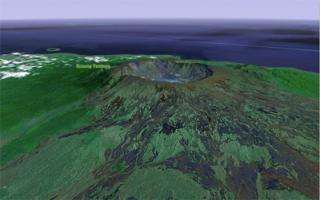
History's largest volcanic eruption destroyed the island kingdom of Tambora in 1815 and now the first remnants of a Tambora village have been found.
The eruption of Mount Tambora on the Indonesian island of Sumbawa in 1815, the largest volcanic eruption in human history, killed 117,000 people and extinguished the tiny kingdom of Tambora. After 20 years of research, a scientist from the University of Rhode Island’s Graduate School of Oceanography has located the first remnants of a Tamboran village under 10 feet of ash and has unearthed the first clues about its culture.
In a six-week archaeological dig in the summer of 2004, URI Professor Haraldur Sigurdsson and colleagues from the University of North Carolina and the Indonesian Directorate of Volcanology excavated a Tamboran home where they found the remains of two adults as well as bronze bowls, ceramic pots, iron tools and other artifacts. The design and decoration of the artifacts suggest that the Tamboran culture was linked to Vietnam and Cambodia, and its language was related to that of the Mon-Khmer group of languages that are now scattered across Southeast Asia.
“There’s potential that Tambora could be the Pompeii of the East, and it could be of great cultural interest,” said Sigurdsson, who believes the village includes a large wooden palace that he hopes to find on a future expedition. “All the people, their houses and culture are still encapsulated there as they were in 1815. It’s important that we keep that capsule intact and open it very carefully.” (Pompeii was similarly wiped out by the eruption of Mt. Vesuvius, and a treasure trove of artifacts from the Roman culture were discovered encapsulated in the ash.)
During the eruption, Mount Tambora ejected up to 100 cubic kilometers of magma and pulverized rock, and it spewed ash and 400 million tons of sulfurous gases 44 kilometers into the atmosphere. The gases that lingered in the atmosphere caused a year of global cooling in 1816 that is now known as “the year without a summer” and which caused disease epidemics and worldwide food shortages due to crop failures. The growing season in New England declined by 100 days that year, which led to the start of a movement by farmers to abandon farming in the region and move west.
Sigurdsson made his first visit to Mount Tambora in 1986 with URI colleague Steven Carey to calculate the size of the eruption. They returned two years later to explore the volcano’s 1,250-meter-deep caldera or crater.
“It’s a remote island with very little access, so it has been little studied over the years,” Sigurdsson said. “My primary motivation was to study the effects the eruption had on society.”
A guide hired by the URI scientists during their second visit to the island told them about ancient objects the local people had found in the jungle 25 kilometers west of the caldera. When Sigurdsson returned to visit the site in 2004, he explored a gully that cut through a 10-foot thick deposit of volcanic pumice and ash where he soon found the first evidence of the village – pottery shards and carbonized lumber. Using radar to look deep into the ground, the scientist quickly found and unearthed a small house built on stilts that rest on foundation stones.
“Everything we found had been carbonized,” Sigurdsson said. “It had turned to charcoal from the heat of the magma.”
Based on the artifacts he found, particularly the many bronze objects, Sigurdsson believes that the Tamborans were “not poor people at all. They were actually quite well off.” Historical evidence supports that belief, as Tamborans had been famous in the East Indies for their honey, horses, sappan wood for producing red dye, and sandalwood used for incense and medications.
According to Sigurdsson, the village was located 5 kilometers inland, where the residents were safe from pirates that frequently captured coastal residents and forced them into slavery. The site had also been highly productive for growing crops.
Sigurdsson intends to return to Tambora in 2007 to find the palace and the rest of the village. He will conduct a detailed radar survey of the site using modern, non-destructive techniques to establish the extent of the town and identify target sites for future excavations.
A native of Iceland who now resides in Wakefield, R.I., Sigurdsson is best known for his studies of the eruption of Mount Vesuvius and the destruction of the Roman cities of Pompeii and Herculaneum. In 1991 he discovered tektite glass spherules in Haiti, proving that the massive impact of a meteorite caused the extinction of the dinosaurs.
Source: University of Rhode Island


