Mars with ice, shaken, not stirred
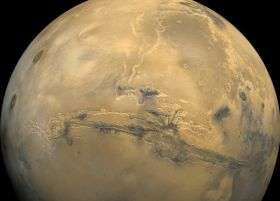
Mars, like Earth, is a climate-fickle water planet. The main difference, of course, is that water on the frigid Red Planet is rarely liquid, preferring to spend almost all of its time traveling the world as a gas or churning up the surface as ice. That's the global picture literally and figuratively coming into much sharper focus as various Mars-orbiting cameras send back tomes of unprecedented super high-resolution imagery of ever vaster tracts of the planet's surface.
What were just a few years ago small hints about Mars' water and climate, as seen in a few "postage-stamp" high-resolution images and topography, have given way to broader theory that explains not only the features seen on the planet today, but imply a dynamic history of Martian climate change.
"When you have postage stamps, it's like studying a hair on an arm instead of the whole arm," said Mars researcher James Head III of Brown University. Head will present the latest integrated global view of Martian surface features and how they fit with Martian climate models on Sunday, 28 October 2007, at the Geological Society of America Annual Meeting in Denver.
The pictures now reveal a range of ice-made features that show a strong preference to certain latitudes, Head explains. As on Earth, latitude-dependent features can mean only one thing: latitude-dependent climate.
The signs of water ice are obvious today at Mars' poles. But as you move towards the equator, there is plenty of evidence of water ice having shaped the surface in different ways not so long ago.
Not far from either pole, for instance, widespread bumpy polygonal patterned ground suggests the contraction and expansion of icy permafrost ground – very similar to that seen in Earth's Arctic and Antarctic. Next, between 30 and 60 degrees latitude in both hemispheres, the patterned ground gives way to a pervasive pitted texture of once ice-rich dust deposits. Even closer to the equator on the flanks of Mars' equatorial volcanoes are compelling signs of large glaciers, almost exactly like those of Earth. There are also craters which seem to be filled with glacial debris and small valleys which drop precipitously into canyons – which on Earth is usually a strong indicator that a glacier once filled and widened the canyon.
As for where all the ice went, much of it was sublimed away and deposited at the poles. The ice rules the more temperate latitudes only when the tilt of Mars' spin axis is far more extreme than today – up to 45 degrees. That tilt, or obliquity, exposed the poles to a lot more sun during the course of a Martian year, according to climate models, evaporating the ice caps. That same water refroze on the surface in the then darker and colder equatorial and middle latitudes, hence all the evidence of ice and glaciers.
"It's a quest to understand the Martian water cycle," said Head describing his work.
Among the instruments used to study Mars are the Mars Global Surveyor's Laser Altimeter (MOLA) and Camera (MOC), the Mars Reconnaissance Orbiter's Context Camera (CTX) and High Resolution Imaging Science Experiment (HiRISE), and the Mars Express's High Resolution Stereo Camera (HRSC).
Source: Geological Society of America


