High-tech textiles pave the way for glowing garments
October 26, 2007 High-tech textiles pave the way for glowing garments

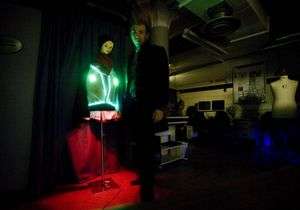
EL yarn garment on dummy with person in normal clothing.

Researchers at The University of Manchester have developed high-tech battery-powered textile yarns that can be used to make clothing glow in the dark.

The yarns have been developed by The William Lee Innovation Centre (WLIC), based in the University’s School of Materials – and have the potential to be incorporated into clothing worn by cyclists, joggers and pedestrians.

Current high visibility products – such as those used by emergency services, cyclists and highway maintenance workers – depend on external light sources to make them visible.

They can be ineffective in low light situations and require a light source from something like vehicle headlights to make them visible. This can lead to the wearer being seen too late.

The latest WLIC development, made from electroluminescent (EL) yarns, allows the wearer to be permanently visible and therefore improves personal safety.

EL yarn is a novel technology, which emits light when powered by a battery. Its development has been based on thin film electroluminescent technology.

The yarn consists of an inner conductive core yarn, coated with electroluminescent ink – which means it emits light when an electric current is passed through it – and a protective transparent encapsulation, with an outer conductive yarn wrapped around it.

When the EL yarn is powered with an inverter the resultant electrical field between the inner and outer conductor causes the electroluminescent coating to emit light. The emission of light occurs between the contact points between the outer yarn and the inner yarn.

Other potential applications for the yarn include flexible woven or knitted road safety signs that communicate written instructions.

Dr Tilak Dias, Head of the WLIC, said: “At the moment the EL yarn we have developed is less flexible than conventional yarns. But it is more flexible than current optical fibres that are incorporated within fabrics to provide illumination.

“EL yarn can be easily incorporated into a knitted or woven fabric and the resultant active illuminating fabric provides illumination when it is powered.

“The luminance of a single strand of the EL yarn is greater than that of photoluminescent glow yarns, which are currently used in some high visibility applications.

“Weaving or knitting the yarn in a particular manner, so that more yarn per unit area is achieved, improves the luminance of the EL yarn.”

Source: University of Manchester


print this article email this article download pdf blog this article bookmark this article     Stumble it Digg this share on Facebook retweet share on Reddit add to delicious
Rate this story - 4.6 /5 (16 votes)


October 26, 2007 all stories

Comments: 0

4.6 /5 (16 votes)
  • Stumble this up

  • Digg this

  • share this

  • hide
  • Related Stories

  • Nature, nanotechnology fuse in electric yarn that detects blood
    created Dec 15, 2008 | popularity not rated yet | comments 0
  • Researchers produce strong, transparent carbon nanotube sheets
    created Aug 18, 2005 | popularity not rated yet | comments 0
  • Major Award for Carbon Natotube Partners
    created Jun 10, 2005 | popularity not rated yet | comments 0
  • Spinning carbon nanotubes spawns new wireless applications
    created Mar 09, 2009 | popularity not rated yet | comments 0
  • Breakthrough for carbon nanotube materials
    created Sep 29, 2008 | popularity not rated yet | comments 0


  • hide
  • Relevant PhysicsForums posts

  • Achromat lens - magnifying LCD
    created 3 hours ago
  • Control System
    created Nov 24, 2009
  • Base Isolation Systems in Skyscrapers?
    created Nov 23, 2009
  • Need to interview a Computer Hardware Engineer for school project
    created Nov 23, 2009
  • More from Physics Forums - General Engineering

Other News

Design chosen for British 1,000 mph car

Design chosen for British 1,000 mph car (w/ Video)

Technology / Engineering

created 14 hours ago | popularity 4.2 / 5 (5) | comments 5

(PhysOrg.com) -- A British team hoping to be the first to get a car to 1,000 mph (1,610 km/h) has made its final design selection. The six-tonne car, known as the Bloodhound, will be powered by a Eurofighter ...


ORNL 'deep retrofits' can cut home energy bills in half

ORNL 'deep retrofits' can cut home energy bills in half

Technology / Energy

created 6 hours ago | popularity 3 / 5 (2) | comments 0

(PhysOrg.com) -- Oak Ridge National Laboratory has announced plans to conduct a series of deep energy retrofit research projects with the potential to improve the energy efficiency in selected homes by as ...


Web sites aim to survive with hyperlocal focus

Technology / Internet

created 1hour ago | popularity not rated yet | comments 0

Finding a financially viable way to provide local news is a challenge large metropolitan newspapers are confronting. But a Coral Gables, Fla., Web site is among a few locally with faith it can succeed.


Should I buy a PC or Mac?

Technology / Software

created 2 hours ago | popularity 5 / 5 (1) | comments 2

Q. Our 6-year-old PC computer is dying a slow death and we are considering moving to a new iMac but have a few concerns. First, of all, we have several Word documents on our disk drive now that we want to keep and add to ...


EU assembly adopts Internet, phone user rights

Technology / Telecom

created 10 hours ago | popularity 5 / 5 (1) | comments 1

(AP) -- The European Parliament has endorsed new telecom rules that would give phone and Internet users more rights and allow them to appeal to national courts if they are cut off for illegal file-sharing.