Persistence pays off
October 26, 2007 Persistence pays off

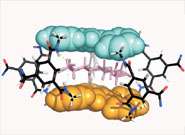
A computational ´synthetic lectin´, with a cellobiose molecule (pink) held inside. Photo by Professor Tony Davis

Chemists have come remarkably close to mimicking a type of protein previously thought impossible to imitate. The long-term application of this work could be in the development of new types of glucose sensors for diabetics, or in the production of new biofuels.

Professor Anthony Davis and his team at the University of Bristol, UK, report this week in Science that they have designed a totally synthetic molecule which mimics the properties of lectins. The molecule binds a particular kind of carbohydrate (cellobiose), while ignoring almost all other carbohydrates. This has previously proved extremely difficult to do.

Lectins are proteins which bind to carbohydrates such as glucose. They are found throughout nature, particularly in plants. By designing synthetic molecules with appropriate shapes, chemists should, in theory, be able to mimic the properties of such biomolecules and then adjust them to suit the needs of humanity. Unfortunately this has proved extremely difficult in practice.

Lectins are large, complex proteins which have evolved to do their jobs over billions of years and it is generally assumed that we cannot realistically hope to match them with artificial systems. Indeed, efforts to do so have usually been disappointing. But research at Bristol University suggests that perhaps we shouldn't give up so easily.

Professor Davis said: “This work should help scientists understand lectins themselves and may lead to specific applications in the future. For example, cellobiose is closely related to cellulose, a key renewable resource which can be used to make materials, biofuels and other chemicals.

“Cellulose is difficult to exploit because of its insolubility, but if it could be bound and made soluble by a synthetic lectin, new ways of processing it should be possible. The researchers are also aiming for molecules which bind selectively to glucose. These could be used in new types of glucose sensor, for use in the treatment of diabetics.”

Source: University of Bristol


print this article email this article download pdf blog this article bookmark this article     Stumble it Digg this share on Facebook retweet share on Reddit add to delicious
Rate this story - 4.8 /5 (6 votes)


October 26, 2007 all stories

Comments: 0

4.8 /5 (6 votes)
  • Stumble this up

  • Digg this

  • share this

  • hide
  • Related Stories

  • E. coli engineered to produce important class of antibiotic, anti-cancer drugs
    created Dec 22, 2008 | popularity not rated yet | comments 0
  • New motor first to be powered by living bacteria
    created Oct 12, 2006 | popularity not rated yet | comments 0
  • Diabetic episodes affect kids' memory
    created Oct 19, 2009 | popularity not rated yet | comments 0
  • Healthy neighborhoods may be associated with lower diabetes risk
    created Oct 12, 2009 | popularity not rated yet | comments 0
  • Body's circadian rhythm tightly entwined with blood sugar control
    created Oct 05, 2009 | popularity not rated yet | comments 0


Other News

Sandia CR5

Machine Converts CO2 into Gasoline, Diesel, and Jet Fuel

Chemistry / Biochemistry

created Nov 23, 2009 | popularity 4.6 / 5 (31) | comments 20

(PhysOrg.com) -- Researchers at Sandia National Laboratories have built a machine that uses the sun's energy to convert carbon dioxide waste from power plants into transportation fuels such as gasoline, diesel, ...


New hydrogen-storage method discovered

New hydrogen-storage method discovered

Chemistry / Materials Science

created Nov 22, 2009 | popularity 4.3 / 5 (42) | comments 15

Scientists at the Carnegie Institution have found for the first time that high pressure can be used to make a unique hydrogen-storage material. The discovery paves the way for an entirely new way to approach ...


New chemical reaction offers opportunities for drug development

Chemistry / Biochemistry

created Nov 26, 2009 | popularity not rated yet | comments 2

Researchers led by Conway Fellow, Professor Pat Guiry have solved a chemistry problem that has stumped researchers worldwide for more than a decade. The results have earned the group the cover story of the leading scientific ...


Research sheds light on workings of anti-cancer drug

Chemistry / Analytical Chemistry

created Nov 26, 2009 | popularity not rated yet | comments 0

(PhysOrg.com) -- The copper sequestering drug tetrathiomolybdate (TM) has been shown in studies to be effective in the treatment of Wilson disease, a disease caused by an overload of copper, and certain metastatic cancers. ...


Ethanol

Microbes to Take Over Ethanol Production?

Chemistry / Biochemistry

created Nov 20, 2009 | popularity 3.5 / 5 (6) | comments 0

(PhysOrg.com) -- Not too long ago, it seemed that ethanol production was the wave of the future. The use of trash, wood chips or different types of plants -- usually grass or corn -- to make ethanol was considered ...