Mystery Comet Explodes into Brightness
October 26, 2007
Mystery Comet Explodes into Brightness

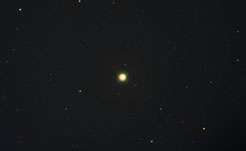
Comet 17P/Holmes is in super-outburst! It brightened by a factor of one million in less than 24 hours. This comet currently appears as a fuzzy, yellowish star-like object in the constellation Perseus and is well-placed for northern hemisphere observers. Credit: Chris Schur

A once-faint comet has made a sudden leap from obscurity to center stage. Comet 17P/Holmes, now visible to northern hemisphere residents, increased its brightness by a factor of one million this week, going from magnitude 17 to 2. This makes it visible to the unaided eye as well as binoculars and telescopes, offering a unique viewing opportunity for sky watchers.

"This is a terrific outburst," said Brian Marsden, director emeritus of the Minor Planet Center, which tracks known comets and asteroids. "And since it doesn’t have a tail right now, some observers have confused it with a nova. We’ve had at least two reports of a new star."

Comet Holmes is located in the constellation Perseus and is visible for most of the night. In fact, for observers at the latitude of Boston, the comet is circumpolar, never setting below the horizon. In appearance, it resembles a fuzzy, yellowish star.

The comet could fade in a matter of days or weeks, so astronomers recommend that viewers take a look now. Sky charts showing where to look for the comet are online at http://www.skyandt … 0775326.html .

Amateur astronomer Edwin Holmes, who was looking at the Andromeda galaxy at the time, discovered Comet Holmes in 1892. The comet has presented a mystery to astronomers ever since. It likely was undergoing a similar outburst when discovered, since it reached 4th magnitude and was faintly visible to the unaided eye. After fading, it brightened again by a factor of 100 in January 1893 before fading again for good.

The comet orbits the Sun once every 7 years at a distance of about 200 million miles (compared to Earth’s 93-million-mile orbit). As a result, it was re-observed in 1899 and 1906 before being lost for nearly six decades. Based on a prediction by Marsden, the comet was recovered in 1964.

"Since then, it’s been behaving well – until now," says Marsden.

On October 23rd, the comet was a dim 17th magnitude, 25,000 times too faint to be seen with the unaided eye. One day later, it had brightened to 7th magnitude, and the most recent observations peg it at magnitude 2 to 3: an increase of a factor of one million. (The magnitude scale used by astronomers is logarithmic.)

"When the Deep Impact probe hit Comet 9P/Tempel, there was almost no change in brightness," says Marsden. "This outburst by Comet Holmes is extreme!"

Indeed, the outburst has left experts scratching their heads. How could a tiny comet, whose nucleus is no more than two miles across, grow so bright so fast? Perhaps a crack opened in the comet’s surface, exposing fresh ice to the sun and causing an explosive eruption of dust and gas. No one knows for sure. Undoubtedly, professional astronomers will be studying it closely in the weeks to come.

Sky coordinates for Comet 17P/Holmes can be found on the Minor Planet Center website at http://www.cfa.har … s/0017P.html .

Source: Smithsonian Astrophysical Observatory in Cambridge

4.4 /5 (28 votes)  

Filter


Move the slider to adjust rank threshold, so that you can hide some of the comments.


Display comments: newest first

MrGrynch
Oct 26, 2007

Rank: 2 / 5 (3)
"Indeed, the outburst has left experts scratching their heads."

This seems to be a common occurence with regard to comet theory.

A crack? More likely the comet has passed through a particularly dense electric field. A similar process is responsible for the emergence of the comets tail, as it approaches our Sun. The Deep Impact event has shown that comets are not "dirty" ice balls or icy dirtballs, but far more complex. Almost nothing predicted about comets, prior to close observation, has been confirmed. Plasma cosmology tells a different tale of comets, and presents far fewer mysteries. In fact, recent close-up observations have shown strong support for the paradigm.

www.thunderbolts.info/home.htm
Reaper6971
Oct 26, 2007

Rank: 1.3 / 5 (3)
And from the peanut gallery: The region it passed through could have more Dark Matter?
earls
Oct 27, 2007

Rank: 1 / 5 (3)
I've been waiting for this article to appear on Physorg... And, once again, MrGrynch already beat me to it...

The increase in brightness is an electrical discharge.
Pundrik
Oct 30, 2007

Rank: 1 / 5 (1)


Comet 17 P Holmes%u2019s super outburst is depending on hypothesizes of this commenter. These hypothesizes are 1. Early warning for global seismic hazards EWGSH 2. The theory of connecting universe with CME 3.The principle of planetary seismic hazards 4. The principle of comets and asteroids%u2019 seismicity 5. The principle of Meteorite.

The Solar, stellar magnetic wind after emission rushes ahead in the space with their Energized powers. This magnetic storm creates on the Earth, aurora, climate change, radio disturbance and seismic hazards.

The Sun is responsible factor during the process and the concentrated towards it suddenly the discovery of EWGSH was accidental due to this. The hypothetical entity of EWGSH is discovered by the commenter. Early warning for global seismic hazards (EWGSH) theory is based on solar activity like coronal mass ejection CME - sun spots - magnetic disturbance. For farther detail of this theory and early warning for global seismic-global Earth quake activity. http://www.glo-seismo-warn.org


Due to magnetic storm many other activities including seismic activity occurs on the all objects of solar system besides the Earth to which I name it as %u201CPrinciple of planetary seismic activity%u201D (Magnetic storm shows its force on the Earth after exploring the journey of 150 million from the Sun. This way seismic activity occurs on the comet by the effect of magnetic storm as it comes near the Sun. The rubble-pile are scattered in the space due to increase to velocity. - %u2019Ejection velocity exceed escape velocity%u2019. As a result when the earth or any planet arrivals this orbit path there happens %u201CMeteorite%u201D on the Earth. The perseids, caused by Swift -Tuttle comet rubble, is on of the largest and most reliable meteor showers on record.)

Rank 4.4 /5 (28 votes)
Tags

Related Stories
Relevant PhysicsForums posts
  • Never ending outer space.....
    created21 hours ago
  • Neutron Star fragments?
    created23 hours ago
  • stationary or not?
    createdFeb 11, 2012
  • Scale of the Universe
    createdFeb 10, 2012
  • Titan's lack of impact craters
    createdFeb 09, 2012
  • Real pictures of black hole eating a star?
    createdFeb 08, 2012
  • More from Physics Forums - General Astronomy

More news stories

Salvage workers begin pumping fuel from Italian shipwreck

Salvage workers Sunday began pumping fuel from the shipwrecked Italian cruise liner Costa Concordia, a day ahead of schedule, officials said.

Space & Earth / Environment

created 6 hours ago | popularity 5 / 5 (1) | comments 0

Latin America mining boom clashes with conservation

Latin America is experiencing a mining boom as prices rise fuelled by a hike in global demand, but the region is also being hit by a wave of violent protests, strikes and rallies by environmentalists.

Space & Earth / Environment

created 14 hours ago | popularity 5 / 5 (1) | comments 1

Political leaders play key role in how worried Americans are by climate change: study

More than extreme weather events and the work of scientists, it is national political leaders who influence how much Americans worry about the threat of climate change, new research finds.

Space & Earth / Environment

created Feb 06, 2012 | popularity 5 / 5 (7) | comments 73

NASA budget will axe Mars deal with Europe: scientists

US President Barack Obama's budget proposal to be submitted next week for 2013 will cut NASA's budget by 20 percent and eliminate a major partnership with Europe on Mars exploration, scientists said Thursday.

Space & Earth / Space Exploration

created Feb 10, 2012 | popularity 5 / 5 (3) | comments 58

Humans may have helped the decline of African rainforests 3000 years ago

(PhysOrg.com) -- Large areas of rainforests in Central Africa mysteriously disappeared over three thousand years ago, to be replaced by savannas. The prevailing theory has been that the cause was a change ...

Space & Earth / Environment

created Feb 10, 2012 | popularity 4.1 / 5 (14) | comments 21 | with audio podcast report


Scientists discover molecular secrets of 2,000-year-old Chinese herbal remedy

For roughly two thousand years, Chinese herbalists have treated Malaria using a root extract, commonly known as Chang Shan, from a type of hydrangea that grows in Tibet and Nepal. More recent studies suggest that halofuginone, ...

New method to examine batteries -- MRI from the inside

There is an ever-increasing need for advanced batteries for portable electronics, such as phones, cameras, and music players, but also to power electric vehicles and to facilitate the distribution and storage of energy derived ...

Overeating may double risk of memory loss

New research suggests that consuming between 2,100 and 6,000 calories per day may double the risk of memory loss, or mild cognitive impairment (MCI), among people age 70 and older. The study was released today and will be ...

A mitosis mystery solved: How chromosomes align perfectly in a dividing cell

Although the process of mitotic cell division has been studied intensely for more than 50 years, Whitehead Institute researchers have only now solved the mystery of how cells correctly align their chromosomes during symmetric ...

Lab study raises questions over nano-particle impact

Tests involving chickens have raised questions about the impact on health from engineered nano-particles, the ultra-fine grains commonly used in drugs and processed foods, scientists said on Sunday.

Google might launch Drive for cloud storage soon

(PhysOrg.com) -- Google's next big move, according to the Wall Street Journal, is a cloud storage service called Drive. Hardly first to the plate, Google is simply catching up to introducing its cloud reposi ...