Researchers race ahead with latest spintronics achievement
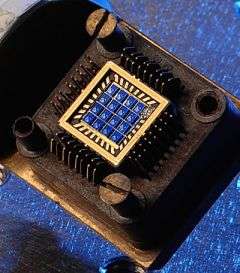
In a rapid follow-up to their achievement as the first to demonstrate how an electron's spin can be electrically injected, controlled and detected in silicon, electrical engineers from the University of Delaware and Cambridge NanoTech now show that this quantum property can be transported a marathon distance in the world of microelectronics-- through an entire silicon wafer.
The finding confirms that silicon--the workhorse material of present-day electronics--now can be harnessed up for new-age spintronics applications.
The results, published in the Oct. 26 issue of the American Physical Society's journal Physical Review Letters, mark another major steppingstone in the pioneering field of spintronics, which aims to use the intrinsic “spin” property of electrons versus solely their electrical charge for the cheaper, faster, lower-power processing and storage of data than present-day electronics can offer.
The research team included Ian Appelbaum, UD assistant professor of electrical and computer engineering, and his doctoral student, Biqin Huang, and Douwe Monsma, of Cambridge NanoTech in Cambridge, Mass. Huang was the lead author of the article.
“Our new result is significant because it means that silicon can now be used to perform many spin manipulations both within the space of thousands of devices and within the time of thousands of logic operations, paving the way for silicon-based spintronics circuits,” Appelbaum said.
In Appelbaum's lab at UD, the team fabricated a device that injected high-energy, “hot” electrons from a ferromagnet into the silicon wafer. Another hot-electron structure (made by bonding two silicon wafers together with a thin-film ferromagnet) detected the electrons on the other side.
“Electron spin has a direction, like 'up' or 'down,' ” Appelbaum said. “In silicon, there are normally equal numbers of spin-up and -down electrons. The goal of spintronics is to use currents with most of the electron spins oriented, or polarized, in the same direction.”
In another recent paper published in the Aug. 13 issue of Applied Physics Letters, the team showed how to attain very high spin polarization, achieving more than 37 percent, and then demonstrated operation as the first semiconductor spin field-effect transistor.
“One hundred percent polarization means that all injected electrons are either spin-up or spin-down,” Huang explained. “High polarization will be necessary for practical applications.”
“In the future, spintronics may bring a great change to daily life,” Huang added.
A native of China, Huang said he feels fortunate to work in Appelbaum's group. When he completes his doctorate next year, Huang hopes to pursue research in industry or academia.
“An alumnus from my undergraduate school in China was studying here at UD and told me this is a great place. I'm happy I made the right decision to come here,” Huang noted. “I am also lucky to have a chance to work in Dr. Appelbaum's group. I think an excellent adviser is always the reason for students to be here.”
“We're taking the first steps at the beginning of a new road,” Appelbaum said. “Before our initial work on spin transport in silicon, we didn't even know where the road was,” he said with a smile. “There's a lot of fundamental work to be done, which we hope will bring us closer to a new age of electronics.”
Source: University of Delaware


