World's hottest chile pepper discovered
October 26, 2007 World's hottest chile pepper discovered

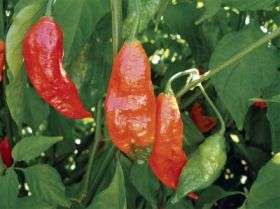
Fruits of Bhut Jolokia on plants grown in the field at the Leyendecker Plant Science Research Center. Credit: Paul Bosland

Researchers at New Mexico State University recently discovered the world’s hottest chile pepper.

Bhut Jolokia, a variety of chile pepper originating in Assam, India, has earned Guiness World Records’ recognition as the world’s hottest chile pepper by blasting past the previous champion Red Savina. In replicated tests of Scoville heat units (SHUs), Bhut Jolokia reached one million SHUs, almost double the SHUs of Red Savina, which measured a mere 577,000.

Dr. Paul Bosland, Director of the Chile Pepper Institute at New Mexico State University’s Department of Plant and Environmental Sciences collected seeds of Bhut Jolokia while visiting India in 2001. Bosland grew Bhut Jolokia plants under insect-proof cages for three years to produce enough seed to complete the required field tests.

“The name Bhut Jolokia translates as ‘ghost chile,’” Bosland said, “I think it’s because the chile is so hot, you give up the ghost when you eat it!” Bosland added that the intense heat concentration of Bhut Jolokia could have significant impact on the food industry as an economical seasoning in packaged foods.

The complete study and abstract are available on the ASHS HortScience electronic journal web site: http://hortsci.ashspublications.org/cgi/content/abstract/42/2/222

Source: American Society for Horticultural Science


print this article email this article download pdf blog this article bookmark this article     Stumble it Digg this share on Facebook retweet share on Reddit add to delicious
Rate this story - 4.3 /5 (36 votes)

Rank Filter

Move the slider to adjust rank threshold, so that you can hide some of the comments.


Display comments: newest first

  • vlam67 - Oct 26, 2007
    • Rank: 1.5 / 5 (2)
    Trust Christopher Columbus to name it chile pepper. Not surprisingly since he thought he discovered Asia. Pepper is pepper, chili is chili, the two has NOTHING in common. Not even the taste!
  • shyataroo - Oct 26, 2007
    • Rank: not rated yet
    I would like to point out that the Naga Dorset is hotter, at 1,598,227 SHU (scoville heat units)
    http://www.bbc.co...46.shtml

October 26, 2007 all stories

Comments: 2

4.3 /5 (36 votes)
  • Stumble this up

  • Digg this

  • share this

  • hide
  • Related Stories

  • Spitzer Telescope Observes Baby Brown Dwarf
    created 59 minutes ago | popularity not rated yet | comments 0
  • Penguins and sea lions help produce new atlas
    created Nov 16, 2009 | popularity not rated yet | comments 0
  • Major schizophrenia study finds striking similarities across 37 countries in 6 regions
    created Nov 16, 2009 | popularity not rated yet | comments 0
  • Hubble Image Showcases Star Birth in M83, the Southern Pinwheel
    created Nov 05, 2009 | popularity not rated yet | comments 0
  • Opening up a colorful cosmic jewel box
    created Oct 29, 2009 | popularity not rated yet | comments 0


Other News

Time-Tunneling for Climate Change Clues

Time-Tunneling for Climate Change Clues

Biology / Ecology

created 1hour ago | popularity not rated yet | comments 0

(PhysOrg.com) -- If you look closely at individual plant species' responses in the past, you may find that the largest effects of high carbon dioxide (CO2) levels occurred decades ago, according to Agricultural ...


A year after discovery, Congo's 'mother lode' of gorillas remains vulnerable

A year after discovery, Congo's 'mother lode' of gorillas remains vulnerable

Biology / Plants & Animals

created 2 hours ago | popularity not rated yet | comments 0

A new study by the Wildlife Conservation Society says that western lowland gorillas living in a large swamp in the Republic of Congo—part of the "mother lode" of more than 125,000 gorillas discovered last ...


Computational microscope peers into the working ribosome

Computational microscope peers into the working ribosome (w/ Video)

Biology / Cell & Microbiology

created 4 hours ago | popularity 5 / 5 (3) | comments 0

Two new studies reveal in unprecedented detail how the ribosome interacts with other molecules to assemble new proteins and guide them toward their destination in biological cells. The studies used molecular ...


New chameleon species discovered in East Africa

New chameleon species discovered in East Africa (w/ Podcast)

Biology / Plants & Animals

created 7 hours ago | popularity 5 / 5 (1) | comments 0

A new species of chameleon has been discovered in Tanzania by a team of scientists.


Insect resistance to Bt crops can be predicted, monitored and managed

Biology / Ecology

created 2 hours ago | popularity not rated yet | comments 0

Since 1996, crop plants genetically modified to produce bacterial proteins that are toxic to certain insects, yet safe for people, have been planted on more than 200 million hectares worldwide. The popularity of these Bt ...