'Deep impact' of pulsar around companion star
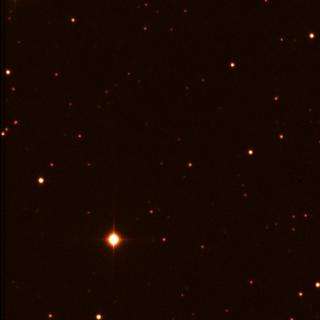
Astronomers have witnessed a never-seen-before event in observations by ESA's XMM-Newton spacecraft - a collision between a pulsar and a ring of gas around a neighbouring star.
The rare passage, which took the pulsar plunging into and through this ring, illuminated the sky in gamma- and X-rays. It has revealed a remarkable new insight into the origin and content of 'pulsar winds', which has been a long-standing mystery. The scientists described the event as a natural but 'scaled-up' version of the well-known Deep Impact satellite collision with Comet Tempel 1.
Their final analysis is based on a new observation from XMM-Newton and a multitude of archived data which will lead to a better understanding of what drives well-known 'pulsar nebulae', such as the colourful Crab and Vela pulsars.
"Despite countless observations, the physics of pulsar winds have remained an enigma," said lead author Masha Chernyakova, of the Integral Science Data Centre, Versoix, Switzerland.
"Here we had the rare opportunity to see pulsar wind clashing with stellar wind. It is analogous to smashing something open to see what's inside."
A pulsar is a fast-spinning core of a collapsed star that was once about 10 to 25 times more massive than our Sun. The dense core contains about a solar mass compacted in a sphere about 20 kilometres across.
The pulsar in this observation, called PSR B1259-63, is a radio pulsar, which means most of the time it emits only radio waves. The binary system lies in the general direction of the Southern Cross about 5000 light-years away.
Pulsar wind comprises material flung away from the pulsar. There is ongoing debate about how energetic the winds are and whether these winds consist of protons or electrons. What Chernyakova's team has found, although surprising, ties in neatly with other recent observations.
The team observed PSR B1259-63 orbiting a 'Be' star named SS 2883, which is bright and visible to amateur astronomers. 'Be' stars, so named because of certain spectral characteristics, tend to be a few times more massive than our Sun and rotate at astonishing speeds.
They rotate so fast that their equatorial region bulges and they become flattened spheres. Gas is consistently flung off such a star and settles into an equatorial ring around the star, with an appearance somewhat similar to the planet Saturn and its rings.
The pulsar plunges into the Be star's ring twice during its 3.4-year elliptical orbit; but the plunges are only a few months apart, just before and after 'periastron', the point when the two objects in orbit are closest to each other. It is during the plunges that X-rays and gamma rays are emitted, and XMM-Newton detects the X-rays.
"For most of the 3.4-year orbit, both sources are relatively dim in X-rays and it is not possible to identify characteristics in the pulsar wind," said co-author Andrii Neronov. "As the two objects draw closer together, sparks begin to fly."
The new XMM-Newton data was collected nearly simultaneously with a HESS observation. HESS, the High Energy Stereoscopic System, is a new ground-based gamma-ray telescope in Namibia.
Announced last year, the HESS observation was puzzling in that the gamma-ray emission fell to a minimum at periastron and had two maximums, just before and after the periastron, the opposite of what scientists were expecting.
The XMM-Newton observation supports the HESS observation by showing how the maximums were generated by the double plunging into the Be star's ring. By combining these two observations with radio observations from the last periastron event, the scientists now have a complete picture of this system.
Tracing the rise and fall of X-rays and gamma rays day after day as the pulsar dug through the Be star's disk, the scientists could conclude that the wind of electrons at an energy level of 10-100 MeV is responsible for the observed X-ray light. (1 MeV represents one million electron volts.)
Although 10-100 MeV is energetic, this is about 1000 times less than the expected energy level of 100 TeV. Even more puzzling is the multi-TeV gamma-ray emission, which, although surely emanating from the 10-100 TeV wind electrons, seems to be produced differently to how it was thought before.
"The only fact that is crystal clear at the moment is that this is the pulsar system to watch if we want to understand pulsar winds," said Chernyakova.
"Never have we seen pulsar wind in such detail. We are continuing with theoretical models now. We have some good explanation of the radio-to-TeV-gamma-ray behaviour of this funny system, but it is still 'under construction.'"
Source: European Space Agency


