Scientists confirm historic massive flood in climate change
February 28, 2006
Scientists confirm historic massive flood in climate change

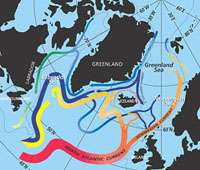
Circulation patterns in the North Atlantic Ocean. Cold, dense water is shown in blue, flowing south from upper latitudes, while warm, less dense water flows north. Credit: Jack Cook for Ocean and Climate Change Institute, Woods Hole Oceanographic Institution.

Scientists from NASA and Columbia University, New York, have used computer modeling to successfully reproduce an abrupt climate change that took place 8,200 years ago. At that time, the beginning of the current warm period, climate changes were caused by a massive flood of freshwater into the North Atlantic Ocean.

This work is the first to consistently recreate the event by computer modeling, and the first time that the model results have been confirmed by comparison to the climate record, which includes such things as ice core and tree ring data.

"We only have one example of how the climate reacts to changes, the past," said Gavin A. Schmidt, a NASA Goddard Institute for Space Studies (GISS), New York, researcher and co-author on the study. "If we're going to accurately simulate the Earth's future, we need to be able to replicate past events. This was a real test of the model's skill."

The study was led by Allegra LeGrande, a graduate student in the department of Earth and environmental sciences at Columbia University. The results appeared in the journal Proceedings of the National Academy of Sciences (PNAS) in Jan. 2006.
Scientists confirm historic massive flood in climate change

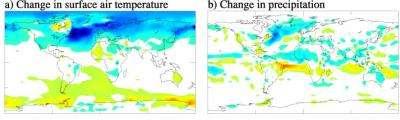
This is a GISS Model simulation of the 8,200 year climate response to freshwater entering into the Hudson Bay. Panels (a) and (b) show the model's simulated changes in surface air temperature and precipitation, respectively. Credit: NASA GISS

The group used an atmosphere-ocean coupled climate computer model known as "GISS Model E-R" to simulate the climate impact of a massive freshwater flood into the North Atlantic that happened about 8,200 years ago after the end of the last Ice Age. As retreating glaciers opened a route for two ancient meltwater lakes, known as Agassiz and Ojibway, to suddenly and catastrophically drain from the middle of the North American continent.

At approximately the same time, climate records show that the Earth experienced its last abrupt climate shift. Scientists believe that the massive freshwater pulse interfered with the ocean's overturning circulation, which distributes heat around the globe. According to the record of what are known as climate proxies, average air temperatures apparently dropped fell as much as several degrees in some areas of the Northern Hemisphere.

Climate researchers use these proxies, chemical signals locked in minerals and ice bubbles as well as pollen and other biological indicators, as indirect measures of temperature and precipitation patterns in the distant past. Because GISS Model E-R incorporates the response of these proxies in its output, the authors of the PNAS study were able to compare their results directly to the historical record.

The researchers prodded their model with a freshwater pulse equal to between 25 and 50 times the flow of the Amazon River in 12 model runs that took more than a year to complete. Although the simulations largely agreed with proxy records from North Atlantic sediment cores and Greenland ice cores, the team's results showed that the flood had much milder effects around the globe than many people surmise.

According to the model, temperatures in the North Atlantic and Greenland showed the largest decrease, with slightly less cooling over parts of North America and Europe. The rest of the northern hemisphere, however, showed very little effect, and temperatures in the southern hemisphere remained largely unchanged. Moreover, ocean circulation, which initially dropped by half after simulated flood, appeared to rebound within 50 to 150 years.

"The flood we looked at was even larger than anything that could happen today," said LeGrande. Still, it's important for us to study because the real thing occurred during a period when conditions were not that much different from the present day."

The GISS climate model is also being used for the latest simulations by the Intergovernmental Panel on Climate Change (IPCC) to simulate the Earth's present and future climate. "Hopefully, successful simulations of the past such as this will increase confidence in the validity of model projections," said Schmidt.

Source: NASA Goddard Space Flight Center

4.5 /5 (46 votes)  

Rank 4.5 /5 (46 votes)
Tags

Relevant PhysicsForums posts

More news stories

Europe stakes billion-dollar bet on new rocket

A pencil-slim rocket is scheduled to lift into space from South America on Monday, carrying a billion-dollar bet that Europe can grab a juicy slice of the market to place satellites in low orbit.

Space & Earth / Space Exploration

created 6 hours ago | popularity 3.5 / 5 (2) | comments 0

NASA sees wide-eyed cyclone Jasmine

Cyclone Jasmine's eye has opened wider on NASA satellite imagery, as it moves through the Southern Pacific Ocean.

Space & Earth / Earth Sciences

created 22 hours ago | popularity 3.5 / 5 (2) | comments 2

NASA sees Giovanna reach cyclone strength, threaten Madagascar

Tropical Storm 12S built up steam and became a cyclone on February 10, 2012 as NASA's Terra satellite passed overhead. Residents of east-central Madagascar should prepare for this cyclone to make landfall ...

Space & Earth / Earth Sciences

created 22 hours ago | popularity not rated yet | comments 0

Political leaders play key role in how worried Americans are by climate change: study

More than extreme weather events and the work of scientists, it is national political leaders who influence how much Americans worry about the threat of climate change, new research finds.

Space & Earth / Environment

created Feb 06, 2012 | popularity 5 / 5 (6) | comments 68

Humans may have helped the decline of African rainforests 3000 years ago

(PhysOrg.com) -- Large areas of rainforests in Central Africa mysteriously disappeared over three thousand years ago, to be replaced by savannas. The prevailing theory has been that the cause was a change ...

Space & Earth / Environment

created Feb 10, 2012 | popularity 4.3 / 5 (13) | comments 16 | with audio podcast report


Walney offshore wind farm is world's biggest (for now)

(PhysOrg.com) -- The Walney wind farm on the Irish Sea--characterized by high tides, waves and windy weather--officially opened this week. The farm is treated in the press as a very big deal as the Walney ...

GPS court ruling leaves US phone tracking unclear

A US Supreme Court decision requiring a warrant to place a GPS device on the car of a criminal suspect leaves unresolved the bigger issue of police tracking using mobile phones, legal experts say.

Anonymous briefly knocks CIA website offline (Update 2)

The website of the Central Intelligence Agency was briefly inaccessible on Friday after the hacker group Anonymous claimed to have knocked it offline.

Study finds that anti-diabetic medication can prevent the long-term effects of maternal obesity

In a study to be presented today at the Society for Maternal-Fetal Medicine's annual meeting, The Pregnancy Meeting, in Dallas, Texas, researchers will report findings that show that short therapy with the anti-diabetic medication ...

Europeans protest controversial Internet pact

Tens of thousands of people marched in protests in more than a dozen European cities Saturday against a controversial anti-online piracy pact that critics say could curtail Internet freedom.

Netflix settlement trims 14 pct off 4Q earnings

(AP) -- Netflix pressed the rewind button on its fourth-quarter earnings after settling allegations that the video subscription service violated a consumer-privacy law.