Andromeda's Stellar Halo Shows Galaxy's Origin to Be Similar to That of Milky Way
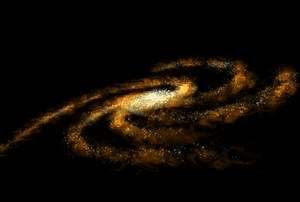
For the last decade, astronomers have thought that the Andromeda galaxy, our nearest galactic neighbor, was rather different from the Milky Way. But a group of researchers have determined that the two galaxies are probably quite similar in the way they evolved, at least over their first several billion years.
In an upcoming issue of the Astrophysical Journal, Scott Chapman of the California Institute of Technology, Rodrigo Ibata of the Observatoire de Strasbourg, and their colleagues report that their detailed studies of the motions and metals of nearly 10,000 stars in Andromeda show that the galaxy's stellar halo is "metal-poor." In astronomical parlance, this means that the stars lying in the outer bounds of the galaxy are pretty much lacking in all the elements heavier than hydrogen.
This is surprising, says Chapman, because one of the key differences thought to exist between Andromeda and the Milky Way was that the former's stellar halo was metal-rich and the latter's was metal-poor. If both galaxies are metal-poor, then they must have had very similar evolutions.
"Probably, both galaxies got started within a half billion years of the Big Bang, and over the next three to four billion years, both were building up in the same way by protogalactic fragments containing smaller groups of stars falling into the two dark-matter haloes," Chapman explains.
While no one yet knows what dark matter is made of, its existence is well established because of the mass that must exist in galaxies for their stars to orbit the galactic centers the way they do. Current theories of galactic evolution, in fact, assume that dark-matter wells acted as a sort of "seed" for today's galaxies, with the dark matter pulling in smaller groups of stars as they passed nearby. What's more, galaxies like Andromeda and the Milky Way have each probably gobbled up about 200 smaller galaxies and protogalactic fragments over the last 12 billion years.
Chapman and his colleagues arrived at the conclusion about the metal-poor Andromeda halo by obtaining careful measurements of the speed at which individual stars are coming directly toward or moving directly away from Earth. This measure is called the radial velocity, and can be determined very accurately with the spectrographs of major instruments such as the 10-meter Keck-II telescope, which was used in the study.
Of the approximately 10,000 Andromeda stars for which the researchers have obtained radial velocities, about 1,000 turned out to be stars in the giant stellar halo that extends outward by more than 500,000 light-years. These stars, because of their lack of metals, are thought to have formed quite early, at a time when the massive dark-matter halo had captured its first protogalactic fragments.
The stars that dominate closer to the center of the galaxy, by contrast, are those that formed and merged later, and contain heavier elements due to stellar evolution processes.
In addition to being metal-poor, the stars of the halo follow random orbits and are not in rotation. By contrast, the stars of Andromeda's visible disk are rotating at speeds upwards of 200 kilometers per second.
According to Ibata, the study could lead to new insights on the nature of dark matter. "This is the first time we've been able to obtain a panoramic view of the motions of stars in the halo of a galaxy," says Ibata. "These stars allow us to weigh the dark matter, and determine how it decreases with distance."
In addition to Chapman and Ibata, the other authors are Geraint Lewis of the University of Sydney; Annette Ferguson of the University of Edinburgh; Mike Irwin of the Institute of Astronomy in Cambridge, England; Alan McConnachie of the University of Victoria; and Nial Tanvir of the University of Hertfordshire.
Source: Caltech


