Burrowing mammals dig for a living, but how do they do that?
October 28, 2007
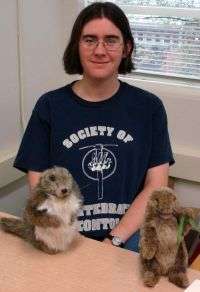
University of Oregon researcher Samantha Hopkins, shown with stuffed animals in her office, studies the evolution of mammals who burrow. Credit: Photo by Jim Barlow
Next time you see a mole digging in tree-root-filled soil in search of supper, take a moment to ponder the mammal's humerus bones. When seen in the lab, they are nothing like the long upper arm bones of any other mammal, says Samantha Hopkins, a paleontologist at the University of Oregon.
Hopkins, a professor of geology in the UO's Robert D. Clark Honors College, studies the evolutionary history of burrowers, in search of why and how they adapted a physique for digging in response to environmental influences or other forced changes in habitats.
In a talk at the annual meeting of the Geological Society of America, Hopkins presented preliminary findings of one line of her research. Moles and mole rats, she said, are examples of mammals that have adapted to moving soil in rocky, root-packed soils, in opposition to most other burrowing mammals that prefer softer, dryer sandy soils.
"It requires a lot of morphological adaptation, a lot of tradeoffs, to be good at digging," she said. "That's intuitive to us as humans who have handled a shovel in the backyard. We know that it's really hard work to shift soil. Burrowing mammals acquire a complex of features that lets them handle whole days moving soil. They make for a great case for understanding convergent evolution because in spite of how difficult it is to do this -- in spite of all the costs of doing this -- it seems to be worthwhile enough that many mammals have done it through time."
Convergent evolution is the development of similar characteristics, necessary for survival, among unrelated organisms in the same environmental conditions. Hopkins studies living burrowers as well as the fossil records of such mammals, living and extinct worldwide, to understand why some choose to live -- and dig for their food and to avoid predators -- in harsher regions. Conventional thinking, she said, is that mammals evolved into burrowers after being driven into grassland habitats, where going into the soil is their only option to eat or escape in the absence of trees.
"There is, however, some evidence that the morphology and behavior required to dig in more compact or rocky soils is recognizably different from that used in softer soils," she said. "This study (still ongoing) aims to determine whether there is an influence of digging substrate on the evolution of digging."
Fossils found in the field or in museum collections allow Hopkins to examine and compare the structure of burrowing mammals' shoulders, skulls, legs, feet and claws to get clues of what features developed and possibly at what points in time these skeletal changes occurred.
In her talk, Hopkins briefly described known methods of burrowing, including scratch, head-lift, incisor and humeral rotation. Humans digging something out of sand with their hands is an example of scratch digging. The other methods are difficult or impossible for humans to even mimic, she said.
As a doctoral student at the University of California, Berkeley, Hopkins studied the fossil record of the extinct burrowing mammal Ceratogaulus, the only horned member of the digging group Mylagaulidae. The gopher-like rodents used the head-lift technique, in which they use the tips of their snouts, powered by enlarged neck muscles, to drive into soil. As part of her dissertation, she showed in the Proceedings of the Royal Society B in 2005 that the horns were used for defense against predators -- not to help with the digging as had been previously theorized.
Mylagaulids were once common in much of North America some 20 million years ago. Existing head-lift diggers include marsupial moles, blind mole rats and mole voles. More common land-dwelling burrowers, which use a variety of techniques, are badgers, ground squirrels, burrowing owls, aardvarks, nutria, kangaroo rats, shrews, prairie dogs and armadillos.
Source: University of Oregon
-
Wildlife Conservation Society supports world's first study of egg-laying mammal
Jun 09, 2009 |
4.8 / 5 (4) |
0
-
Burrowing, digging dinosaurs found in southwest Montana
Mar 21, 2007 |
3.8 / 5 (15) |
0
-
Oldest fossil rodents in South America confirms animals from Africa
Oct 12, 2011 |
5 / 5 (4) |
0
-
Mole rat dental structure similar to a shark
Oct 11, 2011 |
4 / 5 (4) |
0
-
Scientists dig for Ice Age fossils in Los Angeles
Mar 09, 2011 |
3.7 / 5 (3) |
0
-
Engineers build first sub-10-nm carbon nanotube transistor
Feb 01, 2012 |
4.9 / 5 (33) |
30
-
Something old, something new: Evolution and the structural divergence of duplicate genes
Jan 31, 2012 |
4.6 / 5 (7) |
1
-
The hidden nanoworld of ice crystals: Revealing the dynamic behavior of quasi-liquid layers
Jan 30, 2012 |
5 / 5 (4) |
1
-
Stock market network reveals investor clustering
Jan 27, 2012 |
3.9 / 5 (23) |
8
-
Of microchemistry and molecules: Electronic microfluidic device synthesizes biocompatible probes
Jan 26, 2012 |
5 / 5 (2) |
0
More news stories
Integrated pest management recommendations for the southern pine beetle
The southern pine beetle, Dendroctonus frontalis Zimmermann, is a chronic insect pest within pine forests in the southeastern United States. Under favorable environmental and host conditions, it is an agg ...
10 minutes ago |
not rated yet |
0
A mitosis mystery solved: How chromosomes align perfectly in a dividing cell
Although the process of mitotic cell division has been studied intensely for more than 50 years, Whitehead Institute researchers have only now solved the mystery of how cells correctly align their chromosomes during symmetric ...
14 hours ago |
4.5 / 5 (22) |
0
|
Researchers find extensive RNA editing in human transcriptome
In a new study published online in Nature Biotechnology, researchers from BGI, the world's largest genomics organization, reported the evidence of extensive RNA editing in a human cell line by analysis of RNA-seq data, demons ...
14 hours ago |
5 / 5 (4) |
0
|
The proteins ensuring genome protection
Researchers from the University of Geneva (UNIGE), Switzerland, have discovered the crucial role of two proteins in developing a cell 'anti-enzyme shield'. This protection system, which operates at the level of molecular ...
14 hours ago |
5 / 5 (3) |
0
|
Entire genome of extinct human decoded from fossil
(PhysOrg.com) -- In 2010, Svante Pääbo and his colleagues presented a draft version of the genome from a small fragment of a human finger bone discovered in Denisova Cave in southern Siberia. The ...
Feb 07, 2012 |
4.7 / 5 (60) |
51
|
Japan's Fukushima reactor may be reheating: operator
Temperature readings at one of the crippled Fukushima nuclear reactors have risen above Japan's stringent new safety standard but there was no immediate danger, its operator said Sunday.
Botox developer rues missing out on billions
Botox developer Alan Scott says he rues the day he handed over rights to the best-selling wrinkle-smoothing drug to a US company for just $4.5 million, saying he might have become a billionaire.
Australian women reject 'I love u' texts
Australian women may have embraced the digital era, but they prefer a face-to-face declaration of affection to an "I love u" text and find men addicted to their mobile phones a major turnoff.
Many lung cancer patients get radiation therapy that may not prolong their lives
A new study has found that many older lung cancer patients get treatments that may not help them live longer. Published early online in CANCER, a peer-reviewed journal of the American Cancer Society, the findings suggest that p ...
Young adults allowed to stay on parents' health insurance have improved access to care
Researchers from Mount Sinai School of Medicine have found that laws permitting children to stay on their parents' health insurance through age 26 result in improved access to health care compared to states without those ...
Cancer rate 4 times higher in children with juvenile arthritis
New research reports that incident malignancy among children with juvenile idiopathic arthritis (JIA) is four times higher than in those without the disease. Findings now available in Arthritis & Rheumatism, a journal publis ...
Oct 30, 2007
Rank: 1.5 / 5 (2)
Is cooperation a non survival trait?
Is war a survival trait?
How many more thousands of years are we going to think that the best way to live is by killing our neighbors?
Nov 07, 2007
Rank: not rated yet
But we do get along with each other, to a marvellous extent. You live in a town or a city, don't you? And you (presumably) have friends, right? Ever worked on a team project? Do you wait in line at the supermarket?
we don't get along *all* the time - but if you want a thousand examples of humans getting along, hell, just look around you. Humans get along with their neighbours more often than not, by far.