400 Year Old Clam Found -- Oldest Animal Ever
October 29, 2007
Image credit: Bangor University
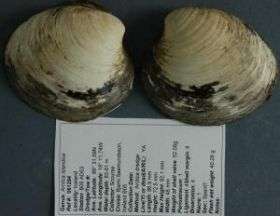
A clam dredged from Icelandic waters had lived for 400 years - is this the longest-lived animal known to science?
Can you imagine living for four centuries? A team of scientists from Bangor University's School of Ocean Sciences believe they have found an animal which did just that, a quahog clam, Arctica islandica, which was living and growing on the seabed in the cold waters off the north coast of Iceland for around 400 years.
When this animal was a juvenile, King James I replaced Queen Elizabeth I as English monarch, Shakespeare was writing his greatest plays Hamlet, Othello, King Lear and Macbeth and Giordano Bruno was burnt at the stake for espousing the view that the Sun rather than the Earth was the centre of the universe.
According to the Guinness Book of Records, the existing record for the longest-lived animal belongs to a 220 year old Arctica clam collected in 1982 from American waters. Unofficially, the record belongs to a 374 year old Icelandic clam which was found in a museum. Both these records appear to have been eclipsed by the latest specimen, whose age, between 405 and 410 years, has been assessed by counting the annual growth lines in the shell.
The Bangor scientists are sclerochronologists who study the growth and age of clams using annual growth lines in the shell in much the same way as dendrochronologists study the growth of trees using tree-rings. Clam shell growth is related to environmental conditions such as seawater temperature, salinity and food availability. The team analyse the shell growth histories with a view to understanding changes in the ocean linked to climate change.
The clam was dredged up by Team members Paul Butler and James Scourse during a data collection cruise in Icelandic coastal waters in 2006 which formed part of the EU MILLENNIUM project investigating climate changes over the last 1000 years. The exciting discovery was made by postdoctoral scientist Al Wanamaker, the newest member of the ‘Arctica’ team. “Al and Paul rushed up to my office to announce that they had found a record-breaker,” said team member Chris Richardson. A detailed assessment later confirmed that, at 400 years, the clam had beaten the previous record by a massive 30 years!!
It is very likely that longer lived individuals of the species remain to be found. Although Icelandic waters seem to provide the ideal conditions for extreme longevity, clams with lifetimes well in excess of 200 years have been found both in the Irish Sea and the North Sea.
So why do these clams live so long? The Bangor scientists are intrigued to find out and believe that the clams may have evolved exceptionally effective defences which hold back the destructive ageing processes that normally occur. "If, in Arctica islandica, evolution has created a model of successful resistance to the damage of ageing, it is possible that an investigation of the tissues of these real life Methuselahs might help us to understand the processes of ageing," explains Chris.
Source: Bangor University
-
50-million-year-old clam shells provide indications of future of El Nino phenomenon
Sep 19, 2011 |
5 / 5 (2) |
1
-
Shells - a unique climate archive on the ocean floor
Jul 10, 2008 |
3.8 / 5 (6) |
0
-
New study demonstrates economic value of invasive species screening programs
Dec 19, 2006 |
3 / 5 (2) |
0
-
Researchers complete mollusk evolutionary tree
Oct 26, 2011 |
4.7 / 5 (3) |
0
-
HP offers tour of your digital future
Sep 29, 2011 |
3.2 / 5 (6) |
0
-
Engineers build first sub-10-nm carbon nanotube transistor
Feb 01, 2012 |
4.9 / 5 (29) |
30
-
Something old, something new: Evolution and the structural divergence of duplicate genes
Jan 31, 2012 |
4.6 / 5 (7) |
1
-
The hidden nanoworld of ice crystals: Revealing the dynamic behavior of quasi-liquid layers
Jan 30, 2012 |
5 / 5 (3) |
1
-
Stock market network reveals investor clustering
Jan 27, 2012 |
4 / 5 (22) |
8
-
Of microchemistry and molecules: Electronic microfluidic device synthesizes biocompatible probes
Jan 26, 2012 |
5 / 5 (1) |
0
More news stories
Study shows how DNA finds its match
It's been more than 50 years since James Watson and Francis Crick showed that DNA is a double helix of two strands that complement each other. But how does a short piece of DNA find its match, out of the millions ...
3 hours ago |
5 / 5 (5) |
0
|
Obstacles no barrier to higher speeds for worms, researchers find
Obstacles in an organism's path can help it to move faster, not slower, researchers from New York University's Applied Math Lab at the Courant Institute of Mathematical Sciences have found through a series ...
5 hours ago |
3 / 5 (1) |
3
|
Transformational fruit fly genome catalog completed
Scientists searching for the genomics version of the holy grail more insight into predicting how an animal's genes affect physical or behavioral traits now have a reference manual that should ...
3 hours ago |
5 / 5 (1) |
0
|
Tiny primate 'talks' in ultrasound
One of the world's smallest primates, the Philippine tarsier, communicates in a range of ultrasound inaudible to predator and prey alike, according to a study published on Wednesday.
12 hours ago |
4.8 / 5 (5) |
0
Scared of a younger rival? Not for some male songbirds
When mature male white-crowned sparrows duel to win a mate or a nesting territory, a young bird just doesn't get much respect.
12 hours ago |
4 / 5 (2) |
0
|
Amasia: As next supercontinent forms, Arctic Ocean, Caribbean will vanish first
(PhysOrg.com) -- Geologists at Yale University have proposed a new theory to describe the formation of supercontinents, the epic process by which Earths major continental blocks combine into a single ...
New images capture 'stealth merger' of dwarf galaxies
New images of a nearby dwarf galaxy have revealed a dense stream of stars in its outer regions, the remains of an even smaller companion galaxy in the process of merging with its host. The host galaxy, known ...
Chandra finds Milky Way's black hole grazing on asteroids
(PhysOrg.com) -- The giant black hole at the center of the Milky Way may be vaporizing and devouring asteroids, which could explain the frequent flares observed, according to astronomers using data from NASA's ...
Windows 8 preview set for February 29
Microsoft on Wednesday revealed plans to unveil a test version of its latest Windows computer operating software later this month.
In scientific coup, Russians reach Antarctic lake
After more than two decades of drilling in Antarctica, Russian scientists have reached a gigantic freshwater lake hidden under miles of ice for some 20 million years - a pristine body of water that may hold ...
European Internet campaigners battle ACTA
A controversial international accord billed as a way to beat online piracy has sparked a fightback led by Internet users in ex-communist countries who say the region's past underlines the need to defend freedom.