Dead clams tell many tales
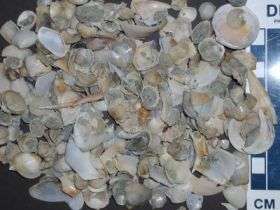
Inventories of living and dead organisms could serve as a relatively fast, simple and inexpensive preliminary means of assessing human impact on ecosystems. The University of Chicago's Susan Kidwell explains how measuring the degree of live-dead mismatch could be used as an ecological tool in the Oct. 26 early online edition of the Proceedings of the National Academy of Sciences.
"We affect ecosystems in many different ways, but the effects of our actions are hard to pin down because we rarely have scientific data from before the onset of those impacts," said Kidwell, the William Rainey Harper Professor in Geophysical Sciences at Chicago.
Detailed ecological data, when they exist at all, often go back no more than 50 years. But scientists would prefer a deeper historical perspective that covers centuries or even a millennium. Live-dead studies can provide some of the needed perspective, according to Kidwell. In these studies, scientists collect data on the living organisms and the skeletal remains found in a specific ecosystem, then evaluate how closely they match.
"Death assemblages are what we call time-averaged. They're like time exposures," Kidwell said, "because skeletal remains can hang around for a long time. In fact, through radiocarbon and other dating methods we know that shells can persist within the upper few inches of the sea floor for decades and even millennia in some circumstances."
Scientists have conducted many such studies over the last several decades. Their initial motivation had nothing to do with documenting the ecological impact of humans. The goal instead was to determine to what extent natural processes altered the record that living organisms had left behind for potential fossilization.
Kidwell's research focuses on coastal and open-marine settings, where disruptions range from dredging and bottom-fishing to the chemical byproducts of urbanization and agriculture that flow into the oceans. She compiled nearly 100 live-dead studies on molluscs-clams and snails-to see how well sediments containing empty shells recorded important ecological information.
The studies ranged from the Gulf of Mexico and the Mediterranean Sea, to the Virgin Islands and the Patagonian coast of South America. Kidwell selected molluscs because their durable shells increase their odds for preservation.
For evidence of human impact in the study areas, Kidwell turned to historical documents and government reports. These non-ecological sources provided independent information on local histories of human impacts. She then subjected the data to a meta-analysis, a statistical method for gleaning large patterns from many individual studies. Her analysis revealed an inverse relationship between the extent of human impact and how well collections of dead shells reflected the current inhabitants of an ecosystem.
"This suggests a new tool for recognizing human impacts in areas where there is no long-term sampling of the living community to guide us," Kidwell said.
A paleontologist who was not involved with Kidwell's study welcomed her findings.
"Where marine ecosystems have remained relatively pristine, living fauna and dead shells agree well,
but where ecosystems have been disturbed by us, dead shells and live fauna often differ notably in composition and abundance of shellfish species," said Michal Kowalewski, Professor of Geobiology at Virginia Polytechnic Institute and State University. "Sue's study is thus a very exciting development for one of the youngest subdisciplines of paleontology, which some of us call 'conservation paleobiology.'"
Kidwell published one of the first meta-analytical studies in paleo-ecology in 2001. That study established the reliability of the shellfish fossil record for analyzing past abundances of species.
"Fortunately, at that point, my database consisted almost exclusively of studies from what I would now call pristine areas, areas of minimal human impact. I say 'fortunately' because it gave a clean pattern of how well death assemblages capture ecological information under natural conditions," Kidwell said. "That finding of good live-dead agreement was tantalizing because it was so counter-intuitive. There are all kinds of reasons not to find good live-dead agreement."
But Kidwell's latest study provided more good news for paleontologists, Kowalewski said. "Sue's analysis provides compelling evidence that in those few spots where fossils did get preserved in the rock record, meaningful quantifiable data can be retrieved," he said. Noted Kidwell: "It's a bonus that poor live-dead agreement also turns out to be informative, telling us where the living community has been pushed off of its former natural state."
Kidwell and the graduate students she advises continue to develop the field of conservation paleobiology. Rebecca Terry is working in the Great Basin of Nevada and Utah, evaluating the reliability of small mammal remains and reconstructing their response to climate change and land use.
Josh Miller, meanwhile, is conducting a live-dead study of elk, bison and other large mammals in Yellowstone National Park to inform management efforts. Kidwell herself is pursuing a large-scale live-dead analysis of molluscs from the southern California coast. With Adam Tomasovych, Research Associate in Geophysical Sciences at Chicago, she is evaluating ecological response to climate change and urbanization.
They are all putting a new twist on an old technique. The first live-dead analysis was conducted in the late 1950s by Chicago paleontologist Ralph Gordon Johnson at Tomales Bay, Calif. Kidwell learned about Johnson's work when she was a graduate student. She now occupies Johnson's former office on the second floor of the Hinds Laboratory building.
"We are going in new directions now, but the roots of live-dead analysis are right here at Chicago," Kidwell said.
Source: University of Chicago


