Researchers find origin of 'breathable' atmosphere half a billion years ago
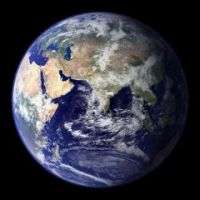
Ohio State University geologists and their colleagues have uncovered evidence of when Earth may have first supported an oxygen-rich atmosphere similar to the one we breathe today.
The study suggests that upheavals in the earth's crust initiated a kind of reverse-greenhouse effect 500 million years ago that cooled the world's oceans, spawned giant plankton blooms, and sent a burst of oxygen into the atmosphere.
That oxygen may have helped trigger one of the largest growths of biodiversity in Earth's history.
Matthew Saltzman, associate professor of earth sciences at Ohio State, reported the findings Sunday at the meeting of the Geological Society of America in Denver.
For a decade, he and his team have been assembling evidence of climate change that occurred 500 million years ago, during the late Cambrian period. They measured the amounts of different chemicals in rock cores taken from around the world, to piece together a complex chain of events from the period.
Their latest measurements, taken in cores from the central United States and the Australian outback, revealed new evidence of a geologic event called the Steptoean Positive Carbon Isotope Excursion (SPICE).
Amounts of carbon and sulfur in the rocks suggest that the event dramatically cooled Earth's climate over two million years -- a very short time by geologic standards. Before the event, the Earth was a hothouse, with up to 20 times more carbon dioxide in the atmosphere compared to the present day. Afterward, the planet had cooled and the carbon dioxide had been replaced with oxygen. The climate and atmospheric composition would have been similar to today.
“If we could go back in time and walk around in the late Cambrian, this seems to be the first time we would have felt at home,” Saltzman said. “Of course, there was no life on land at the time, so it wouldn't have been all that comfortable.”
The land was devoid of plants and animals, but there was life in the ocean, mainly in the form of plankton, sea sponges, and trilobites. Most of the early ancestors of the plants and animals we know today existed during the Cambrian, but life wasn't very diverse.
Then, during the Ordovician period, which began around 490 million years ago, many new species sprang into being. The first coral reefs formed during that time, and the first true fish swam among them. New plants evolved and began colonizing land.
“If you picture the evolutionary ‘tree of life,' most of the main branches existed during the Cambrian, but most of the smaller branches didn't get filled in until the Ordovician,” Saltzman said. “That's when animal life really began to develop at the family and genus level.” Researchers call this diversification the “Ordovician radiation.”
The composition of the atmosphere has changed many times since, but the pace of change during the Cambrian is remarkable. That's why Saltzman and his colleagues refer to this sudden influx of oxygen during the SPICE event as a “pulse” or “burst.”
“After this pulse of oxygen, the world remained in an essentially stable, warm climate, until late in the Ordovician,” Saltzman said.
He stopped short of saying that the oxygen-rich atmosphere caused the Ordovician radiation.
“We know that oxygen was released during the SPICE event, and we know that it persisted in the atmosphere for millions of years -- during the time of the Ordovician radiation -- so the timelines appear to match up. But to say that the SPICE event triggered the diversification is tricky, because it's hard to tell exactly when the diversification started,” he said.
“We would need to work with paleobiologists who understand how increased oxygen levels could have led to a diversification. Linking the two events precisely in time is always going to be difficult, but if we could link them conceptually, then it would become a more convincing story.”
Researchers have been trying to understand the sudden climate change during the Cambrian period ever since Saltzman found the first evidence of the SPICE event in rock in the American west in 1998. Later, rock from a site in Europe bolstered his hypothesis, but these latest finds in central Iowa and Queensland, Australia, prove that the SPICE event occurred worldwide.
During the Cambrian period, most of the continents as we know them today were either underwater or part of the Gondwana supercontinent, Saltzman explained. Tectonic activity was pushing new rock to the surface, where it was immediately eaten away by acid rain. Such chemical weathering pulls carbon dioxide from the air, traps the carbon in sediments, and releases oxygen -- a kind of greenhouse effect in reverse.
“From our previous work, we knew that carbon was captured and oxygen was released during the SPICE event, but we didn't know for sure that the oxygen stayed in the atmosphere,” Saltzman said.
They compared measurements of inorganic carbon -- captured during weathering -- with organic carbon -- produced by plankton during photosynthesis. And because plankton contain different ratios of the isotopes of carbon depending on the amount of oxygen in the air, the geologists were able to double-check their estimates of how much oxygen was released during the period, and how long it stayed in the atmosphere.
They also studied isotopes of sulfur, to determine whether much of the oxygen being produced was re-captured by sediments.
It wasn't.
Saltzman explained the chain of events this way: Tectonic activity led to increased weathering, which pulled carbon dioxide from the air and cooled the climate. Then, as the oceans cooled to more hospitable temperatures, the plankton prospered -- and in turn created more oxygen through photosynthesis.
“It was a double whammy,” he said. “There's really no way around it when we combine the carbon and sulfur isotope data -- oxygen levels dramatically rose during that time.”
What can this event tell us about climate change today" “Oxygen levels have been stable for the last 50 million years, but they have fluctuated over the last 500 million,” Saltzman said. “We showed that the oxygen burst in the late Cambrian happened over only two million years, so that is an indication of the sensitivity of the carbon cycle and how fast things can change.”
Global cooling may have boosted life early in the Ordovician period, but around 450 million years ago, more tectonic activity -- most likely, the rise of the Appalachian Mountains -- brought on a deadly ice age. So while most of the world's plant and animal species were born during the Ordovician period, by the end of it, more than half of them had gone extinct.
Source: Ohio State University


