New peptide communication factor enabling bacteria to 'talk to each other' discovered
October 29, 2007
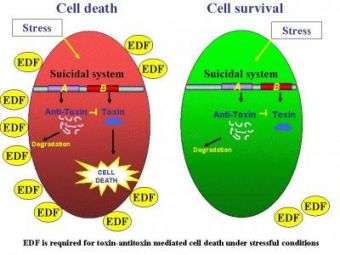
Illustration shows how bacteria under stress (left) dies when exposed to EDF. Credit: The Hebrew University of Jerusalem
Discovery by Hebrew University of Jerusalem researchers of a new communication factor that enables bacteria to “talk to each other” and causes their death could have significant consequences leading to development of a new class of antibiotic medications.
Bacteria are traditionally considered unicellular organisms. However, increasing experimental evidence indicates that bacteria seldom behave as isolated organisms. Instead, they are members of a community in which the isolated organisms communicate among themselves, thereby manifesting some multi-cellular behaviors.
In an article published Friday (Oct. 26) in the journal Science, the Hebrew University scientists describe the new communication factor they have discovered that is produced by the intestinal bacteria Escherichia coli. The new factor is secreted by the bacteria and serves as a communication signal between single bacterial cells.
The research was carried out by a group headed by Prof. Hanna Engelberg-Kulka of the Department of Molecular Biology at the Hebrew University –Hadassah Medical School. It includes Ph.D. student Ilana Kolodkin-Gal , and a previous Ph.D. student, Dr Ronen Hazan. In addition, the research included Dr Ariel Gaathon from the Facilities Unit of the Medical School.
The communication factor formed by Escherichia coli enables the activation of a built-in “suicide module” which is located on the bacterial chromosome and is esponsible for bacterial cell death under stressful conditions. Therefore, the new factor has been designated EDF (Extra-cellular Death Factor).
While suicidal cell death is counterproductive for the individual bacterial cell, it becomes effective for the bacterial community as a whole by the simultaneous action of a group of cells that are signaled by EDF. Under stressful conditions in which the EDF is activated, a major sub-population within the bacterial culture dies, allowing the survival of the population as a whole.
Understanding how the EDF functions may provide a lead for a new and more efficient class of antibiotics that specifically trigger bacterial cell death in the intestine bacteria Escherichia coli and probably in many other bacteria, including those pathogens that also carry the “suicide module.”
The discovered communication factor is a novel biological molecule, noted Prof Engelberg-Kulka. It is a peptide (a very small protein) that is produced by the bacteria. The chemical characterization of the new communication factor was particularly difficult for the researchers because of two main reasons: it is present in the bacterial culture in minute amounts, and the factor decomposes under the conditions that are routinely used during standard chemical characterization methods. Therefore, it was necessary to develop a new specific method. The research has also identified several bacterial genes that are involved in the generation of the communication factor, said Prof. Engelberg-Kulka.
Source: The Hebrew University of Jerusalem
-
Digestive problems early in life may increase risk for depression, study says
May 12, 2011 |
not rated yet |
0
-
Bacteria interrupted: Disabling coordinated behavior and virulence gene expression
Apr 21, 2011 |
not rated yet |
0
-
Structure of key molecule in immune system provides clues for designing drugs
Dec 23, 2010 |
4 / 5 (3) |
1
-
Marine bacteria cope with harsh mileu, learn to adapt
Sep 07, 2010 |
not rated yet |
0
-
Antibiotic found to protect hearing in mice
Jan 28, 2010 |
not rated yet |
0
-
Engineers build first sub-10-nm carbon nanotube transistor
Feb 01, 2012 |
4.9 / 5 (32) |
30
-
Something old, something new: Evolution and the structural divergence of duplicate genes
Jan 31, 2012 |
4.6 / 5 (7) |
1
-
The hidden nanoworld of ice crystals: Revealing the dynamic behavior of quasi-liquid layers
Jan 30, 2012 |
5 / 5 (4) |
1
-
Stock market network reveals investor clustering
Jan 27, 2012 |
3.9 / 5 (23) |
8
-
Of microchemistry and molecules: Electronic microfluidic device synthesizes biocompatible probes
Jan 26, 2012 |
5 / 5 (2) |
0
More news stories
A mitosis mystery solved: How chromosomes align perfectly in a dividing cell
Although the process of mitotic cell division has been studied intensely for more than 50 years, Whitehead Institute researchers have only now solved the mystery of how cells correctly align their chromosomes during symmetric ...
2 hours ago |
5 / 5 (3) |
0
|
The proteins ensuring genome protection
Researchers from the University of Geneva (UNIGE), Switzerland, have discovered the crucial role of two proteins in developing a cell 'anti-enzyme shield'. This protection system, which operates at the level of molecular ...
2 hours ago |
5 / 5 (2) |
0
|
Researchers find extensive RNA editing in human transcriptome
In a new study published online in Nature Biotechnology, researchers from BGI, the world's largest genomics organization, reported the evidence of extensive RNA editing in a human cell line by analysis of RNA-seq data, demons ...
2 hours ago |
5 / 5 (3) |
0
|
Entire genome of extinct human decoded from fossil
(PhysOrg.com) -- In 2010, Svante Pääbo and his colleagues presented a draft version of the genome from a small fragment of a human finger bone discovered in Denisova Cave in southern Siberia. The ...
Feb 07, 2012 |
4.7 / 5 (58) |
48
|
Why are there so few fish in the Earth's oceans?
(PhysOrg.com) -- A Stony Brook University researcher has found that, contrary to popular belief, there are not plenty of fish in the sea.
Feb 08, 2012 |
4.3 / 5 (17) |
27
|
Scientists discover molecular secrets of 2,000-year-old Chinese herbal remedy
For roughly two thousand years, Chinese herbalists have treated Malaria using a root extract, commonly known as Chang Shan, from a type of hydrangea that grows in Tibet and Nepal. More recent studies suggest that halofuginone, ...
New method to examine batteries -- MRI from the inside
There is an ever-increasing need for advanced batteries for portable electronics, such as phones, cameras, and music players, but also to power electric vehicles and to facilitate the distribution and storage of energy derived ...
Google might launch Drive for cloud storage soon
(PhysOrg.com) -- Google's next big move, according to the Wall Street Journal, is a cloud storage service called Drive. Hardly first to the plate, Google is simply catching up to introducing its cloud reposi ...
Lab study raises questions over nano-particle impact
Tests involving chickens have raised questions about the impact on health from engineered nano-particles, the ultra-fine grains commonly used in drugs and processed foods, scientists said on Sunday.
Starve a virus, feed a cure? Findings show how some cells protect themselves against HIV
A protein that protects some of our immune cells from the most common and virulent form of HIV works by starving the virus of the molecular building blocks that it needs to replicate, according to research published online ...
Injured boomers beware: Know when to see doctor
(AP) -- It happened to nurse Jane Byron years after an in-line skating fall, business owner Haralee Weintraub while doing "men's" push-ups, and avid cyclist Gene Wilberg while lifting a heavy box.