The Watchdogs of chromosome-segregation
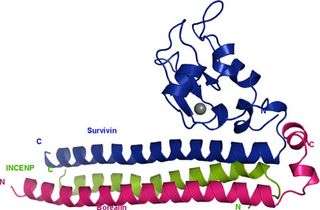
Chromosomes are duplicated before they are segregated in equal parts to daughter-cells during cell division. An important regulator of this chromosome-separation is the "chromosomal passenger complex", a protein complex which plays a central role in cell division and in ongoing research on cancer development.
A collaboration of scientists from the Max Planck Institute (MPI) of Biochemistry in Martinsried and the European Molecular Biology Laboratory (EMBL), Heidelberg, have succeeded in clarifying the central structure of this complex. In the latest edition of Cell, they describe the molecular features of the complex detailing how they use this knowledge to draw conclusions of its function (CELL, 19 October 2007).
There is always a cell from the outset, no matter if the cell is from worms, frogs or human beings. To begin with, a cell creates identical copies of chromosomes during the cell cycle, which are then distributed to existing daughter cells. The multiplication to a multi-cellular organism is made possible through the subsequent cell division or "cytokinesis", a marvel of nature. Through these means the daughter cells receive a complete batch of genetic information. Cancer or strong genetic illnesses arise when chromosomes are unequally divided during cell division.
A central role in the segregation process of the chromosomes plays the chromosomal passenger complex, CPC. It is a dynamic protein complex which is first binding to the centromer, a central anchor at the chromosomes at which the chromosomal spindle, a network of protein filaments, attaches. The chromosomes are drawn by the spindle to each pole of the cell before it is going to be separated into two daughter cells. CPC is guaranteeing that the chromosomes are binding properly at the spindle. Up to now it was known that the watchdogs of the cell division consist of four subunits which all have to be present for accurate chromosome segregation. For the detailed understanding of their regulation scientists at the MPI of Biochemistry in collaboration with researchers at the EMBL solved the crystal structure of the regulatory core of CPC.
The structural biologists and cell biologists report about the central parts of the molecules which are involved in the regulation of CPC. Arockia Jeyaprakash at EMBL characterised the CPC regulatory core in vitro and elucidated its high resolution structure with X-ray analysis. Cell biologist Ulf Klein, then assembled molecular mutants of the complex and tested them in human cell cultures. This assay enabled him to exactly define the amnio acids which were needed for the correct regulation of chromosome segregation process by CPC.
For the understanding and research on cell division the work of Jeyaprakash and his colleagues is a milestone. The results show that the four passenger proteins INCENP, Survivin, Borealin, and Aurora B do not function individually as assumed earlier by the scientific community. The solved structure now shows clearly that the three proteins INCENP, Survivin, and Borealin are very tightly connected to each other by interactions between amino acids of the helical structures in each molecule.
"We were very amazed finding the three partners so tightly twined around each other and understand now much better why the structure and function of the chromosomal protein complex cannot hold up if one partner is missing. The complex is just no longer able to bind at it’s cellular destination", says Ulf Klein which performed the study as a part of his PhD thesis.
The scientists also found that Survivin, which was described in earlier publications as a dimeric strcture, now embedded in the structure of the whole complex only appears as a monomer. Instead, a second passenger protein, Borealin, is binding at the Survivin monomer as a mimicry molecule.
"Only because we succeeded in solving the crystal structure of the core complex, we are now able to dissect and better understand the regulatory function of cpc in the cell at live conditions", says Dr. Jeyapraksh, postdoctoral fellow at the MPI of Biochemistry. This new "high-end structure analysis", was a challenge and will set new trends in structure research, showing that the analysis of individual proteins is not enough for the complete understanding of molecular processes in cellular regulation.
Wrong segregation of chromosomes during cytokinesis leads prevalently to tumor development. Therefore the detailed knowledge of the the structure of it’s central regulator may be important for drug development which might be able to stop cell division in tumors or activate their regulation of apoptosis (cell death). Jeyapraksh and his colleagues cast new light on the discussion about the function of Survivin. It was already known that a dimeric structure of the molecule is essential for its antiapototic activity. Now the scientists clearly show that it is also essential as a monomer to regulate cell division. Survivin might be a new target for cancer drugs.
Arockia Jeyaprakash is working in the newly started Department Structural Cell Bioloy at the Max Planck Institute of Biochemistry in Martinsried. The department is headed by Dr. Elena Conti who was appointed as Scientific Member of the Max Planck Society in 2006. She is the first female director at the institute and moved her laboratory from EMBL in Heidelberg to Martinsried. The present study is a result of the collaboration with the Department Cell Biology, headed by Professor Erich Nigg.
Citation: A. Arockia Jeyaprakash, Ulf R. Klein, Doris Lindner, Judith Ebert, Erich A. Nigg, and Elena Conti, Structure of a Survivin-Borealin-INCENP Core Complex Reveals How Chromosomal Passengers Travel Together, CELL 131 (2) 19. Oktober 2007, Online-Vorabpublikation DOI 10.1016
Source: Max Planck Institute of Biochemistry


