Sound training rewires dyslexic children's brains for reading
October 30, 2007
Sound training rewires dyslexic children's brains for reading

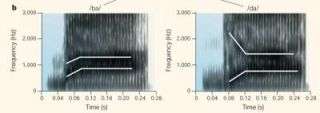
Syllables contain fast-changing sounds. The maps above show how the syllables /ba/ and /da/ sound in normal speech. The graphs show the pitch over time. In this example, the part of the sound that changes quickly is the consonant at the beginning. In /ba/, the pitch of /b/ rises quickly--over tens of milliseconds--from between 500 and 1,000 Hertz to between 900 and 1,200 Hertz. The pitch of /d/ in /da/ changes just as quickly, but in a different pattern. If infants can't capture the details of these patterns, they can't understand the differences between the syllables "ba" and "da" and may confuse them (even before they learn to read). Learning the sounds of other syllables involves making other fast-sound computations, like measuring silences between syllables lasting minute fractions of seconds. In infancy, children with a higher risk of developmental dyslexia may not be able to capture these details because their brains process fast-changing sounds in the wrong way. Credit: Image excerpted from: Tallal P. Improving language and literacy is a matter of time. Nat Rev Neurosci. 2004 Sep;5(9):721-8.

Some children with dyslexia struggle to read because their brains aren't properly wired to process fast-changing sounds, according to a brain-imaging study published this month in the journal Restorative Neurology and Neuroscience (online October 16).

The study found that sound training via computer exercises can literally rewire children's brains, correcting the sound processing problem and improving reading. According to the study's first author, Nadine Gaab, PhD, of the Laboratory of Cognitive Neuroscience at Children's Hospital Boston, the finding may someday help clinicians diagnose dyslexia even before reading begins, and suggests new ways of treating dyslexia, such as musical training.

Children with developmental dyslexia confuse letters and syllables when they read. The idea that they may have an underlying problem processing sound was introduced by Paula Tallal, PhD, of Rutgers University in the 1970s, but it has never been tested using brain imaging. Gaab used functional MRI imaging (fMRI) to examine how the brains of 9- to 12-year old children with developmental dyslexia, and normal readers, responded to sounds, both before and after using educational software called Fast ForWord Language, designed in part by Tallal, a co-author on the study.

Gaab first tested how the children's brains responded to two types of sounds: fast-changing and slow-changing. These sounds were not language, but resembled vocal patterns found in speech. As Gaab watched using brain fMRI, the children listened to the sounds through headphones. The fast-changing sounds changed in pitch or other acoustic qualities quickly—over tens of milliseconds—as in normal speech. By contrast, slow-changing sounds changed over only hundreds of milliseconds.

In typical readers, 11 brain areas became more active when the children listened to fast-changing, compared to slow-changing, sounds. Gaab set this as "normal." In dyslexic children, the fast-changing sounds didn't trigger this ramped-up brain activity. Instead, dyslexic children processed the fast-changing sounds as if they were slow-changing—using the same brain areas, at the same lower intensity. "This is obviously wrong," says Gaab.

Infants must correctly process fast-changing sounds, like those within the syllable "ba," in order to learn language and, later, to know what printed letters sound like. Infants use sound processing to grab from speech all the sounds of their native language, then stamp them into their brains, creating a sound map. If they can't analyze fast-changing sounds, their sound map may become confused.

"Children with developmental dyslexia may be living in a world with in-between sounds," says Gaab. "It could be that whenever I tell a dyslexic child 'ga,' they hear a mix of 'ga,' 'ka,' 'ba,' and 'wa'."

Reading trouble may develop when these children first see printed letters, Gaab and cognitive scientists believe, because at this stage, the children's brains wire their internal sound map to letters they see on the page. Linking normal letters to confused sounds may lead to syllable-confused reading.

But the brains of the children with dyslexia changed after completing exercises in a computer program known as Fast ForWord Language (Scientific Learning, Oakland, CA). The exercises involved no reading—only listening to sounds, starting with simple, changing noises, like chirps that swooped up in pitch. The children then had to respond—clicking to indicate, for instance, whether the chirp’s pitch went up or down. The sounds played slowly at first—an easy task for the dyslexic children—but gradually sped up, becoming more challenging. The exercises then repeated with increasingly complex sounds: syllables, words, and finally, sentences.

The repetitive exercises appeared to rewire the dyslexic children's brains: after eight weeks of daily sessions—about 60 hours total—their brains responded more like typical readers' when processing fast-changing sounds, and their reading improved. It's unclear, though, whether the improvement lasts beyond a few weeks, since follow-up tests were not done.

Brain imaging study in preschoolers

Gaab has begun recruiting for a new study of preschoolers whose family members have dyslexia. By looking for sound-processing problems on brain fMRI, she hopes to catch dyslexia at an early stage, before the children begin learning to read—and then remediate it through sound training, sparing them from years of frustration and low self-esteem later in life.

She will also investigate what other types of sound training might help dyslexic children. Learning to sing or play an instrument, for example, involves gradual, repetitive, and intense listening and responding to fast-changing sounds.

"We've done a few studies showing that musicians are much better at processing rapidly changing sounds than people without musical training," says Gaab. "If musicians are so much better at these abilities, and you need these abilities to read, why not try musical training with dyslexic children and see if that improves their reading?"

Source: Children's Hospital Boston

4.6 /5 (10 votes)  

Rank 4.6 /5 (10 votes)
Tags

Relevant PhysicsForums posts
  • Is Everyday Technology Killing Us?
    createdFeb 08, 2012
  • Exercise and weight loss
    createdFeb 08, 2012
  • Why do we have head aches? Our brains can't feel anything.
    createdFeb 07, 2012
  • "The end of diseases" by David Agus, interview from Daily Show with Jon Stewart
    createdFeb 04, 2012
  • Oncolytic adenovirus
    createdFeb 04, 2012
  • Nutrition label stuffs and diets
    createdFeb 02, 2012
  • More from Physics Forums - Medical Sciences

More news stories

Starve a virus, feed a cure? Findings show how some cells protect themselves against HIV

A protein that protects some of our immune cells from the most common and virulent form of HIV works by starving the virus of the molecular building blocks that it needs to replicate, according to research published online ...

Medicine & Health / Research

created 12 hours ago | popularity 5 / 5 (3) | comments 0 | with audio podcast

Overeating may double risk of memory loss

New research suggests that consuming between 2,100 and 6,000 calories per day may double the risk of memory loss, or mild cognitive impairment (MCI), among people age 70 and older. The study was released today and will be ...

Medicine & Health / Neuroscience

created 8 hours ago | popularity 5 / 5 (2) | comments 0 | with audio podcast

Declining health-care productivity in England: Who says so?

Reports that the National Health Service in England has been declining in productivity in the last decade appear to have been accepted as fact. However, a Viewpoint published Online First by The Lancet disputes this. The Vi ...

Medicine & Health / Health

created 6 hours ago | popularity 1 / 5 (1) | comments 0

Injured boomers beware: Know when to see doctor

(AP) -- It happened to nurse Jane Byron years after an in-line skating fall, business owner Haralee Weintraub while doing "men's" push-ups, and avid cyclist Gene Wilberg while lifting a heavy box.

Medicine & Health / Health

created 13 hours ago | popularity 5 / 5 (1) | comments 0

FDA-approved drug rapidly clears amyloid from the brain, reverses Alzheimer's symptoms in mice

Neuroscientists at Case Western Reserve University School of Medicine have made a dramatic breakthrough in their efforts to find a cure for Alzheimer's disease. The researchers' findings, published in the journal Science, show t ...

Medicine & Health / Neuroscience

created Feb 09, 2012 | popularity 4.9 / 5 (58) | comments 17 | with audio podcast


Scientists discover molecular secrets of 2,000-year-old Chinese herbal remedy

For roughly two thousand years, Chinese herbalists have treated Malaria using a root extract, commonly known as Chang Shan, from a type of hydrangea that grows in Tibet and Nepal. More recent studies suggest that halofuginone, ...

New method to examine batteries -- MRI from the inside

There is an ever-increasing need for advanced batteries for portable electronics, such as phones, cameras, and music players, but also to power electric vehicles and to facilitate the distribution and storage of energy derived ...

A mitosis mystery solved: How chromosomes align perfectly in a dividing cell

Although the process of mitotic cell division has been studied intensely for more than 50 years, Whitehead Institute researchers have only now solved the mystery of how cells correctly align their chromosomes during symmetric ...

Google might launch Drive for cloud storage soon

(PhysOrg.com) -- Google's next big move, according to the Wall Street Journal, is a cloud storage service called Drive. Hardly first to the plate, Google is simply catching up to introducing its cloud reposi ...

Lab study raises questions over nano-particle impact

Tests involving chickens have raised questions about the impact on health from engineered nano-particles, the ultra-fine grains commonly used in drugs and processed foods, scientists said on Sunday.

Researchers find extensive RNA editing in human transcriptome

In a new study published online in Nature Biotechnology, researchers from BGI, the world's largest genomics organization, reported the evidence of extensive RNA editing in a human cell line by analysis of RNA-seq data, demons ...