Team IDs ancient cargo from DNA
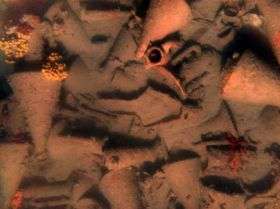
For the first time, researchers have identified DNA from inside ceramic containers in an ancient shipwreck on the seafloor, making it possible to determine what the ship's cargo was even though there was no visible trace of it.
The findings, by a team from MIT, the Woods Hole Oceanographic Institution (WHOI) and Lund University in Sweden, are being reported in an upcoming issue of the Journal of Archeological Science.
By scraping samples from inside two of the containers, called amphoras, the researchers were able to obtain DNA sequences that identified the contents of one as olive oil and oregano. The other probably contained wine, and the researchers are conducting further analyses to confirm this.
Brendan Foley, a lecturer in MIT's Program in Science, Technology and Society (STS) and a researcher at WHOI, and Maria Hansson, a biologist at WHOI and at Lund University in Sweden, found the DNA evidence in the remains of a 2,400-year-old shipwreck that lies 70 meters deep near the Greek island of Chios in the Aegean Sea.
Foley, along with David Mindell, MIT's Frances and David Dibner Professor of the History of Engineering and Manufacturing and director of STS, led an expedition in 2005 that explored the wreck and recovered the amphoras.
Many archeologists specialize in the study of amphoras, which were the cargo containers of the ancient world, used for shipping all kinds of liquid or semi-liquid goods. But the study of these containers can be frustrating, Foley said, because after centuries on the seafloor, the contents have usually been washed away and archeologists are "just left with empty bottles."
The new research points the way toward analyzing hundreds of containers, which could "tell us what was being traded, and something about the total agricultural production of a country," Foley said. Such analysis of ancient crops could even yield insights into the climate of that period.
The discovery of DNA from olive oil and oregano in one amphora came as a surprise, Foley says, because Chios was well-known in the ancient world as a major exporter of highly prized wines, and archeologists had assumed that amphoras from a ship in that area would have been carrying wine.
The other amphora from which Foley and Hansson were able to extract DNA may indeed have contained wine, although that is not yet certain. The short fragments of DNA they found may have come from pistachios or from resins used to coat the insides of amphoras that carried wine. Analysis continues, using present-day samples of plants from the island to pin down the identification.
Their method could be used to identify most plant products that were being shipped, Foley said, but probably not fish products. While these may also have sometimes been carried in amphoras, they would be too hard to identify because of contamination in the marine environment.
Foley and Hansson also studied amphoras from a different shipwreck, a few centuries younger, but found nothing. Foley thinks that's because the second site was much more severely disturbed by weather and currents. "It was badly degraded, smashed up, churned up," he said. It remains to be seen whether the technique also could be used on amphoras that have been stored in museums for many years, or will only work on those that have been freshly brought up from the ocean.
The method could provide new insights into life in ancient Greece and other seafaring civilizations, Foley said. "Imagine if you were asked to analyze the American economy just by looking at the empty shells of 40-foot shipping containers," he said. "You could say something, but not much."
Foley and Hansson have applied for a grant to go back and study a few dozen more amphoras next year, in order to further develop the technique.
Source: MIT


