New Type of Retinol Cell Discovered in Primates
October 30, 2007 New Type of Retinol Cell Discovered in Primates

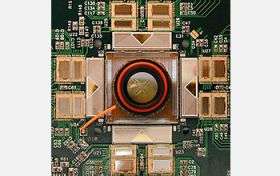
A pinhead size 512-electrode array in the center of this "neuroboard" records the output of retinal neutrons. Credit: Photo by Alan Litke

Scientists are one step closer to understanding how the retinas of humans and primates turn incoming light into coded messages communicated to the brain.

A team of researchers funded by the National Science Foundation recently reported their discovery of a type of cell in the output (ganglion cell) layer of the retina that likely plays a key role in transforming visual images, received by the rods and cones, into coded messages headed to the brain. Ultimately, their research could help guide the design of devices to provide artificial sight to the blind.

The research paper by Alan Litke, adjunct professor of physics at the University of California at Santa Cruz, and his colleagues at the same university and the Salk Institute in La Jolla, Calif., appeared recently in the Journal of Neuroscience.

The retina is an exquisitely complex and sophisticated image detector that converts incoming light from an image in the environment into a set of highly processed sub-images. The retinal cell type discovered by the researchers was first observed more than 40 years ago in other animals. Scientists have been looking for its counterpart in primates ever since.

"To find these cells after so many decades of searching is truly a stunning achievement," said NSF Program Director Krastan Blagoev. "The discovery was made by a multidisciplinary team of physicists and neuroscientists working together on the problem. These results highlight the importance of supporting a cross approach when investigating complex biological processes."

Litke said the work had been a "fantastic journey through high-energy physics, neurobiology, technology and human health." Litke and his team started out developing instruments to look for the fundamental particles of the universe such as the top quark and the Higgs boson. They soon realized they could apply some of those technological concepts to studying neural systems. "Now we are using the new technology for experiments that will help guide the design of future retinal prosthetic devices."

Scientists know that at least 22 anatomically distinct types of retinal ganglion cells exist in the primate retina. Knowing the physiological properties of these ganglion cells is essential to understanding how a primate's visual system functions. Only a handful of these cells have been studied in detail so far. Using their newly developed multielectrode array system for large-scale recording of neural activity, the researchers discovered a physiologically distinct population of ganglion cells which they have named "upsilon cells."

Their qualities suggest they may contribute to the perception of motion. Litke believes the upsilon cells went undetected by traditional physiological techniques for so long because they are a tiny fraction of the million ganglion cells in the primate retina. With their 512-electrode array, Litke and his colleagues plan to search for other unknowns.

Source: NSF


print this article email this article download pdf blog this article bookmark this article     Stumble it Digg this share on Facebook retweet share on Reddit add to delicious
Rate this story - 4.2 /5 (5 votes)


October 30, 2007 all stories

Comments: 0

4.2 /5 (5 votes)
  • Stumble this up

  • Digg this

  • share this

  • hide
  • Related Stories

  • Discovery of retinal cell type ends 4-decade search
    created Oct 09, 2007 | popularity not rated yet | comments 0
  • Now hear this: Mouse study sheds light on hearing loss in older adults
    created Nov 09, 2009 | popularity not rated yet | comments 0
  • Caltech scientists create robot surrogate for blind persons in testing visual prostheses
    created Oct 19, 2009 | popularity not rated yet | comments 0
  • Nerve cells live double lives
    created Oct 06, 2009 | popularity not rated yet | comments 0
  • Researchers identify gene variant linked to glaucoma
    created Sep 21, 2009 | popularity not rated yet | comments 0


Other News

Hammerhead shark

Wide heads give hammerheads exceptional stereo view

Biology / Plants & Animals

created 18 hours ago | popularity 4.5 / 5 (6) | comments 4

Hammerhead sharks are some of the Ocean's most distinctive residents. 'Everyone wants to understand why they have this strange head shape,' says Michelle McComb from Florida Atlantic University. One possible ...


Golden Oldie: Key Role for Ancient Protein in Algae Photosynthesis

Golden Oldie: Key Role for Ancient Protein in Algae Photosynthesis

Biology / Biotechnology

created 10 hours ago | popularity not rated yet | comments 1

The discovery that an ancient light harvesting protein plays a pivotal role in the photosynthesis of green algae should help the effort to develop algae as a biofuels feedstock. Researchers with the Lawrence ...


Tough yet stiff deer antler is materials scientist's dream

Biology / Plants & Animals

created 18 hours ago | popularity 3 / 5 (2) | comments 2

Prized for their impressive antlers, red deer have been caught in the hunters' sights for generations. But a deer's antlers are much more than decorative. They are lethal weapons that stags crash together when duelling. John ...


Indonesia rejects Bali plan for turtle sacrifices (AP)

Indonesia rejects Bali plan for turtle sacrifices

Biology / Ecology

created 16 hours ago | popularity 5 / 5 (1) | comments 0

(AP) -- Indonesia has rejected a push by the resort island of Bali for rare turtles to be legally slain in Hindu ceremonies, siding with conservationists of the protected reptiles against religious advocates, ...


Ecologists sound out new solution for monitoring cryptic species

Biology / Ecology

created 19 hours ago | popularity not rated yet | comments 0

Ecologists have at last worked out a way of using recordings of birdsong to accurately measure the size of bird populations. This is the first time sound recordings from a microphone array have been translated into accurate ...